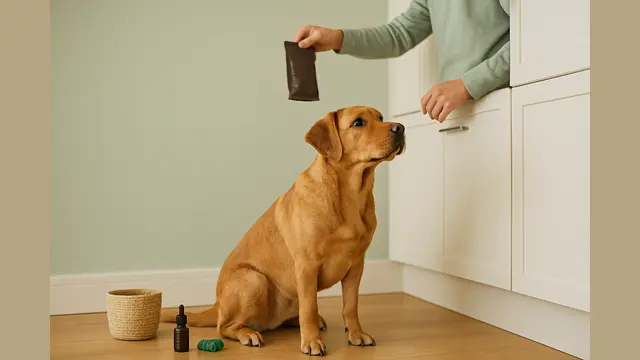
Can dogs eat plain crackers, and which flavored crackers should I avoid?
Learn which crackers you can share with your dog, how to check seasonings and fillings, and what to do if your dog ate a salty snack or an unsafe ingredient.

In this guide (7 sections)
- My dog already ate a cracker. What should I do?
- What counts as a plain cracker for a dog?
- Which savory cracker flavors should I avoid?
- What should I check in sweet crackers and peanut butter fillings?
- How much matters if the crackers were salty or buttery?
- What information will the vet need?
- Talk it through with Vicky
Yes. A healthy dog that ate a small piece of plain, unsalted, unseasoned cracker is unlikely to need treatment; if you share one on purpose, offer a small piece occasionally. Avoid crackers, fillings, and dips containing onion, garlic, chives, xylitol, chocolate, cocoa, or raisins. If your dog may have eaten one of those ingredients, call your veterinarian or animal poison control now, even if your dog looks well.
My dog already ate a cracker. What should I do?
If your dog is struggling to breathe, is unconscious, or is having a seizure, go to an emergency veterinary clinic now. Don't delay to find the wrapper or work out how much is missing. The ASPCA's poisoning first-aid guide distinguishes signs that need emergency care from exposures you should call about before signs appear.
Otherwise, take the food out of reach and use what you know about the snack to choose your next step:
| What your dog ate | What to do |
|---|---|
| A small piece of a known plain, unsalted cracker with nothing on it | For a healthy dog acting normally, no special treatment is usually needed. |
| A bite of a butter, cheese, or salted cracker | Check the exact flavor and any topping. If there's no unsafe ingredient, salt and fat are the main concerns. A bite is different from a sleeve. |
| A cracker with a potentially poisonous seasoning, filling, or topping | Call your veterinarian or animal poison control now. Keep the package, but don't wait for a perfect count before calling. |
| A large amount of salty crackers, or an open box with much of it missing | Call your veterinarian for advice based on the product, the amount your dog could have eaten, and your dog's weight. |
What counts as a plain cracker for a dog?
For sharing, look for unsalted and unseasoned, with no filling or coating. A water cracker, a piece of matzo, or a rice cracker can fit that description. The name alone doesn't tell you. “Original” is a flavor name, and “wheat” or “rice” tells you which grain the maker used, not what else went into the dough.
The American Kennel Club's guide to human foods for dogs notes that healthy dogs generally tolerate a little plain baked bread and recommends checking the ingredients in prepared foods. Apply that distinction at the table: if the cracker itself is suitable, break off a small piece before you add a spread. If it's already covered in dip and you don't know what's in the dip, choose a different treat.
If you're buying something specifically because your dog likes the crunch, NC State Veterinary Hospital's treat guide lists salt-free, unflavored rice cakes. A little piece gives you an option you don't have to scrape seasoning or filling off first.
Which savory cracker flavors should I avoid?
Leave French onion, garlic-herb, and sour cream and chive crackers off your dog's plate. Check ranch, pizza, everything-seasoned, and flavored cheese crackers for the same ingredients. Recipes vary, so use the package in front of you rather than an ingredient list you remember from a different flavor.
On the label, look for onion powder, garlic powder, dried onion or garlic flakes, and chives, as well as fresh onion and garlic. Read the ingredients in parentheses after a seasoning blend. These plants belong to the onion family, and they can damage a dog's red blood cells. The Merck Veterinary Manual's guide to onion and garlic exposure identifies powders and dried flakes as sources of exposure. A cracker doesn't need to have a visible piece of onion on it for the ingredient to matter.
Check what was on the cracker separately. For example, if your dog picked up a plain cracker with French onion dip, the useful thing to tell your clinic is the name and ingredients of the dip, along with how much was on the cracker. Reporting only “one plain cracker” leaves out the part that changes the advice.
What should I check in sweet crackers and peanut butter fillings?
Start with the sweetener. Some peanut butters, baked goods, and sugar-free fillings contain xylitol. The FDA's xylitol guidance for dog owners notes that it may also appear as birch sugar or wood sugar. All three names mean the same thing for your dog: if your dog may have eaten it, call immediately. Even a small exposure can cause a rapid drop in blood sugar.
“Sugar-free” is a reason to read the label, not proof that the product contains xylitol. Likewise, ordinary sugar is not another name for xylitol. If your dog got into a sugar-free sandwich snack and you can't identify the sweetener, tell the clinic that rather than guessing. For a homemade snack, check the jar of peanut butter that went into it, not just the cracker box.
Next, look for chocolate, cocoa, and raisins. Check the dough and the middle of the snack as well as the coating: a sandwich cracker can have a cocoa filling without looking chocolate-covered. Raisins baked into a fruit cracker still count as raisins and can injure a dog's kidneys. The ASPCA's guide to people foods to avoid identifies both raisins and chocolate products as hazards. If either was in the snack, keep the wrapper so you can describe the product precisely when you call.
How much matters if the crackers were salty or buttery?
A dropped corner of an ordinary butter cracker is not the same situation as a bite of a xylitol-filled cracker. If you've checked both the cracker and the topping and found no toxic ingredient, the questions are how salty or fatty the snack was and how much your dog ate. Salty or fatty foods can upset digestion. That makes them poor choices for regular treats without making every dropped crumb a poisoning emergency.
For a torn sleeve or partly empty box, read sodium per serving alongside the number of crackers per serving. A serving on the box is a human serving, not a recommended portion for a dog. Those two label details help your clinic interpret “about half a sleeve.” You don't need to convert them into a dose or decide on a safe cutoff yourself.
What information will the vet need?
Finding an open snack bag can happen even when you're careful. You can give the clinic useful information without knowing exactly what happened. Cornell's first-aid guide for possible poisoning recommends reporting the product, ingredients, amount, time, and your dog's weight.
- Identify the exact snack. Read out the flavor and the ingredient you're concerned about. Have the package handy, or take a clear photo of the ingredients and serving size. Include a separate dip, spread, or topping if there was one.
- Give your best estimate, including what's uncertain. “I saw one corner fall” tells the clinic something different from “I found the bag open.” If two dogs reached the same bag, report both weights and the total amount missing. Don't divide it in half unless you saw each dog eat that much.
- Give a time or a range. If you didn't see your dog eat the crackers, say when you last saw the package intact and when you found it open. Describe how your dog is acting now, including if nothing seems different.
- Ask what happens next. The veterinary team can use those details to decide whether your dog should come in or can be watched at home. Don't make your dog vomit unless a veterinarian tells you to. If the team recommends watching at home, ask which changes should trigger another call and for how long to watch. A dog looking well right after a suspected exposure isn't a reason to skip that first call.
Talk it through with Vicky
If you're choosing an occasional treat, you can tell Vicky what you're seeing right now. Share the exact flavor, the label, and anything you plan to put on the cracker. Vicky will bring in Sam (Virtual PhD (Animal Nutrition)), our animal nutritionist, to help you decide what to offer. If your dog may already have eaten a poisonous ingredient, call your veterinarian or animal poison control first.
Common questions
My dog ate one plain saltine. Do I need to do anything?
Check whether it was an ordinary saltine with nothing on it. If your healthy dog ate one, is acting normally, and the label has no unsafe ingredient, treatment is unlikely to be needed. Saltines often have added salt, so choose an unsalted option for intentional sharing.
Are unsalted rice crackers or water crackers a better choice than Ritz?
A small piece of an unsalted, unseasoned cracker with no unsafe ingredients is a better choice than a salty, buttery one. If you're also comparing fat, check the nutrition labels for comparable serving sizes: “unsalted” tells you nothing about fat content.
Can my dog have a Goldfish or Cheez-It, or does it depend on the flavor?
It depends on the exact variety. If your dog ate one small cheese cracker, check for onion, garlic, or another unsafe seasoning. If the ingredients check out, salt and fat are the concerns, and a single dropped cracker is different from eating a box.
Does garlic or onion powder still count if the cracker is baked?
Yes. Treat garlic or onion powder on a baked cracker's ingredient list as an exposure. Call your veterinarian or animal poison control with the flavor and the amount your dog may have eaten, even if your dog seems well.
What if my dog licked off the peanut butter but left the cracker?
Check the peanut butter itself. A little smooth peanut butter without unsafe ingredients can be an occasional treat, but if the label lists xylitol, birch sugar, or wood sugar, call your veterinarian or animal poison control immediately, even for a small lick.
Sources
- Which Human Foods Can Dogs Eat and Which Are Dangerous? — American Kennel Club
- Healthy Human Food Treats for Pets — NC State Veterinary Hospital
- Garlic and Onion (Allium spp) Toxicosis in Animals — Merck Veterinary Manual
- Top 10 Kitchen Toxins — Pet Poison Helpline
- Xylitol Toxicities — Cornell University College of Veterinary Medicine
- Salt Poisoning Symptoms — Pet Poison Helpline
- First-aid for Poisonous Substances — Cornell University College of Veterinary Medicine
- What to Do if Your Pet Is Poisoned — ASPCA
- ASPCA Poison Control — People Foods to Avoid Feeding Your Pets
- U.S. Food and Drug Administration — Paws Off Xylitol; It’s Dangerous for Dogs
- Pet Poison Helpline — Sodium Toxicity Symptoms in Pets
- Virginia Tech Veterinary Teaching Hospital — Small Animal Emergency and Critical Care