Can dogs get lice, and how can I tell lice from fleas?
Check your dog’s coat for lice, fleas, or dandruff, use damp white paper to identify flea dirt, and learn which pets and household items need attention.
In this guide (6 sections)
Yes, dogs can get lice, but fleas are more common. Lice crawl and grip hairs; a bug that jumps points toward a flea, not a louse. If all you see are specks, look for two clues: lice eggs stay attached to individual hairs, while flea droppings leave a rusty stain on damp white paper.
How to check your dog for lice and fleas
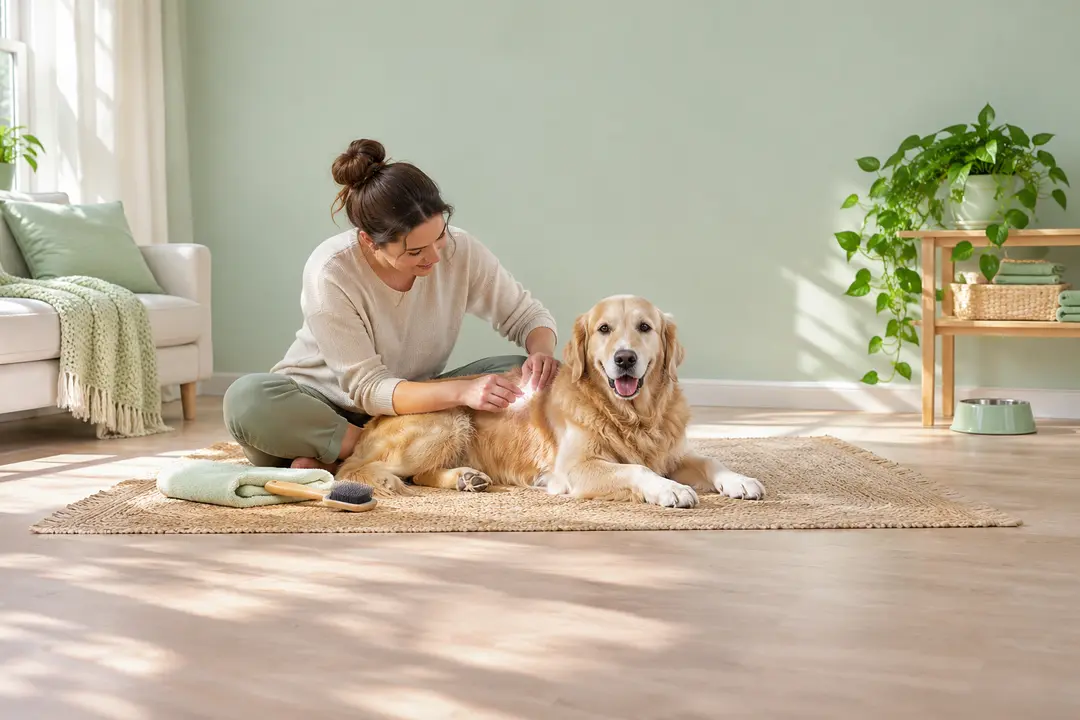
Start with the coat as you found it, before brushing out the specks or giving your dog a bath. All you need is good light, a fine-toothed flea comb, and a damp white paper towel. Check around the head and neck for lice, then check the lower back and base of the tail for evidence of fleas.
- Part the hair around the ears and neck. Use your fingers to make a part wide enough to see the skin. Look along the hairs on either side, then move the part over a little. Adult lice are large enough to see. Watch for an insect crawling through the coat and holding onto a hair rather than trying to identify it by color alone.
- See whether a pale speck is fixed to one hair. Gently brush across it. If it stays in place, take a close-up that shows the speck on the hair. That's more useful to your clinic than a picture of a white dot you’ve picked off. The Merck Veterinary Manual’s guide to dog lice explains how firmly lice eggs, called nits, are attached.
- Run the flea comb through the lower back, including the base of the tail. Look between the teeth after each pass. A fast-moving bug may disappear before you get a good look. If you don't catch an insect but do collect dark crumbs, keep them for the paper test. You don't need a live flea to do it.
- Tap the dark crumbs onto the damp white paper towel. Look at the paper around the crumbs. A rusty, reddish-brown stain suggests flea dirt, another name for flea droppings. The Companion Animal Parasite Council’s flea guide recommends looking for droppings because they can be present even when you don’t see a flea. If the crumbs leave no stain, the test hasn't identified them; it doesn't prove your dog is flea-free.
White specks: lice eggs, flea eggs, or dandruff?
For white specks, the useful question is “Does it stay on the hair?” The damp-paper test is for dark debris; it won’t tell you what a white speck is.
| What you find | What it suggests | What to look for next |
|---|---|---|
| A pale speck firmly attached to a single hair | A possible nit | Part the surrounding coat and look for other attached specks or a crawling louse. |
| Light flakes that come away with ordinary grooming | Dandruff, which is shed skin | Notice whether the flakes clear when you brush. A loose flake is less typical of a nit. |
| Tiny, loose white specks in the coat or bedding | Possibly flea eggs | Flea eggs fall out of fur. Look for a flea or test dark crumbs rather than identifying fleas by loose white specks alone. |
For example, suppose you notice white flakes near your dog's neck but find dark grit when you comb over the tail. The two findings don't have to mean the same thing. If the flakes brush away and the grit leaves a rusty stain, you have a reason to ask about fleas, not to assume that the white flakes are eggs. If some specks stay stuck to hairs, show your vet those separately. PDSA’s guide to dandruff in dogs explains why ordinary grooming often clears small amounts of shed skin.
If you suspect lice, focus on dogs and shared brushes
Think about which dogs have had close contact and which have used the same grooming tools. Lice can pass from dog to dog either way. Finding them can come as a surprise even when you groom your dog regularly. Set the shared brush aside and tell your clinic if you’ve used it on another dog, even if that dog hasn’t been scratching.
Ask your vet which dogs need checking, how to clean the brushes and combs, and which bedding to wash. A blanket used by both dogs belongs on that list as much as the bed your itchy dog uses at night. PDSA’s guidance on dog lice includes close contacts and shared items in the control plan. Dog lice mainly live on dogs; finding them does not mean everyone in the household needs lice treatment.
Before using a shampoo or other parasite product, give your vet its exact name. Ask whether it treats the insect you found and whether your dog needs a repeat treatment after eggs hatch. Some lice treatments do. Get the follow-up instructions for that product, rather than washing your dog again when you see a speck that’s still attached.
If you find fleas or flea dirt, include other pets and resting places
With fleas, the household question is different: which pets share the space, and where do they rest? In North America, the flea most often found on a dog is called the cat flea. Despite its name, it lives on both dogs and cats and can bite people. Tell your clinic about every pet in the home so you can get a plan appropriate to each one.
The Merck Veterinary Manual’s guide to fleas on dogs explains that flea eggs drop from the coat into bedding and carpets. That makes your dog's favorite resting spots a practical place to start cleaning. Wash the bedding your pets use and vacuum the areas where they lie. If your dog sleeps in a bed at night but spends the afternoon on a rug beside your desk, include both places. Cleaning helps control fleas developing off your dog; it doesn't replace a plan for the pets themselves.
When to involve your vet and what to report
If your dog keeps scratching, has sore skin, or is losing hair, arrange an exam even if you haven’t found an insect. Itching alone can’t distinguish fleas from lice. Your vet can part the coat to look for insects and nits and examine the skin underneath, including the spots your dog keeps scratching.
If your dog seems seriously ill, go to an emergency veterinary clinic now rather than finishing a coat check. Cornell’s emergency guide describes sudden marked weakness or collapse; PDSA’s guide to gum color addresses normally pink gums that have turned pale or white. Report a change like that directly. Don't assume it’s due to parasites or wait to see whether a flea treatment helps.
For a dog who otherwise seems well, tell the clinic where you found the specks, whether they moved or stayed attached, and what happened on the damp paper. Have the name of your dog's last flea or lice product and the date you used it. After treatment, keep track of what you actually see: a moving insect, attached specks, fresh dark debris, or continued scratching. If the problem persists, that description will help your vet decide what to check next without you having to guess whether to add another product.
Talk it through with Vicky
You can tell Vicky what you’re seeing right now, including what stayed on the hair and what came off on the comb. Vicky will bring in Dr. Nadia (Virtual DVM, DACVD), our AI specialist in veterinary dermatology, to help you interpret those clues and prepare questions for your vet.
Common questions
Could a bug still be a flea if I never see it jump?
Yes. Not seeing a jump doesn't identify the bug as a louse. If it disappears into the coat, check the comb for dark crumbs that leave a rusty stain on damp white paper.
Can my child give our dog head lice, or can we catch lice from the dog?
That’s very unlikely. Dog lice and human head lice usually stay on their own hosts. A child’s head lice alone aren't a reason to treat the dog, and finding lice on your dog isn't a reason to treat your family for head lice.
Does my indoor cat need treatment if my dog has bugs?
It depends on which bug you find. Cats aren't usual hosts for dog lice, but the same flea can live on your dog and your indoor cat. If you find fleas or flea dirt, ask your vet for a plan that includes the cat rather than using the dog's product on both.
Does my dog’s regular flea medicine kill lice eggs?
Don't assume flea coverage means a product treats lice or kills their eggs. Check the exact product with your vet; some lice treatments need to be repeated to deal with lice that hatch after the first treatment.
Sources
- Lice on Dogs: Signs, Symptoms, Treatments — American Kennel Club
- Lice in Dogs and Cats — Veterinary Partner
- Dandruff in Dogs — PDSA
- How to Check Your Pet for Fleas — VCA Animal Hospitals
- Fleas of Dogs — Merck Veterinary Manual
- Fleas: Dog Owners — Companion Animal Parasite Council
- Lice in Dogs — PDSA
- Are My Dog’s Gums Pale? — PDSA
- When to Go to the ER — Cornell Riney Canine Health Center
- Lice of Dogs — Merck Veterinary Manual
- Lice in Dogs and Cats — Merck Veterinary Manual
- Can Dogs Get Lice? Everything Pet Parents Should Know About Dog Lice — PetMD