
Can dogs have heart attacks, and what should I do if my dog suddenly collapses or struggles to breathe?
Learn when a collapsed dog needs CPR or emergency transport, what to tell the hospital, and how vets distinguish a rare heart attack from other causes.
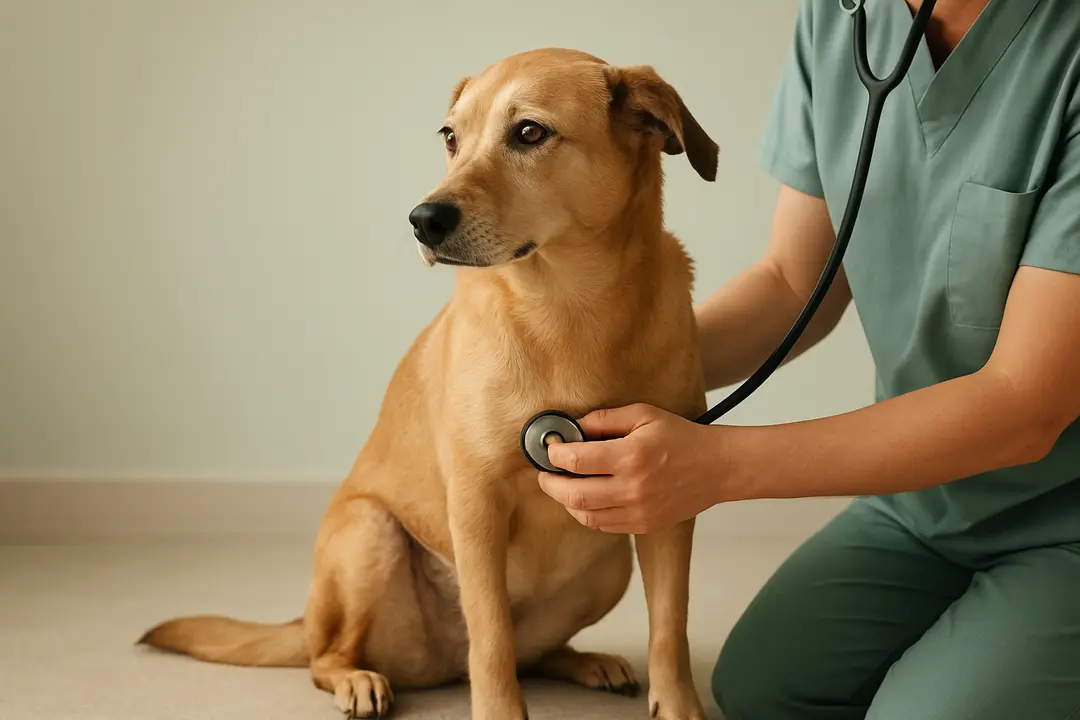
In this guide (8 sections)
- Get urgent help
- What to check in the first few seconds
- How to give pet CPR if your dog is unresponsive and not breathing
- Getting a weak but breathing dog to the hospital
- A heart attack, cardiac arrest, and a faint are different
- What to tell the emergency team
- What the vet can check after a collapse
- Talk it through with Vicky
Get urgent help
If your dog is struggling to breathe, won’t respond, or has collapsed and can’t get up, contact the nearest open emergency veterinary hospital and leave now. If someone is with you, have them call while you help your dog. Yes, dogs can have heart attacks, but a true heart attack is rare. You don’t need to know the cause to give the right first aid.
- Unresponsive, with no sustained breathing: Start pet CPR immediately. Have a helper arrange emergency transport while you begin chest compressions. If you’re alone, put the hospital on speaker so your hands are free.
- Still breathing on their own, even if they can’t stand: Do not give chest compressions. A dog working hard for each breath needs emergency transport, not CPR. Tell the hospital if your dog is breathing but won’t respond.
- Already back on their feet and breathing comfortably: Call your vet and describe the collapse so they can advise you about an examination. Getting up again changes the first aid your dog needs, but it doesn’t explain the fall. PDSA’s first aid guide for collapse also addresses dogs who seem to have recovered.
What to check in the first few seconds
Start with two questions: Does my dog respond to me? Are they breathing on their own? Speak to your dog and look briefly at their chest. A dog lying still may be breathing. Equally, if all you saw was one gasp, report that rather than telling the hospital that normal breathing has returned.
If your dog is awake, notice how hard it is to get air, not just how fast they’re breathing. Look at what their chest and belly do with each breath. Notice how they hold their head and whether their breathing sounds different from usual. These are details you can describe while help is being arranged, not tests your dog has to fail before you leave. If breathing looks like hard work even at rest, don’t spend time counting breaths or waiting for another sign. Cornell’s guide to breathing distress in dogs explains what owners may see.
How to give pet CPR if your dog is unresponsive and not breathing
CPR combines chest compressions to move blood with rescue breaths to move air. Begin while someone else contacts the emergency hospital. Don’t give compressions to an awake dog fighting for air or to an unconscious dog who is still breathing on their own.
- Position your hands for your dog’s chest shape. For most dogs, lay them on their side on a firm surface and place your hands over the widest part of the chest. For a deep, narrow-chested dog, such as a Greyhound, compress over the heart, near where the elbow meets the chest. For a broad, flat-chested dog who lies naturally on their back, compress over the breastbone. If you’re unsure, describe your dog’s size and shape to the emergency team for coaching.
- Give 30 compressions. Aim for about two compressions per second. Press the chest down by about one-third to one-half of its width, then release the pressure so the chest can return to its usual shape before the next compression.
- Give two rescue breaths. Gently hold the mouth closed and breathe into the nose. Go straight back to compressions and repeat the sequence: 30 compressions, two breaths. Have someone else drive if CPR is needed during transport.
The Merck Veterinary Manual’s CPR guidance and PDSA’s dog CPR instructions describe compression depth, pace, and hand position. If this is happening now, use the emergency team’s coaching rather than stopping to read a second guide.
Getting a weak but breathing dog to the hospital
Tell the hospital if your dog cannot stand so the team can guide you on moving them into the car and meeting you when you arrive. You don’t need to make your dog walk to show how weak they are. If two people are available, one can drive while the other stays with the dog and relays any change in breathing or responsiveness.
Don’t stop to give aspirin or another medicine intended for people. The FDA’s guidance on medicines that may harm pets identifies aspirin as potentially harmful. If someone has already given your dog medicine, tell the emergency team rather than assuming it will help because the episode looked like a heart problem.
A heart attack, cardiac arrest, and a faint are different
A heart attack, also called a myocardial infarction, is an injury to the heart muscle. A coronary artery normally brings oxygen-rich blood to that muscle. If the supply is cut off, part of the muscle is damaged. That specific event is unusual in dogs. The word collapse describes what you saw; it doesn’t tell you that a coronary artery was blocked.
Cardiac arrest means the heart is no longer pumping blood effectively around the body. It describes the immediate emergency, not the condition that caused it. That’s why the decision to start CPR depends on responsiveness and breathing, not on whether your dog has been diagnosed with heart disease.
A faint, or syncope, is a brief loss of consciousness. A dog who goes limp and then gets back up presents a different problem from one who stays down without breathing. The first dog may need an investigation that includes checking the heart rhythm; the second needs CPR before anyone can establish a diagnosis. Breathing problems can also lead to collapse. The sequence matters: tell the vet if your dog was already struggling for air before they fell.
What to tell the emergency team
Lead with what’s happening now. “My dog is awake and breathing, but can’t get up” gives the team a more useful starting point than “My dog had a heart attack.” If your dog seems back to normal, say that first, then describe the episode. You don’t need a medical term or an exact time for your observations to help.
- Before the fall: What was your dog doing? Were they breathing comfortably, or had their breathing already changed?
- While they were down: Did they respond to your voice? What breathing or movements did you see? Give your best estimate of how long they were down.
- Since the fall: Can they stand now? Does each breath still look difficult? Has there been more than one episode? Tell the team if anyone gave rescue breaths, chest compressions, or medicine.
If you found your dog already on the floor, say so. “I didn’t see the fall; when I got there, they were breathing” preserves an important distinction without making you guess what happened before you arrived.
What the vet can check after a collapse
Once your dog’s immediate needs are addressed, the vet can investigate the cause. If a heart problem is a possibility, different tests answer different questions. An electrocardiogram and an echocardiogram sound alike, but one records an electrical signal and the other makes moving pictures.
| Test | The question it helps answer |
|---|---|
| Electrocardiogram (ECG) | What is the heart rhythm while the recording is being made? |
| Echocardiogram (heart ultrasound) | What do the heart muscle, chambers, and valves look like as the heart beats? |
| Chest X-rays | What can the vet see about the heart and lungs together that a rhythm recording can’t show? |
The Merck Veterinary Manual’s guide to heart testing in dogs explains the differences. VCA’s guide to fainting in dogs describes how these tests can fit into an investigation after a brief collapse. Your dog may be standing and alert by the time of the exam. In that case, your description helps the vet connect what they see in the clinic with what happened at home.
If your dog is going home, ask two questions: “What do today’s findings explain?” and “What should I do if I see the same thing again?” The plan should be based on your dog’s findings, not on a recovery timeline for a presumed heart attack. New difficulty breathing or a collapse that leaves your dog unresponsive or unable to get up is an emergency, even if an earlier episode passed quickly.
Talk it through with Vicky
Emergency care comes first. Once you’ve contacted the hospital and your dog is getting help, you can tell Vicky what you’re seeing right now. Vicky will bring in Dr. Ivan (Virtual DVM, DACVECC), our Emergency & Critical Care Specialist, to help you organize your observations and questions for your vet.
Common questions
My dog fell over twice but seems normal now. Can I wait for a scheduled appointment?
Tell your vet about both episodes and ask whether the scheduled visit is soon enough. Describe how long each lasted, whether your dog responded, and how they’re breathing now. If your dog is currently struggling to breathe or cannot get up, leave for the emergency hospital.
My dog stiffened or peed when they fell. Should I tell the vet it was a seizure?
Tell the vet exactly what you saw rather than deciding on a label. Include whether you saw the start of the fall, how your dog moved, and what they were like when they got up.
If the ECG is normal, does that tell me what my dog’s rhythm was during the collapse?
Not if the ECG was recorded only after the episode. It shows the rhythm during the recording. Ask your vet what that result explains and whether they need more information about the rhythm over time.
Is fluid in the lungs the same thing as a heart attack?
No. Fluid in the lungs is a different finding from damage to heart muscle caused by loss of its blood supply. If your dog is working hard to breathe, they need emergency care regardless of which condition you suspect.
Sources
- Recognizing and responding to canine respiratory distress — Cornell University College of Veterinary Medicine
- First aid for collapsed pets — PDSA
- CPR Guidelines for Dogs or Cats — Virginia-Maryland College of Veterinary Medicine
- Cardiopulmonary Resuscitation — Clinician’s Brief
- Potentially Dangerous Items for Your Pet — US Food and Drug Administration
- Aspirin Poisoning in Dogs — VCA Animal Hospitals
- Can Dogs Have Heart Attacks? Causes, Treatment, and Prevention — American Kennel Club
- Heart Attack in Dogs — PetMD
- Diagnosis of Cardiovascular Disease in Dogs — Merck Veterinary Manual
- Cardiopulmonary Resuscitation of Small Animals
- CPR for Dogs and Puppies
- Syncope (Fainting) in Dogs



