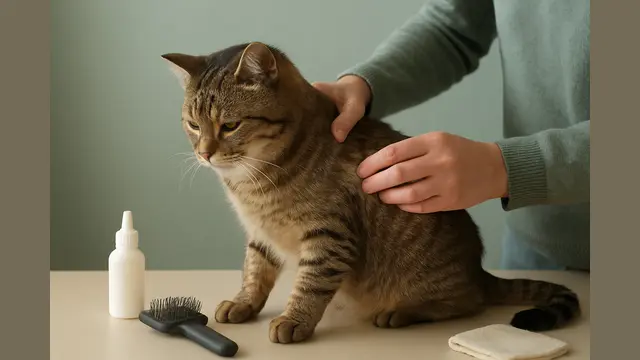
How can I safely tell whether my kitten is male or female?
Learn how to support your kitten, recognize the two patterns under the tail, and decide when to leave a newborn undisturbed or ask your vet to confirm.
In this guide (7 sections)
With your kitten belly-down and supported, gently raise the tail and look at the opening below the round anus. A short vertical slit close to the anus suggests a female; a small round opening farther below it suggests a male. If you can't see both openings in one brief look, let the tail down rather than holding your kitten still for a better view.
Should you check a newborn kitten or wait?
An experienced caregiver may be able to tell a kitten's sex at birth. That doesn't mean you need to take a newborn away from its mother to check. The differences can be hard to see, even when you know what to look for. If the kitten is nursing or the litter is settled together, leave them undisturbed.
For a mother cat and newborns, the priorities are warmth, quiet, and clean, dry bedding. RSPCA Australia's guide to caring for a mother and her kittens recommends observing them without unnecessary handling. If you're making a list of the kittens in a litter, it's reasonable to put “not sure” beside a kitten's sex. You don't need to get the whole litter out to make a comparison.
How to hold your kitten for a brief look
For a kitten that's up and about, choose a quiet moment in a warm room. Put a soft towel or mat on the floor where your kitten is comfortable. Use it as a place for the kitten to stand or rest, not as a wrap to keep them still. Cats Protection's handling guide recommends brief sessions in which the cat is free to move away.
- Get into position behind your kitten. Leave their paws or belly resting on the towel. Move yourself to where you can see under the tail rather than rolling the kitten onto their back or holding them up to your face.
- Support the belly with one hand. Keep your kitten right side up. Your supporting hand should steady the body while the other hand is free to raise the tail. If your kitten steps away, let them go.
- Gently raise the tail just enough to see. Don't pull it toward you or use it to lift your kitten's hind feet off the towel. The University of Florida's illustrated guide to identifying a kitten's sex shows the supported position as well as the view you're looking for.
- Look from the tail toward the belly, then release. Notice the opening nearest the tail and the one below it. Let the tail come down after that look. If your kitten sits down or resists before you can see, that's the end of the check; don't try to hold them in position.
What a female or male kitten looks like under the tail
The first opening, right beneath the tail, is the anus, where stool comes out. It's round in both male and female kittens. Finding that round spot tells you where to start, not which sex your kitten is. Now look below it for the genital opening. Two details matter together: what shape is that lower opening, and how close is it to the anus?
| Look at | Female pattern | Male pattern |
|---|---|---|
| Shape of the lower opening | A short vertical slit called the vulva | A small round opening |
| Gap below the anus | The slit sits close to the anus | There's more space between the anus and the round opening |
| Memory aid | A lowercase i: a dot over a short line | A colon : two dots, one above the other |
You don't need a ruler. The useful comparison is between the two openings on your kitten, not between a measurement you take and one from a picture of a different cat. If you prefer to see the patterns side by side, look at the ASPCApro visual guide for kitten caregivers before handling your kitten. That way you know which details to notice without trying to consult a screen and support a kitten at the same time.
What if you see only one dot or can't see testicles?
Picture a fluffy kitten standing on the towel. You lift the tail, spot a round dot, and the kitten sits down. If that dot was immediately under the tail, you saw the anus. You didn't see a male pattern: that would take a second round opening. Nor does the lack of a visible second dot tell you the kitten is female. For the female pattern, you'd look for a slit.
A partial view can be less obvious than that. You might see a space below the anus but not be able to tell where the lower opening begins. Rather than guessing from the size of the space, note what was missing: “I couldn't see the lower opening clearly.” Fur in the way or a kitten changing position is reason enough to leave the question open.
You also don't need to find testicles or see a penis to use the visual guide. In a young male, the penis is normally tucked inside a covering of skin and may not extend fully before puberty, as the University of Florida's guide to male cat anatomy explains. Don't press on the area, squeeze between the openings, or try to expose anything. The check is about two visible landmarks, not what you can feel beneath the skin.
What to tell your vet if you're unsure
If identifying sex is your only concern and your kitten seems well, ask at the next routine veterinary visit. You don't need to keep checking over the next few days. At the appointment, describe what you saw rather than giving your best guess as a fact. “I saw both openings, but couldn't tell whether the lower one was a slit” is more useful than “I think my kitten is female.”
Ask your vet to point out the anus and lower opening during the exam and show you which features distinguish them. If you also need to know whether an adopted kitten has been neutered, make that a separate question. Bring any adoption or surgery paperwork you have so the clinic knows what was recorded and what you still need confirmed.
When a litter box problem can't wait
If your kitten is straining to pee and producing only drops or no urine, seek emergency veterinary care now. This could mean urine is blocked from coming out. Don't delay to look under the tail or work out whether your kitten is male or female first.
Tell the emergency clinic that your kitten is trying to urinate and whether you're seeing drops or nothing at all. Both the Cornell Feline Health Center's guide to urinary tract problems and the American College of Veterinary Surgeons' guidance on urinary blockage advise immediate veterinary attention for a suspected blockage. It's the difficulty passing urine, not uncertainty about your kitten's sex, that makes this urgent.
Talk it through with Vicky
If you're unsure how to interpret a brief look, you can tell Vicky what you're seeing right now. Include your kitten's age if you know it, which opening you could see, and what was unclear. Vicky will bring in Dr. Ravi (Virtual DVM), our AI specialist in feline-friendly general practice, to help you understand the pattern and decide what to ask your vet.
Common questions
Can nipples tell me whether my kitten is female?
No. Male and female kittens are born with nipples, and they generally look alike. There's no need to turn your kitten over to look for them.
Is the biggest or most affectionate kitten in a litter usually a boy?
Neither trait can settle the question for an individual kitten. Males tend to be a little larger, but size varies, and cats of either sex can be affectionate.
Why does my kitten look male in one photo and female in another?
Check whether each picture actually shows both openings. If the shape of the lower opening or its position relative to the anus isn't clear, that photo doesn't give you enough information. You don't need to restrain your kitten to take another one.
What if my kitten's rescue paperwork and exam record list different sexes?
Show both records to your vet and point out the entries that disagree. Ask the clinic to confirm your kitten's sex on exam and clarify which entry needs correcting rather than choosing between the records based on a photo.
Sources
- Sex Determination in Kittens — University of Florida
- How to train your cat to be comfortable with handling — Cats Protection
- Kitten Sexing Job Aid: How to Tell if a Kitten Is Male or Female — ASPCApro
- How do I care for newborn kittens and their mother? — RSPCA Australia
- Planning for neuter — VCA Animal Hospitals
- Do male cats have nipples? — Cats Protection
- Feline Lower Urinary Tract Disease — Cornell Feline Health Center
- Urinary Stones — American College of Veterinary Surgeons
- The Visual Guide to Feline Reproduction: Penis — University of Florida
- Should I get a male or female cat? — Cats Protection