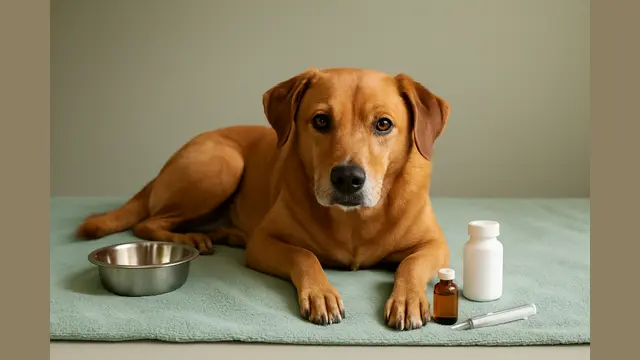
If my dog swallowed something dangerous, who should I call before trying to make my dog vomit?
Find out when to go straight to an emergency vet, who to call about a possible poisoning, and what to report if your dog has already thrown up.

In this guide (7 sections)
- Get urgent help
- Who to call: your vet, the emergency vet, or animal poison control
- What to tell the clinic, even if you didn't see it happen
- Why the vet may tell you not to make your dog vomit
- Don't give peroxide or salt while you wait for advice
- What happens after the call or emergency visit?
- Talk it through with Vicky
Get urgent help
Go straight to the nearest emergency veterinary hospital if your dog is choking, struggling to breathe, having a seizure, has collapsed, or is unresponsive. Otherwise, call your veterinarian now, or the nearest emergency veterinary hospital if your vet is closed or can't be reached, before giving anything to make your dog vomit. If poisoning is possible, two US animal poison services can also guide you around the clock: ASPCA Poison Control and Pet Poison Helpline.
If you're leaving for the hospital, have someone else call ahead if possible. Don't delay the trip to reach poison control, find a label, or try a home treatment. If your dog is alert and breathing normally, move them away from the item so they can't swallow more, and make the call. You don't need to see symptoms or prove that your dog swallowed something first. Pet Poison Helpline's first-aid guidance explains which signs need immediate care.
Who to call: your vet, the emergency vet, or animal poison control
| What you found | Who can help |
|---|---|
| An object is missing, such as a sock or something sharp | Call your vet or the emergency vet. Describe the object's size, shape, and what it's made of. |
| Your dog may have eaten medicine, a toxic food, or a household product | Call your vet now. An animal poison service can also assess the particular product and amount and advise you and your clinic. |
| Your dog chewed a container, and both the contents and part of the container are missing | Call your vet or the emergency vet and mention both. Don't let a question about the contents overshadow the missing piece. |
The FDA's guide to pet emergency contacts recommends starting with your own vet and contacting an emergency animal hospital if you can't reach them. You don't need to complete a series of calls before your dog can be seen. If a clinic or poison specialist tells you to go in, leave rather than calling the other service for confirmation.
What to tell the clinic, even if you didn't see it happen
Accidents like this happen to careful owners. The person taking your call needs an honest account, not a perfect one. Start with how your dog is acting right now, especially any trouble breathing, swallowing, or responding to you. Then work through these details while you're on the phone:
- Identify the item. If the package is within reach, keep it with you or take a clear photo of the label. Read the full product name and active ingredients, not only the brand. For medicine, read the strength printed on the package. For an object, say whether it's whole or in pieces and whether any edge is sharp.
- Describe how much could be missing. Separate what you saw your dog swallow from what you can't account for. For example, finding an empty pill compartment tells you a pill is missing; it doesn't tell you that you saw your dog eat it. Say which is true. If the package was already partly empty, mention that too.
- Give a time or a window. Say when you saw it happen. If you found the mess afterward, give the last time you know the item was out of reach and the time you discovered it. Those are more useful than reporting the discovery time as the time your dog swallowed it.
- Give your dog's weight and say what you've tried. Use a recent weight if you know it, and say if it's an estimate. Report anything you've given since the incident, how much you gave, and when. Mention any vomiting and whether it happened before or after you gave something.
Cornell's guide to first aid for poisonous substances explains why the product, amount, timing, and dog's weight matter. Don't postpone the call to weigh your dog, count every missing tablet, or search for a receipt. Start with what you know; someone else can look for the package while you speak.
Why the vet may tell you not to make your dog vomit
The question isn't only whether the item was dangerous going down. It's also whether it could hurt your dog coming back up, and whether your dog can swallow and keep vomit out of their lungs. That's why advice you received for a previous incident, even for the same dog, doesn't carry over to this one.
- A sharp or large object can injure or get caught in the tube between the mouth and stomach, called the esophagus. If a piece is missing from something your dog chewed, describe the missing piece rather than trying to bring it up to see what it is.
- A corrosive product, such as a cleaner that burns tissue, can injure the esophagus again on the way up. Read the label to the clinician. Saying that it was a bathroom cleaner, for example, isn't the same as identifying the product.
- A dog who can't swallow normally may breathe vomit into the lungs. This is called aspiration. A seizure or loss of consciousness makes trying to cause vomiting especially dangerous; go to the emergency hospital instead.
Pet Poison Helpline explains the risks from objects and cleaners, and the Merck Veterinary Manual explains when vomiting is unsafe. Even with something that seems easy to bring back up, like a pill, let the clinician decide whether vomiting would help in this particular exposure.
Don't give peroxide or salt while you wait for advice
Don't give hydrogen peroxide unless a veterinarian specifically directs you to use it for this dog and this incident. Don't use salt or another household remedy instead. If you're on hold, use that time to get the product information ready, not to try to make your dog throw up. The ASPCA's guidance on inducing vomiting cautions against trying it on your own.
If you already gave something, don't give more without instructions, even if your dog didn't vomit. Tell the clinician the name on the bottle, the amount you believe you used, and what happened afterward. If you're unsure about the measurement, say so. That information helps the clinician account for both the original exposure and what your dog received at home.
What happens after the call or emergency visit?
Your vet or the poison specialist will use the exposure details and your dog's current condition to advise you on the next step. That might mean going to the clinic rather than doing anything at home. If your dog has vomited, tell them what you saw, but don't assume that seeing part of the item means the whole exposure is over. Further care may still be needed.
If you're sent to a clinic, bring the label or photo if you have it. Tell the team if anything has changed since the call. If you spoke with animal poison control, give the clinic the case number so the two teams can work from the same information. The ASPCA's guide to a poison control call describes what the team will ask and what information you'll receive to pass along.
If the clinician recommends watching your dog at home, ask three questions before you hang up: What change should I watch for? For how long? Who should I call if it happens after hours? Write down the answers for this exposure rather than using a timeline from a different one. If your dog develops trouble breathing, collapses, has a seizure, or stops responding, go straight to the emergency hospital.
Talk it through with Vicky
Make the urgent call to your vet, the emergency hospital, or animal poison control first. After that, you can tell Vicky what you're seeing right now, including what your dog may have swallowed and the instructions you received. Vicky will bring in Dr. Nora (Virtual DVM, DABT), our veterinary toxicologist, to help you understand the advice.
Common questions
Is it worth calling if only a tiny amount might be missing and my dog seems fine?
Yes. A small amount isn't enough information by itself: the ingredient, the amount relative to your dog's weight, and the timing all matter. Call your vet or animal poison control now with the label rather than waiting for a change in behavior.
What if a vet told me to give peroxide but I think I measured it wrong?
Call the vet or emergency clinic back now. Read them the label and describe the measuring spoon or container you used, how full it was, when you gave it, and how your dog is acting. Don't give more to try to correct the measurement.
My dog threw up on their own before our appointment. Should I still go?
If you were told to come in, follow that plan unless the treating clinic changes it. Let them know your dog vomited and what you saw; vomiting alone doesn't establish that no further treatment is needed.
Is there a fee for animal poison control, and can my emergency vet use the same case number?
US animal poison services generally charge a consultation fee. Keep the case number and share it with the emergency vet so the clinic can discuss the same incident with the poison team.
Sources
- FDA Center for Veterinary Medicine: Who Do You Call if You Have a Pet Emergency?
- Cornell University College of Veterinary Medicine: First-aid for poisonous substances
- Pet Poison Helpline: Triaging a Potentially Poisoned Pet at Home
- ASPCA: What to Expect When Calling ASPCA Poison Control
- Pet Poison Helpline: What to Do After Inducing Vomiting in Your Dog
- Merck Veterinary Manual: General Treatment of Poisoning
- ASPCA: Is It Ever Safe to Induce Vomiting?
- Pet Poison Helpline: Frequently Asked Questions