Should rabbits eat meat, or should their diet consist entirely of plants?
Find out how rabbits get protein from plants, what to feed a healthy adult rabbit, and when a stolen bite of chicken or pet food calls for veterinary help.
In this guide (7 sections)
Don’t feed your rabbit meat, raw or cooked. A weaned rabbit is a herbivore, an animal whose diet should come from plants; grass hay supplies protein as well as the fiber your rabbit needs. Before weaning, baby rabbits also need their mother’s milk, but they don’t need meat.
If your rabbit already ate meat, what should you do?
Take the food out of reach and leave your rabbit’s usual grass hay and fresh water available. Then separate two questions: Was there something harmful in the food? Is your rabbit eating and passing droppings as usual? The first question matters even if your rabbit looks well. The second matters even if you know exactly what was on the plate.
- Go to a veterinary clinic now if your rabbit has stopped eating altogether. If your regular veterinarian can’t see your rabbit immediately, go to an emergency clinic. A rabbit that has stopped passing droppings also needs an immediate examination. After a possible poisoning, trouble breathing or a seizure means go straight to an emergency clinic rather than waiting for advice by phone.
- Call now if poisoning is possible, even if your rabbit is still eating and acting normally. Call your veterinarian or an animal poison control service. Don’t wait for symptoms, try to make your rabbit vomit, or give medicine or a home remedy. The ASPCA’s poisoning guidance explains what information to save; the Pet Poison Helpline’s triage guide distinguishes a call about a possible exposure from signs that mean go straight to the clinic.
- For a routine feeding question, such as whether you should offer your rabbit some of your plain chicken, the answer is no. If a bite has already happened and you’re unsure about the ingredients or the amount, ask your rabbit’s veterinarian about that particular exposure. “Not rabbit food” tells you what to leave off the menu; it doesn’t tell you what was in a particular dish.
What to check after a stolen bite
- Identify the whole food, not just the meat. If your rabbit reached a dinner plate, was the chicken plain, or was it part of a prepared dish? Keep the wrapper, ingredient list, or recipe if you have it. If your rabbit got into another pet’s food, save that package. Don’t put off an urgent call while you look for a label.
- Note when it happened and what you actually saw. Seeing your rabbit take one piece is different from finding a tipped bowl with kibble scattered around it. Tell the clinic how much might be missing and whether that is an estimate. If all you know is when you found the bowl, say that.
- Look at hay intake as well as the food bowl. Is your rabbit pulling out strands of hay and chewing them as usual? A rabbit may take an offered leaf yet eat noticeably less overall. If appetite is down, contact your veterinarian about the change; you don’t need to wait for complete refusal before reporting it.
- Check the litter area. Look for fresh droppings and compare their number and size with what you normally see. Smaller or fewer droppings can go along with eating less, as PDSA’s guide to reduced appetite in rabbits explains. That’s useful information for the clinic, not proof that the stolen food caused the change.
When you call, lead with the most important observation: “My rabbit has stopped eating” or “My rabbit got into a dish that may contain a harmful ingredient.” Then give the time, amount, and any changes in droppings. The clinic can use those details to advise you about an examination or what to watch for next. The Rabbit Welfare Association & Fund’s guide to gut slowdown explains why a rabbit that is no longer eating or passing droppings needs an examination, not an overnight wait or an attempt to get the gut moving at home.
How rabbits get protein without eating meat
If you think of meat as the protein in a meal and plants as the fiber, it makes sense to wonder what’s missing from a rabbit’s food. Grass hay provides both. Its protein is one reason a healthy adult rabbit on an appropriate plant-based diet doesn’t need a piece of chicken, a meat treat, or food from the dog’s bowl.
The fiber in grass hay helps keep food moving through your rabbit’s gut. Hay also does something you can see: watch your rabbit work through a long strand. The repeated side-to-side chewing helps wear down teeth that keep growing throughout life. The Rabbit Welfare Association & Fund’s feeding guide describes both benefits. Cooking meat or cutting it into thin strips doesn’t give it the fiber or the chewing qualities of grass hay.
What to feed a healthy adult rabbit each day
Think of hay and water as the two things your rabbit should still be able to reach after you’ve cleared the dinner dishes. Greens are a daily food, and pellets have a place too, but you offer those in portions. The Merck Veterinary Manual’s rabbit diet guide recommends this pattern for healthy adults.
| Food or drink | What to do |
|---|---|
| Grass hay | Keep an unlimited supply within reach. Timothy hay and orchard grass hay are both suitable. |
| Fresh water | Keep it available at all times, including between meals. |
| Rabbit-safe leafy greens | Offer greens daily. Romaine lettuce and cilantro are two choices. |
| Plain rabbit pellets | Measure a limited daily portion of plain, timothy-based pellets. Don’t keep refilling the dish as it empties. |
When you put down the greens, check the hay at the same time. A full salad bowl beside an empty hay feeder is a plant-based meal, but it leaves out the food your rabbit should be able to chew throughout the day. VCA’s guide to everyday rabbit care puts leafy greens alongside freely available grass hay, not in place of it.
If more than one person feeds your rabbit, set aside the day’s pellet portion in one container. That way, whoever finds an empty dish can tell whether there are more pellets to offer. Use the opposite rule for hay: nobody needs to wait for the next scheduled meal to replenish it.
Why a rabbit might keep going back to the cat’s bowl
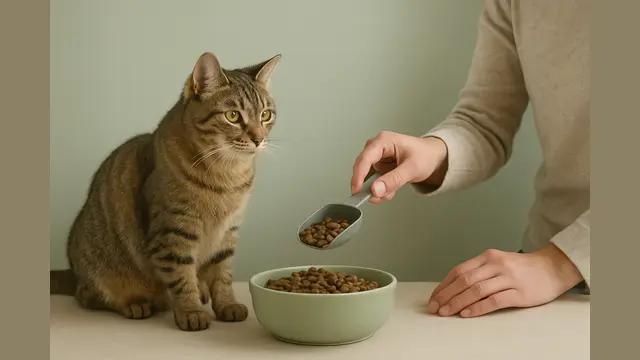
Finding your rabbit eating kibble can happen in a careful household. Going back for a second piece tells you the food is appealing and accessible; it doesn’t show that your rabbit needs animal protein. Change where the other pet eats rather than counting on your rabbit to lose interest.
If the cat needs access to food between meals, choose a feeding space the cat can enter but the rabbit cannot. Check the floor around the bowl for scattered pieces. If your rabbit finds chicken scraps after family meals instead, clear plates and put scraps in a closed container before your rabbit has access to the room. In either setup, keep the rabbit’s own hay and water on the accessible side of the barrier.
What about a baby rabbit that still drinks milk?
A baby rabbit, called a kit, relies on its mother’s milk before weaning. That’s a normal part of development, not a reason to introduce meat or to separate the kit from its mother so it can start an all-plant menu. Rabbit.org’s guidance on nursing kits cautions against separating them too early. If you’re caring for a young rabbit and don’t know whether it’s weaned, ask your veterinarian for a feeding plan rather than assuming the healthy adult menu fits.
Talk it through with Vicky
For help with everyday feeding, you can tell Vicky what you’re seeing right now, including which hay you offer, how you portion pellets, or where your rabbit keeps finding the cat’s food. Vicky will bring in Sam (Virtual PhD (Animal Nutrition)), our animal nutritionist, to help you plan a feeding setup that works in your home. For possible poisoning or a rabbit that has stopped eating, use the veterinary care steps above rather than waiting for feeding advice.
Common questions
If a wild hare eats meat, does that mean pet rabbits are omnivores?
No. What a wild hare might pick up is not a guide to what a domestic rabbit needs. A weaned pet rabbit is a herbivore and should have a hay-based diet, not a mix of plants and meat.
Can I offer plain cooked chicken as a hand-fed treat?
No. Removing the sauce or cooking the chicken doesn’t make it an appropriate rabbit treat. Offer a sprig of cilantro or a piece of romaine from your rabbit’s daily greens instead.
Can I use dog or cat kibble if I run out of rabbit pellets?
No. Kibble that looks like a rabbit pellet isn’t a substitute for a plain, timothy-based rabbit pellet. Keep your healthy adult rabbit’s usual hay and fresh water available and offer the usual daily greens rather than borrowing from another pet’s bowl.
Do timothy-based pellets count as my rabbit’s hay for the day?
No. Even though the pellets are made with hay, a measured serving doesn’t replace access to grass hay throughout the day. Loose strands give your rabbit repeated side-to-side chewing that helps wear down growing teeth.
Sources
- Merck Veterinary Manual: Diet for Rabbits
- Rabbit Welfare Association & Fund: How to Feed Rabbits
- Rabbit.org: Debunking Common Myths About Baby Rabbits, Part II
- VCA Animal Hospitals: Spotlight: Bunny Care Basics
- ASPCA Animal Poison Control: What to Do if Your Pet Is Poisoned
- PDSA: Reduced Appetite in a Rabbit
- RSPCA — Pregnant Rabbits
- Rabbit Welfare Association & Fund — Gut Slowdown
- RSPCA — Poisoning in Rabbits
- Pet Poison Helpline — Triaging a Potentially Poisoned Pet at Home