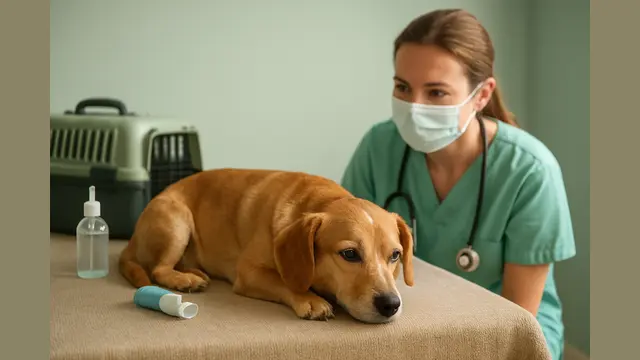
Does my dog need emergency care if they won't eat or drink and barely move?
If your dog won't eat or drink and can barely move, go to an emergency vet now. Learn how to get them to the car safely and which signs to report first.
In this guide (7 sections)
Get urgent help
Yes. Go to an emergency veterinary hospital now. A dog who refuses food and water and can barely move needs immediate assessment because of the severe weakness, even if they were walking normally earlier today. Have someone call the hospital as you leave or on the way so the team can prepare.
Tell the hospital first if your dog has collapsed, is hard to wake, cannot stand, or is struggling to breathe. Also report a swollen belly with repeated attempts to vomit that bring nothing up. Don't wait for any of these additional signs: the weakness you've already noticed is reason enough to go. Both Cornell's guide to when a dog needs the ER and NC State Veterinary Hospital's emergency guidance identify marked weakness as a reason for immediate care.
If your dog can't stand, don't make them walk to the car. Don't stop to offer a different meal, force food, or syringe water into their mouth. The priority is getting your dog to the hospital, not getting them to take a bite or a sip before you leave.
How to move a dog who is too weak to walk
- Bring help to your dog. If someone is with you, have them open the doors and clear a path to the car. That way you won't have to put your dog down midway to move something out of the way. If you're alone and can't safely lift your dog, call the emergency hospital now. Explain where your dog is, how large they are, and that you need help figuring out how to move them.
- Use a blanket as a stretcher if needed. For a large dog, two people can gently ease the dog onto a strong blanket, hold the corners, and lift together. The aim is to support your dog's body and move them as little as possible. PDSA's safe transport guide and the Schwarzman Animal Medical Center's instructions for carrying a sick pet describe this approach.
- Plan for the other end of the trip. Have a passenger tell the hospital if your dog will need to be carried in from the car. Ask where to pull up and how to let staff know you've arrived. If your dog is unconscious or having trouble breathing, start transport rather than staying home to finish a phone conversation.
What “barely moving” means to the emergency vet
You don't have to choose the right medical word for what you're seeing. Think about what happened when you last went over to your dog. Did they look toward you when you spoke but stay lying down? Try to rise but fail? Not respond to you at all? Tell the team which one you saw. There's no need to ask your dog to stand again to prove they can't do it.
Be specific about what your dog isn't responding to. For example, a dog may ignore a favorite food but still turn their head toward you. Saying that gives the team a clearer picture than saying your dog is “unresponsive,” which could mean they aren't responding to you either. If your dog looks at you but is still too weak to get up, report both observations. One doesn't cancel out the other.
What to tell the ER on the way
Start with your dog's current condition, not a list of everything they ate yesterday. A useful order for the call is: what your dog can do right now, whether they're having trouble breathing, when you expect to arrive, and whether you'll need help at the car. Once the team has that information, fill in the history you know:
- Last normal activity: When did you last see your dog walk or get up as usual? If they walked outside last night but were already weak when you found them this morning, give both times. That's more accurate than guessing when the weakness began.
- Food, water, and urination: When did you last see your dog eat, drink, and urinate? Mention any change you noticed before they became weak, too. It's useful to distinguish “I saw them turn away from water” from “I haven't seen them drink.”
- Health conditions and medicines: Name any known illness, including past kidney or urinary problems. Tell the team what medicines your dog takes and when you last gave them. A medication list or a photo of the labels can help if it's already handy.
- Anything your dog may have swallowed: Report what you saw or what is missing. Seeing your dog swallow a piece of a toy is different from finding the toy torn up afterward. Both are worth mentioning; the vet needs to know which happened.
BluePearl's ER medical history form gives an idea of what you may be asked. These are questions for the call or the visit, not tasks to complete before leaving. If someone else was caring for your dog earlier, they can fill in missing details by phone while you're at the hospital.
What could cause my dog to refuse food and water and barely move?
The signs tell you that your dog needs help now, but they don't point to a single cause. One possibility is an intestinal blockage: something a dog swallowed gets stuck instead of passing through. A dog with a blockage may stop eating and become dehydrated. The signs can vary depending on where the object is and how much of the intestine it blocks. Cornell's guide to swallowed objects in dogs explains how the vet investigates that possibility.
A different history may lead the vet in another direction. For instance, if your dog's drinking or urination had already changed over the past few days, that matters even though the refusal to drink is what stands out today. Mention that pattern rather than assuming the last meal caused the problem. You aren't expected to work out at home whether the weakness and appetite change started for the same reason.
What will the emergency hospital do first?
The first job is to find out what needs attention right away, including whether your dog is responsive and breathing comfortably. Finding the underlying cause is a separate step. If staff start assessing your dog before you've finished describing the day's events, give them the most urgent change first. You can supply the longer timeline as they work. The Merck Veterinary Manual's overview of emergency assessment explains why immediate problems take priority over a full examination.
The exam and your observations help the vet choose the next tests. For example, if a swallowed object is a concern, the vet may recommend pictures of the belly, such as X-rays or an ultrasound, to look for a blockage. Blood tests can help assess your dog's condition. A useful question is, “What are you looking for with this test, and how would the result change what you do next?”
What happens over the next day depends on what the team finds, not on how many meals your dog missed. Before you leave the hospital, ask what the vet knows so far, what's still uncertain, and when to expect an update or a recheck. If your dog is going home with you, ask the team to spell out what improvement should look like for your dog and which changes mean you should come straight back.
Talk it through with Vicky
Go to the emergency hospital first. Once your dog is with the ER team, you can tell Vicky what you're seeing right now and what questions you still have. Vicky will bring in Dr. Ivan (Virtual DVM, DACVECC), our Emergency & Critical Care Specialist, to help you understand the next steps your clinic describes.
Common questions
Can this wait until my regular vet opens if my dog has missed only one meal?
No. The reason to go to an emergency hospital now is that your dog can barely move. How recently they ate doesn't change that decision.
Is it still an emergency if my dog hasn't vomited or had diarrhea?
Yes. Severe weakness needs immediate assessment on its own. Don't wait for vomiting or diarrhea before getting help.
What if my dog takes a sip of water but still won't get up?
Continue to the emergency hospital. Tell the team your dog drank a little but is still too weak to get up; the sip doesn't resolve the reason they need urgent care.
How do I report water intake if my dogs share a bowl?
Give the last time you actually saw this dog drink, or say you don't know. A lower water level won't tell you which dog drank, and you don't need to separate them to find out before leaving.
Sources
- Merck Veterinary Manual — When to See a Veterinarian
- Cornell Riney Canine Health Center — When to Go to the ER
- PDSA — How to Safely Move an Injured Pet
- VCA Animal Hospitals — Emergencies in Dogs
- Merck Veterinary Manual — Pneumonia in Dogs
- BluePearl Specialty and Emergency Pet Hospital — ER Medical History Form
- Merck Veterinary Manual — Detecting Disorders of the Kidneys and Urinary Tract in Dogs
- Merck Veterinary Manual — Evaluation and Initial Treatment of Dog and Cat Emergencies
- Cornell University College of Veterinary Medicine — Gastrointestinal Foreign Body Obstruction in Dogs
- American College of Veterinary Surgeons — Gastrointestinal Foreign Bodies
- NC State Veterinary Hospital — Emergency and Critical Care
- Schwarzman Animal Medical Center — How to Move a Sick or Injured Pet in an Emergency