How can I tell normal red eye color from redness that needs a vet visit in my rabbit?
Compare your rabbit’s eyes in ordinary light, tell normal pink tissue from signs of soreness, and learn which changes need a vet call or emergency care.
In this guide (6 sections)
Where is the red, and is it new? A lifelong pink or ruby color inside both eyes can be normal if the eyes are clear and your rabbit holds them open comfortably. Call a rabbit-experienced vet today if you see new redness that persists in ordinary light, or if either eye is watering, cloudy, swollen, or partly shut.
Find the red: is it inside the eye or around it?
Watch your rabbit at eye level in ordinary light, without a camera flash. Look at each eye as your rabbit turns toward you. You don’t need to pull a lid back: what your rabbit does with the eye is as useful as the color you can see.
| Where you see it | How to interpret it |
|---|---|
| In the colored ring around the center | This ring is the iris. A familiar ruby shade seen through a clear surface is different from new redness in the lid. |
| In the center of the eye in a photo | The center opening is the pupil. A camera can catch a red reflection here. Compare the picture with what you see in person. |
| Along the inside edge of the eyelid | The lining is normally pink. If tissue that used to lie flat now looks red and puffy, or there is discharge beside it, call your vet. |
| Across the front of the eye | The cornea is the clear surface over the iris and pupil. A new haze that makes the colored ring hard to see is not the same as a pink iris. |
The Best Friends rabbit health check describes healthy eyes as clear and bright. Clear doesn’t mean colorless. You can see a ruby iris clearly, just as you can a brown one. Conversely, a rabbit’s usual ruby color can stay exactly the same while the lid or the surface of the eye becomes sore.
Which changes need a vet today, and which are emergencies?
Call a rabbit-experienced vet today for a new, lasting color change in either eye, a newly red or swollen lid, repeated rubbing, tearing, discharge, or cloudiness. Call if you suspect a hay poke, too. If your rabbit is squinting or holding an eye closed, tell the clinic that first and ask for urgent assessment. You don’t need to wait for pus or be able to see a scratch. PDSA’s guide to rabbit eye problems distinguishes the normally pink lining from changes that warrant a call, particularly signs of pain.
Seek emergency veterinary help now if the eye looks cut or punctured, you think something has pierced it, or your rabbit appears to have severe eye pain. If a piece of hay or another object looks lodged in the eye, leave it in place and call for urgent instructions. You can’t judge its depth by how much of it you see. The Merck Veterinary Manual’s guide to eye injuries explains why rapid assessment matters for a damaged cornea.
If your rabbit stops eating or stops passing droppings, seek emergency veterinary care now, even if you see no eye injury. Don’t wait overnight or for both changes to happen. The Rabbit Welfare Association & Fund’s guidance on gut slowdown explains this separate reason for emergency care. If your usual clinic is closed, call the emergency hospital and ask whether someone on duty can treat a rabbit. Lead with the most urgent sign, not your question about eye color.
Why a healthy eye can look ruby in person or in a photo
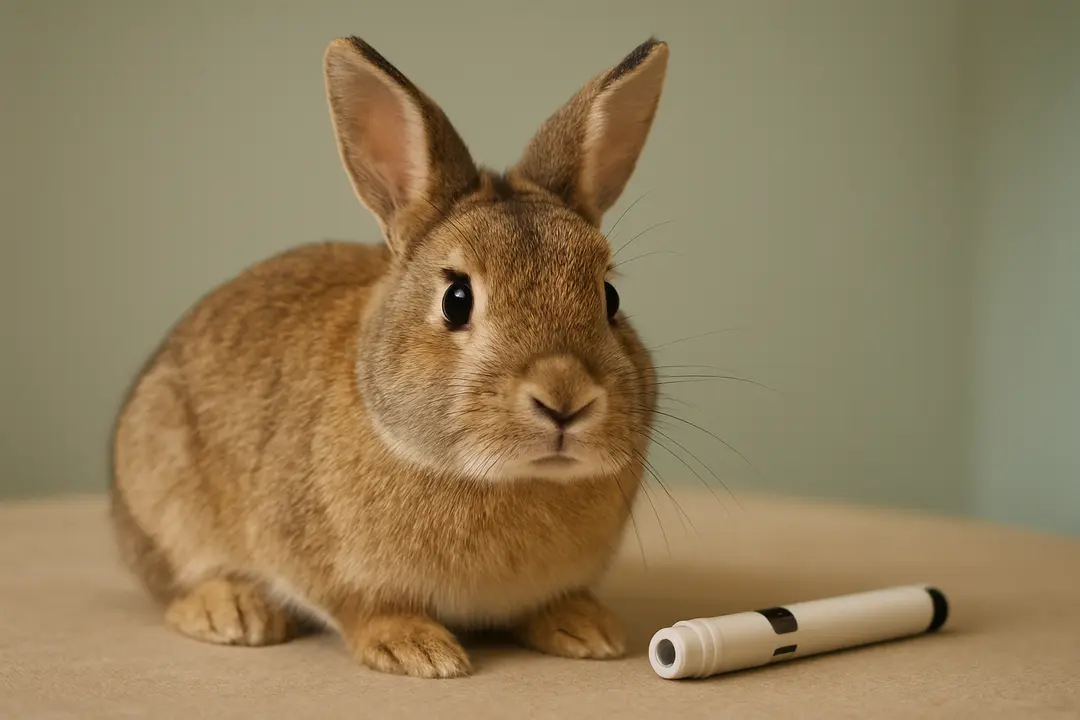
Pigment gives the eye its color. In an eye with little pigment, the color of blood vessels inside can show through. That is different from blood leaking into the eye. MediRabbit’s examples of rabbit eye colors include the naturally pink eyes of an albino rabbit, a rabbit that lacks pigment. Your best comparison is with your own rabbit’s usual eyes, not the coat color of a rabbit in a picture.
A flash photo raises a different question. Light from blood vessels at the back of the eye can show up as a red glow in the pupil, as the American College of Veterinary Ophthalmologists explains in its guide to photographic eyeshine. That can account for a ruby center in a photo even when the ring around it looks brown in daylight. A picture alone can’t confirm that the eye is healthy or that the iris has changed color.
If the photo surprised you, put the camera down and look at the rabbit. Are both eyes open as usual? Is the surface clear? Is the cheek dry? An older picture taken without flash may help you recognize a familiar color or eyelid edge. There’s no need to repeat the flash test. If the eye is now half shut or wet, those findings matter more than whether you can recreate the glow.
What to check before you call the clinic
If you suspect a serious injury, call first rather than working through a checklist. Otherwise, a few observations will help you describe what changed without handling a sore eye.
- Compare how your rabbit uses the two eyes. Watch while your rabbit is awake and looking around. Note whether one eye stays narrower, closes repeatedly, or is the one your rabbit rubs. “The left eye stays half shut” tells the clinic more about comfort than “the eyes look red.” Don’t force the lids apart to see underneath.
- Look at the corner of the eye and the fur below it. Check for fresh tears, a damp strip down the cheek, or discharge collected at the lid. Tell the clinic whether this is the first wet patch you’ve seen or whether the same cheek has been wet on and off. Clear tears count; they don’t have to be thick to be worth reporting.
- Describe the timing without guessing the cause. If you saw your rabbit push into hay and then close one eye, say that. If you noticed wet fur at breakfast but didn’t see what happened, say that instead. Include when you last saw your rabbit eat and pass droppings. Don’t delay the call to get a better picture or a more exact timeline.
While you arrange care, don’t probe under the lid, pull on a strand that might be embedded, or use human redness-relief drops. Eye medicine left over from a previous visit isn’t a safe substitute for advice about this eye today. Rabbit.org’s emergency care guide advises prompt treatment for a serious eye scratch and cautions against using eye medicines unless a vet directs their use for the current problem.
What the vet may check beyond the eye color
A red, watery eye is not necessarily an infection. Hay can scratch the clear front of the eye during an ordinary meal, even in a carefully kept home. If the vet suspects a wound, they may use fluorescein, a dye that shows damage to the cornea. It helps the vet find a break in a surface that can be hard to inspect at home, especially when the rabbit wants to keep the lid closed.
Repeated watering can point the exam in another direction. Tears normally drain away through a small duct. Dental problems can obstruct that route, so tears spill onto the cheek. That’s why a vet may examine the teeth and tear drainage as well as the eye itself. Lafeber’s guide to rabbit eye problems explains both hay injuries and the link between teeth and tears. A wet cheek alone doesn’t tell you which is responsible.
Before you leave the clinic, ask what improvement to look for and when your rabbit needs a recheck. For a rabbit with naturally ruby eyes, a less-red iris isn’t the goal. More useful observations are whether the eye opens comfortably again, whether the lid swelling changes, and whether fresh tears still wet the cheek. Report new pain or cloudiness rather than waiting for a scheduled recheck.
Talk it through with Vicky
You can tell Vicky what you’re seeing right now: where the red appears, whether it’s visible without a camera, and how your rabbit is holding each eye. Vicky will bring in Dr. Lena (Virtual DVM, DACVO), our AI specialist in veterinary ophthalmology, to help you sort out what you’re seeing. If your rabbit has urgent signs, call your clinic or emergency hospital first.
Common questions
I just adopted my rabbit. How can I tell what’s normal without an older photo?
Look at the location of the color, whether the surface is clear, and whether both eyes open comfortably. If possible, ask the previous caregiver whether the shade is familiar. Don’t wait for that history before calling about swelling, tearing, squinting, or cloudiness.
Is the pink bit at the inner corner of my rabbit’s eye normal?
A little visible pink eyelid lining can be normal; seeing pink there doesn’t mean the iris has turned red. A corner that is newly puffy, has discharge, or sits beside an eye your rabbit keeps closed needs veterinary attention.
Only one eye is watery and half shut, but my rabbit is eating. Can it wait until morning?
Call a rabbit-experienced clinic now for advice rather than waiting on the strength of a normal appetite. Holding one eye half shut can signal pain, and a watery eye may have a surface injury even when the other eye looks clear.
Could hay have scratched the eye even if I can’t see anything in it?
Yes. A strand doesn’t have to remain in the eye to leave a wound. Tell your vet about the possible hay contact; a fluorescein dye exam can reveal a scratch you can’t see at home.
Should I rinse my rabbit’s eye if I think hay is under the lid?
Call the clinic for instructions before trying to rinse it, since you can’t tell at home whether the strand is loose or embedded. Don’t pull the lid open to retrieve it or put in drops left over from another eye problem.
Sources
- Heterochromia of the iris in rabbits belonging to the Dutch breed — MediRabbit
- Intraocular Hemorrhage — Clinician’s Brief
- The Rabbit Eye: A Complete Guide — Rabbit.org
- Why Do My Dog’s Eyes Shine at Night? — American College of Veterinary Ophthalmologists
- Rabbit Health Check: Signs of a Healthy Bunny — Best Friends Animal Society
- Rabbit Eye Problems and Treatments — Lafeber Company
- Overview of Ophthalmic Emergencies in Small Animals — Merck Veterinary Manual
- Gut Slowdown — Rabbit Welfare Association & Fund
- Find a Rabbit-Savvy Vet Near You — Rabbit.org
- Help! My rabbit is sick and I can’t reach my vet! — Rabbit.org
- PDSA — Eye problems in rabbits: an overview
- MSD Veterinary Manual — Corneal Foreign Bodies in Small Animals