What can cause blood in my dog's poop, and how can I tell if it needs emergency care?
Learn which changes in your dog's poop mean go to the ER, when to call about a red streak, and what a photo or stool sample can help your vet check.
In this guide (6 sections)
Go to an emergency vet now if your dog has bloody diarrhea, heavy bleeding, or black, tarry poop, or if you see pale or white gums, severe pain, marked weakness, or collapse. If you see one tiny red streak on formed poop and your dog is eating and acting normally, call your regular vet now for guidance; that finding alone does not automatically mean an ER trip. Possible causes range from straining or an inflamed colon to parasites, an ulcer, a blockage, or a problem with blood clotting.
When to go to the ER and when to call your vet
The first distinction is between a streak on a bowel movement that otherwise looks normal and passing loose or watery stool that contains blood. Bloody diarrhea needs emergency care even if this is the first episode. Don't wait to see how many times it happens. Heavy bleeding or thick, black, tar-like stool also needs immediate attention, even if your dog is still walking around.
How your dog is doing can matter more than how much blood you found. If your dog collapses, can't stand, seems severely weak or painful, or has gums that look unusually pale or white, leave for the ER rather than examining another stool. The Merck Veterinary Manual's immediate-care guide and Texas A&M's small-animal emergency service describe signs that call for immediate care.
For a dog with a single red streak on formed poop and no other changes, the next step is a phone call, not a waiting period. If your clinic is closed, call its after-hours service or an emergency clinic and ask whether your dog needs to come in. You don't need to wait for a second streak to make that call.
What the color, texture, and location of the blood can tell you
Fresh red blood often comes from the lower digestive tract: the colon (large intestine), rectum, or area around the anus. Look at where it appeared. Was it a narrow line on the surface of a formed stool? Did you see a few drops at the very end? Or was the blood mixed throughout loose poop? Those details are more useful to your clinic than color alone. Bright red does not necessarily mean mild.
Black, tarry poop can contain digested blood. The distinction from ordinary dark-brown poop is the tar-like appearance: black, thick, and sticky. You may not see any red at all. If you're unsure what you're looking at, describe both the color and the texture to the clinic. Take a photo if one is easy to get, but don't delay leaving for care to get a better picture.
What can cause blood in a dog's poop?
- Colitis. This means the colon is inflamed. Your dog may rush outside, strain, then pass a little mucus and fresh blood near the end of a bowel movement. Stress is a common trigger. VCA's guide to colitis in dogs explains why that combination of signs can lead a vet to examine the large intestine. It doesn't prove stress caused the bleeding.
- Constipation or an anal gland problem. Either can cause bleeding. If your dog strained, note what came out rather than assuming your dog is constipated. Passing hard stool is a different pattern from repeated squatting with a little soft stool and mucus.
- A diet change or scavenging. A new food or getting into the trash can trigger diarrhea. Tell your vet about it, but don't use it to explain away blood. Knowing that your dog ate something unusual is helpful; knowing what they ate is better, particularly if an object is missing.
- Parasites and other digestive problems. Intestinal parasites can cause blood in the stool, and a stool test can help look for them. Other possibilities include an ulcer (a sore in the digestive lining), a blockage, a growth, or a disorder that keeps blood from clotting normally. PDSA's guide to blood in dog stool describes this range of causes. A red streak by itself doesn't distinguish among them.
One specific cause of sudden, profuse bloody diarrhea, often with vomiting, is acute hemorrhagic diarrhea syndrome, or AHDS. This isn't another name for every case of bloody poop. With AHDS, fluid loss can be rapid enough to cause shock, meaning blood no longer circulates adequately, before dehydration is obvious to you. That's one reason not to wait for a dog with bloody diarrhea to look sicker. The Merck Veterinary Manual's guide to AHDS in dogs explains why vets treat these dogs promptly with fluids through a vein.
What to tell the clinic when you call
Start with the most concerning thing you see right now. “My dog is too weak to stand and passed bloody liquid” and “My dog ate breakfast and passed one formed poop with a thin red line on it” give the clinic very different starting points. Then share the details you have; you don't need to complete a checklist before getting help.
- Give the sequence. Say when you first noticed blood, how much you saw, and how many times your dog has passed stool since. Count attempts separately from bowel movements. Three trips to the door with almost nothing coming out is different from three puddles of bloody diarrhea.
- Describe the rest of your dog, not just the poop. Report any vomiting, refusal to eat, straining, or change in energy. Give your dog's age. Flag a puppy's vaccination history, or tell the clinic if your dog is older, has a chronic illness, or takes medication. Don't guess at a vaccination date or medication name if you can check the record or label instead.
- Mention anything your dog may have eaten. Include recent food changes, trash, a new chew, medication, or an object your dog might have swallowed. Say what you saw and what you only suspect. A missing piece of a toy is worth mentioning even if you didn't see your dog eat it.
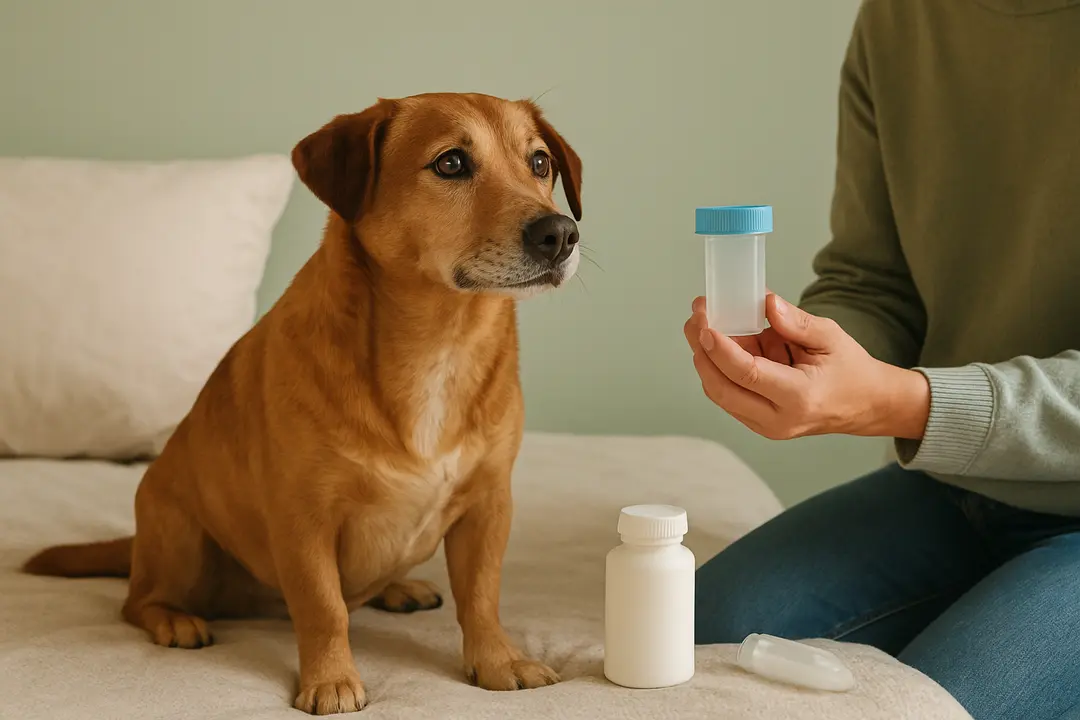
- Bring a photo or a fresh stool sample if available. A photo of the whole bowel movement shows both its shape and where the blood appeared. A sample gives the vet something to test. If you've already cleaned up, call anyway; neither a photo nor a sample is a condition for getting care.
If poisoning is possible, call your veterinarian, an emergency clinic, or an animal poison control service immediately, even if your dog still seems well. Have the packaging handy if available, and share the product, possible amount, and time of exposure if known. Do not give your dog anything to make them vomit unless a veterinary professional directs you to. Cornell's first-aid advice for possible poisoning and the Pet Poison Helpline's guidance on suspected exposure explain what to do before trying any home treatment.
What the vet may check and what to watch for afterward
At the visit, the vet may check your dog's gum color and hydration and feel the abdomen for pain or a mass. The exam helps answer the first question: does your dog need treatment for fluid loss or poor circulation now? Finding the exact cause of the bleeding is a separate question. A stool test can help identify parasites. If the problem keeps returning, your vet may suggest imaging to look for a cause that a stool test wouldn't show.
If your vet recommends watching at home after a small streak, ask what to expect at the next bowel movement and when they'd like an update. Note whether the stool stays formed, whether the blood returns or increases, and whether your dog's appetite or energy changes. If bleeding recurs after a normal poop, tell the clinic about both. That sequence is useful when deciding whether your dog needs another check.
Home monitoring is a plan for the signs you described on the call. If a streak becomes bloody diarrhea, your dog passes black, tarry stool, or your dog becomes markedly weak, the plan has changed. Go to the emergency clinic rather than waiting for a scheduled update.
Talk it through with Vicky
You can tell Vicky what you're seeing right now, including whether the poop held its shape, where the blood appeared, and how your dog is acting. Vicky will bring in Dr. Ivan (Virtual DVM, DACVECC), our Emergency & Critical Care Specialist, to help you understand those observations. If your dog has emergency signs, go to the ER now rather than waiting for a reply.
Common questions
What does red jelly in my dog's poop mean?
Mucus mixed with fresh blood can look like red jelly. It can happen with colitis, but the appearance alone doesn't identify the cause. Tell your vet whether it was a small coating on formed poop or whether your dog passed mostly bloody liquid; bloody diarrhea needs emergency care.
Can I try pumpkin, chicken and rice, Pepto-Bismol, or Imodium first?
Call your vet about the blood before trying to manage it with food. Ask what to feed your dog, and don't give Pepto-Bismol or Imodium unless your vet recommends it for your dog. A diet change or a diarrhea medicine is not a substitute for emergency care for bloody diarrhea.
My puppy has had some shots. Can the poop tell me whether it's parvo?
The appearance of the stool alone can't tell you what's causing the bleeding. If your puppy has bloody diarrhea, seek emergency veterinary care and tell the clinic which vaccinations your puppy has received. Don't delay the trip to track down the records.
How can I find out what the vet visit and tests will cost?
Ask the clinic for the exam fee and an estimate for the first tests or treatment your dog needs. One useful question is, “Which part does my dog need right now, and which decisions depend on the exam or test results?” If your dog has emergency signs, let the clinic know you're on your way rather than waiting for a full estimate.
Sources
- Merck Veterinary Manual — When to See a Veterinarian
- American Kennel Club — Blood in Dog Poop: Signs, Symptoms and Treatment
- PDSA — Blood in your dog’s poo
- VCA Animal Hospitals — Colitis in Dogs
- Cornell University College of Veterinary Medicine — First-aid for poisonous substances
- Emergency Medicine — Texas A&M Veterinary Medical Teaching Hospital
- Eight Home Remedies for Diarrhea and Two That Could Be Dangerous for Your Pet — VCA Animal Hospitals
- Your Dog Has Diarrhea: What to Do and NOT Do — Preventive Vet
- Acute Hemorrhagic Diarrhea Syndrome in Dogs — Merck Veterinary Manual
- Acute Vomiting & Diarrhea in Dogs — Clinician’s Brief
- Triaging a Potentially Poisoned Pet at Home — Pet Poison Helpline