Why does my cat press its paws into my lap as if kneading dough?
See what lap kneading can tell you about friendly contact, how to handle uncomfortable paw presses, and when a chewed blanket needs urgent veterinary care.
In this guide (7 sections)
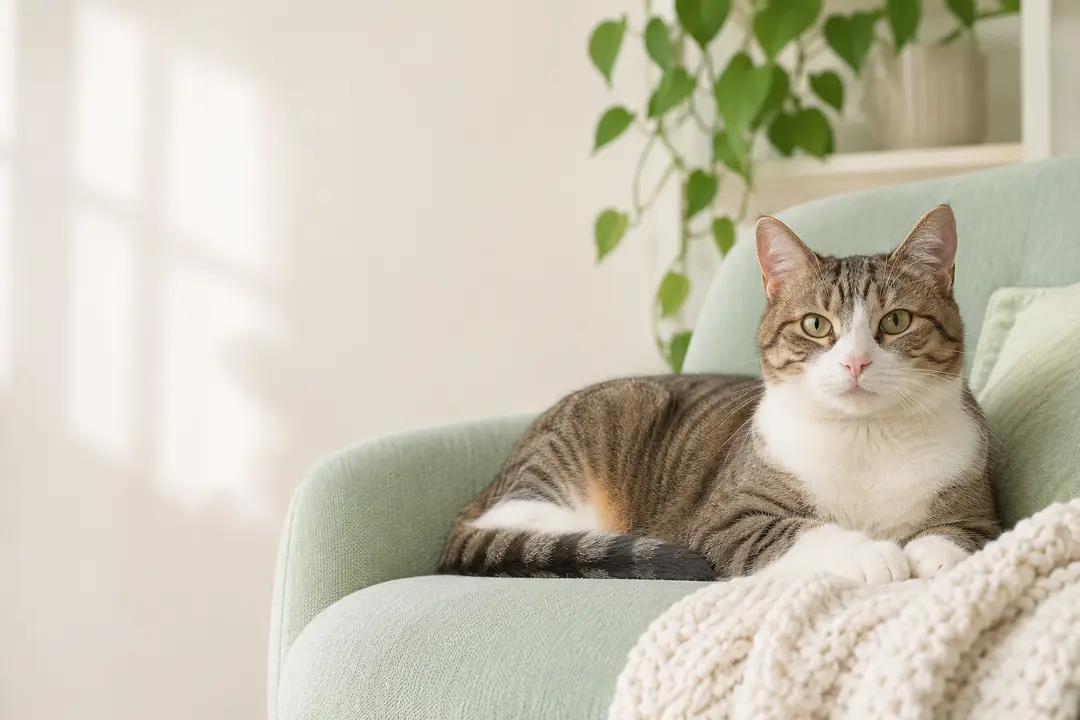
Your cat is kneading, often called “making biscuits.” When your cat chooses your lap and presses their paws into it as if working dough, it can be a way of making friendly contact with you. If you both enjoy it, you can let the moment be exactly that.
What the paw presses tell you
Picture a cat stepping onto your knees while you read. One front paw presses into your jeans, then the other. After a few turns, your cat stops and stays on your lap. You might notice the point of a claw more than anything else, but there are two parts to this encounter: what you felt on your leg and what your cat chose to do. A prick can hurt even when the approach is friendly.
The ASPCA’s feline behavior checklist includes kneading among the ways a cat can initiate friendly contact. The American Veterinary Society of Animal Behavior’s guide to feline affection also describes relaxed lap kneading as consistent with comfort. So if your question is “Does my cat want to be near me?” a cat who comes over, kneads, and stays is giving you a good reason to think the answer is yes. You don’t need to decide exactly what each press means.
Why your lap, and why right before a nap?
Your lap is different from an empty seat in at least one obvious way: you’re there. If your cat crosses the couch to get to you, that choice is part of the answer. And if they press their paws against your legs before lying down, you’ve learned something about their routine. You can recognize “this is what my cat does before resting here” without assuming your knees need to be shaped into a bed.
You may also have heard that a kneading cat is marking you as their own. Cornell’s explanation of scratching discusses scent in the context of scratching. That’s a different action. It doesn’t establish that leaving scent is the purpose of a cat’s lap visit. The clearest answer is the one you can see: your cat had a choice of places to go and picked a spot in contact with you.
How to enjoy the company if kneading hurts
You don’t have to choose between putting up with pain and discouraging your cat from coming near you. It’s reasonable to welcome the visit without offering your legs for the whole of it. Start with what actually bothers you:
- If it’s the sharp contact, you can end lap time at that point. You don’t owe your cat a certain number of turns before you change position. There’s no need to treat the cat as if they’ve done something wrong, either.
- If it’s the pressure, leave room beside you instead. If even a paw resting still on your thigh hurts, covering your skin doesn’t address the part you dislike: the weight on your leg. Sitting side by side gives you another way to enjoy the visit. Let your cat decide whether to stay.
- If it doesn’t hurt, you don’t need to find a substitute. You can carry on reading with your cat on your lap. The goal is for the time together to work for both of you, not for the cat to learn a different greeting.
If your cat also chews whatever is on your knees, don’t offer a favorite throw as a way to keep the cuddle going. Whether the material stays in one piece matters more than whether it keeps claws away from your skin.
What if your cat’s usual kneading changes?
Think about the part that made you take a second look. “My cat has started visiting my lap every evening” describes a change in when you spend time together. “My cat still visits my lap, but today I noticed something different about how they walk” describes a concern beyond lap time. Those are different questions for your veterinarian. There’s no need to count paw presses to explain either one.
If you’re concerned about a change in movement or how your cat responds to ordinary touch, contact your veterinarian and lead with what is different for your cat. The Feline Veterinary Medical Association’s guide for cat owners can help you put such changes into words. Tell the clinic when you first noticed the difference and whether you’ve seen it off your lap as well. You don’t have to handle a paw to test your theory or make the movement happen again. Describing what you’ve already seen is a useful place to start.
Blanket sucking, chewing, and swallowing are different
If your cat uses their mouth as well as their paws, shift your attention from the kneading to the material. If you saw your cat swallow thread or cloth, or think they may have, call your veterinarian now. If your regular clinic cannot assess your cat right away, go to an emergency veterinary hospital for immediate assessment. Don’t wait for your cat to look sick.
A damp spot where your cat held a blanket in their mouth tells you the fabric got wet; it doesn’t show that a piece went down. A strand pulled free from a hem is a different situation. Put material your cat is pulling apart out of reach. Cornell’s guide to destructive chewing discusses limiting access to items cats chew. If fabric chewing keeps happening, ask your vet about the chewing itself rather than looking for a different blanket that would be safe to swallow.
If you find a newly chewed edge with a strip missing, you may not know exactly what happened. Say that when you call. You don’t need to find the strip or prove that your cat ate it before asking for urgent help. Fabric can get stuck in the digestive tract, and swallowed thread can injure the intestine. The American College of Veterinary Surgeons’ guide to swallowed objects and the University of Illinois guide to foreign objects in pets explain why what your cat looks like right now doesn’t settle the question.
What to tell the clinic if material may be missing
Start with the possible swallow, not with the lap kneading. Tell the clinic what the material was, when it could have happened, and what you actually saw. For example, seeing a cat swallow a loose thread is different from finding a gap in a blanket fringe after the cat got up. Either is worth explaining as it happened, without guessing how much went down.
The immediate question for the clinic is whether swallowed material could be causing harm, not why your cat was interested in the blanket. Ask where your cat can be assessed right away. The FDA’s guide to veterinary emergency care identifies an emergency animal hospital as an alternative when your own veterinarian is unavailable. This urgency is about a possible swallowed object; it’s not what an ordinary pair of paws pressing into your lap means.
Talk it through with Vicky
You can tell Vicky what you’re seeing right now, whether you’re curious about a familiar lap greeting or trying to describe a new one. Vicky will bring in Dr. Hana (Virtual DVM, DACVB), our team’s AI veterinary behaviorist, to help you talk through what you’ve noticed. For a possible swallowed thread or piece of fabric, contact your veterinarian or an emergency clinic directly instead.
Common questions
Why does my cat knead one particular blanket but not the others?
If it’s always the same throw, you’ve spotted a preference, but not necessarily its cause. Think about whether your cat also chooses that throw when it’s off your lap. If you’ve only seen the two together, there’s no need to pick between “it’s the blanket” and “it’s me.”
Does kneading mean my cat already feels safe, or are they trying to calm down?
Those are more specific interpretations than the gesture can give you. Kneading during friendly contact is consistent with comfort, but it doesn’t tell you how your cat felt in the moments before they climbed up.
Does making biscuits mean my cat was weaned too early?
Lap kneading isn’t evidence of a particular weaning age. You can recognize it as a friendly gesture today without making assumptions about your cat’s kittenhood.
One of my cats never kneads me. Does that cat like me less?
You don’t need to rank your cats’ affection by their paw presses. Notice how the other cat chooses contact: rubbing against you, reaching out to touch you, or coming to sit beside you can be friendly, too.