How urgently does my cat need a vet if I see blood in the stool but my cat seems fine?
Learn when to call your vet about a red streak in your cat’s poop, which signs need emergency care, and why it matters whether your cat is passing urine.
In this guide (6 sections)
Call your vet today if you see blood in your cat’s stool, even if your cat is eating and playing. One tiny bright-red streak on formed poop does not automatically mean an ER trip in an otherwise healthy adult cat who is comfortable and peeing normally. Go to an emergency veterinary hospital now for heavy bleeding, pale or white gums, collapse, or repeated attempts to pee that produce little or nothing.
One red streak or something more urgent?
The most useful distinction is between a trace on one stool and bleeding that continues or comes with other signs. Your cat’s usual appetite is helpful information, but it doesn’t outweigh what you see in the litter box.
| What you see | What to do |
|---|---|
| One tiny red spot or streak on an otherwise formed stool; your healthy adult cat seems comfortable and is passing urine normally | Call your regular vet today. Ask whether your cat can be watched at home and when the clinic wants an update. |
| Another stool has blood, or there is more blood than before | Contact the clinic now and arrange prompt in-person care for continued bleeding. Don’t keep watching for a third episode. If bleeding is heavy or won’t stop, go directly to the ER. |
| Blood mixed into diarrhea, or black, sticky, tar-like poop | Call a veterinarian immediately, even if this is the first episode. If your regular clinic is closed, call an emergency hospital now for direction rather than waiting until morning. |
| A large amount of blood, pale or white gums, marked weakness, collapse, severe pain, or repeated vomiting along with blood in the stool | Go to an emergency veterinary hospital now. This applies even if the stool itself is firm. |
Preventive Vet’s guide to cat diarrhea distinguishes a small red spot from substantial bleeding or tarry stool. PetMD’s guidance on when to call about diarrhea advises immediate contact for bloody or tarry diarrhea. An immediate call means a vet should help you decide where to go now; it isn’t an instruction to wait for a routine appointment. With heavy bleeding, collapse, or other emergency signs described by Banfield, leave for emergency care rather than waiting for a callback.
If your cat keeps squatting, check whether urine is coming out
Straining to pee can look like straining to poop. Think about the last trip you saw: did this cat pass a usual amount of urine, a few drops, or nothing at all? A piece of hard stool in the box may explain why you first thought of constipation, but it doesn’t tell you whether your cat can pee. In a home with several cats, a urine clump may belong to a different cat.
Repeated trips with little or no urine are an emergency. The urethra, the tube urine passes through to leave the body, may be blocked. Male cats are at higher risk, according to the Cornell Feline Health Center’s guide to urinary tract disease. If your cat keeps trying and you can’t confirm that urine is coming out, go to an emergency veterinary hospital. Tell them, “My cat keeps squatting, and I haven’t seen urine come out.” Don’t wait for the next bowel movement to settle the question.
What the color and texture can tell you
A thin line of fresh red blood on the outside of poop often comes from the colon (large intestine), rectum (the last part of the bowel), or anus. A hard piece of stool can injure small blood vessels as it passes. That makes a small injury one possible explanation, not proof of constipation. Intestinal parasites are another possible cause of bleeding. You can’t choose a treatment from the color alone.
Black, tar-like stool looks different because the blood may have been digested. Instead of a red mark you can pick out on the surface, the stool itself looks black and sticky. PetMD’s guide to blood in cat stool explains the difference between fresh and digested blood. If you aren’t sure which you’re seeing, describe the color and the texture when you call. You don’t have to decide for yourself whether a black stool contains blood before asking for urgent advice.
What to tell the clinic, and what to bring
Lead with the finding that worries you most. “There was one red line on a hard stool this morning” tells the clinic something different from “She’s been to the box four times, and now only blood is coming out.” If there’s an emergency sign, don’t delay leaving to work through a checklist. Otherwise, these details will help your vet decide the next step:
- Describe one bowel movement. Did the poop hold its shape, come out in hard pieces, or spread like liquid? Say whether the blood was a dot on the surface, mixed throughout the poop, or left separately in the box. Mention clots or jelly-like mucus if you saw them. An ordinary description is more useful than a guess at the number of teaspoons.
- Give the pattern. Say when you first noticed blood and how many stools have had it. Count trips to the box separately from stools passed. If you found the stool while scooping and didn’t see your cat pass it, say that rather than guessing whether there was straining.
- Describe your cat, not only the poop. Give your cat’s age, whether they’re eating and moving around as usual, and whether you’ve seen normal urination. Report vomiting, pain, weakness, or a drop in appetite. Flag a young kitten, a very old cat, pregnancy, or an ongoing illness at the start of the call. Don’t assume the monitoring advice for a healthy adult applies in those circumstances.
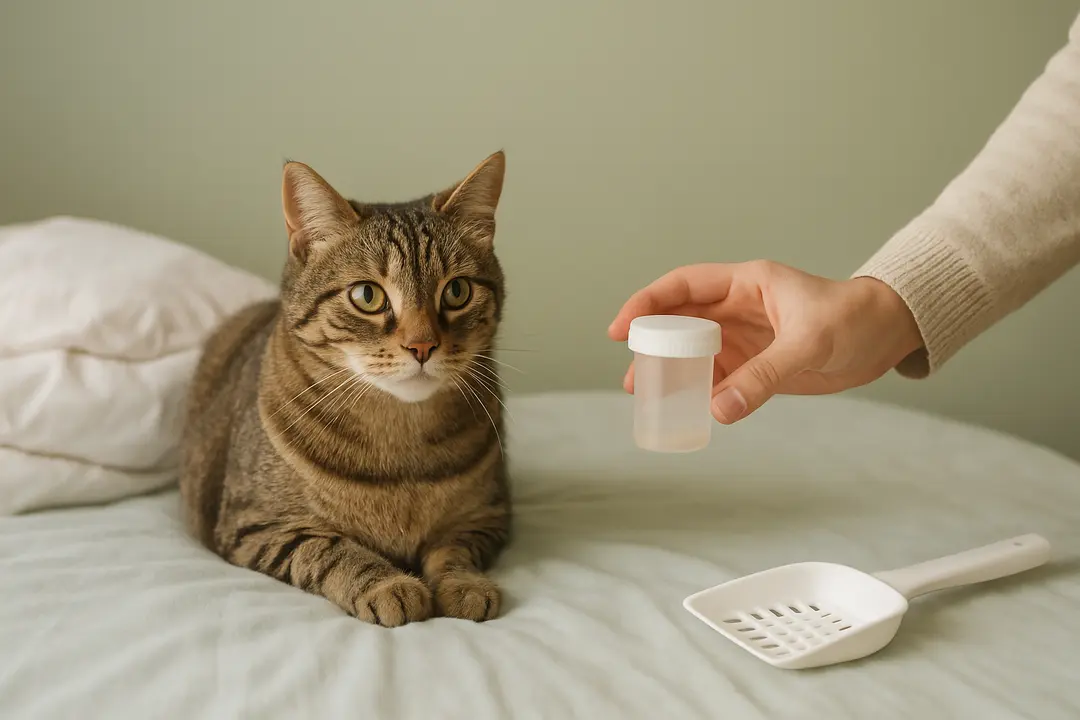
- Offer a photo or fresh stool sample if one is available. Ask how the clinic wants the sample collected and when to bring it. The number of bowel movements, their consistency, and a fresh sample can help the vet investigate, as VCA’s guide to diarrhea in cats explains. If you’ve already cleaned the box, call anyway; the clinic can tell you whether it needs a later sample.
What to watch for if your vet says an exam can wait
For a tiny amount of blood in an otherwise well cat, your vet may advise watching for 24 hours before an appointment, as described in PDSA’s guidance on blood in cat poop. That’s a plan to agree on after you call, not a general rule to wait a day. Before hanging up, ask when to report back and which clinic to use if things change after hours.
At the next bowel movement, note whether the stool is formed and whether you can still see blood. A normal stool and a cat who remains comfortable are useful news for your vet, though they don’t explain the first streak. Follow the agreed plan, including any recommended visit. If you see blood again, the finding is no longer a one-time trace: contact the clinic for prompt assessment rather than finishing the monitoring period. If an emergency sign appears, go directly to the emergency hospital.
Talk it through with Vicky
If you’d like help putting what you saw into words for your clinic, you can tell Vicky what you’re seeing right now. Vicky will bring in Dr. Ravi (Virtual DVM), our feline-friendly general practice veterinarian. If your cat has an emergency sign, go straight to an emergency veterinary hospital; don’t wait for an online reply.
Common questions
I found one tiny streak after my vet closed. Do I need to drive to the ER tonight?
Not necessarily. If it was one trace on formed stool and your otherwise healthy adult cat is comfortable and peeing normally, call your vet’s after-hours service or an emergency clinic and ask whether an exam can wait. If your cat is very young, very old, pregnant, or has a medical condition, say so before assuming the same advice applies.
Is dark-brown poop the same as black tarry stool?
No. Tarry stool looks black rather than brown and has a sticky, tar-like texture. If that fits what you see, or you can’t tell, call a veterinarian now; a photo can help you describe it.
What if my cat passes jelly-like mucus with blood but no poop?
Tell the vet exactly that: passing only blood or bloody mucus is different from leaving a tiny streak on a formed stool. Contact the clinic now for assessment. If your cat keeps squatting and you can’t confirm that they’re peeing, go to an emergency veterinary hospital.
Should I try pumpkin or give my cat medicine while I wait?
Don’t start a home remedy or give human medicine unless your vet directs you to. A red streak doesn’t establish that hard stool caused the bleeding, so ask the clinic what, if anything, your cat should have while awaiting the visit.
Sources
- PDSA — Blood in your cat’s poo
- Preventive Vet — Your Cat Has Diarrhea: What to Do and NOT Do
- Merck Veterinary Manual — When to See a Veterinarian
- VCA Animal Hospitals — First Aid for Bleeding in Cats
- Cornell Feline Health Center — Feline Lower Urinary Tract Disease
- VCA Animal Hospitals — Diarrhea in Cats
- PetMD — Blood in Cat Stool
- PetMD — Cat Diarrhea Treatment: What to Give Cats With Diarrhea
- Banfield Pet Hospital — When to call the vet for a dog or cat: emergency warning signs
- MSPCA-Angell — Urethral Obstruction in Cats
- PetMD — Why Is My Cat Pooping Mucus?
- Alley Cat Allies — How to Help Sick or Injured Cats