
Can pet birds eat rice, and does it matter whether it's cooked or uncooked?
Find out which rice to share with a budgie or cockatiel, how much to offer, and what to do if your bird ate dry grains, seasoned rice, or leftovers.
In this guide (6 sections)
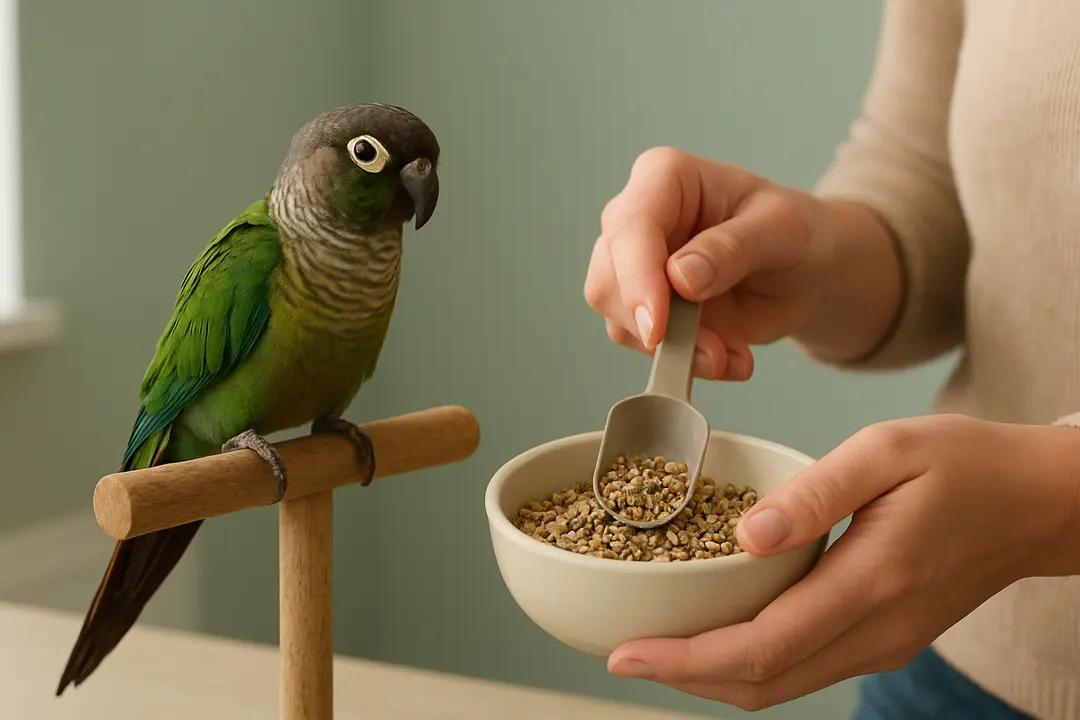
Yes. For a healthy pet parrot, including a budgie or cockatiel, a few grains of plain cooked brown rice can be an occasional taste alongside its usual food. Cooking makes rice softer; it isn't needed to remove a poison from the grain. Some wild parrots eat uncooked rice, but cooked brown rice is the better-supported choice when you're deciding what to put in a pet bird's bowl.
If your bird already ate rice, check what kind
Start with where the rice came from. A dry grain spilled from a pantry bag, a bite from your dinner plate, and a spoonful left in the cage since yesterday call for different decisions. If it came from a prepared dish, check what went into the cooking water as well as what was added at the table.
| What your bird found | What to do |
|---|---|
| A few grains of fresh, plain cooked brown rice | Count them as the treat. Leave your bird's usual balanced food available rather than offering a refill. |
| A few dry grains from a bag of plain rice | Pick up the spill. The dry grain alone is not a reason to assume poisoning. Note how much your bird picked up and how it's acting if you need advice about your particular bird. |
| Rice from takeout, broth, or a seasoned mix | Remove the dish and check the recipe or label. If your bird may have eaten onion or garlic, call your veterinarian or an animal poison service now, even if your bird looks well. |
| Cooked rice left out overnight | Discard it. Don't warm it up to serve again. If your bird already ate it and you need advice, tell your clinic how long it sat out and how your bird is acting. |
If your bird is struggling to breathe, has a seizure, or is unconscious, go directly to an emergency veterinary clinic. Don't stay home looking for the ingredient list first.
Does uncooked rice swell dangerously inside a bird?
The wedding-rice story claims that dry grains swell until a bird's stomach bursts. There's a useful real-world check on that claim: a World Parrot Trust field report describes red-vented cockatoos eating rice from the crop at harvest. Uncooked rice is a food some parrots choose in the wild, not something that has to be boiled before any bird can eat it.
That observation answers a different question from what to feed your budgie. It doesn't tell you how much dry rice suits a small pet bird or establish that every kind of rice, including instant rice, has been tested in cockatiels. If your budgie picked up a couple of plain grains and is acting normally, distinguish that from eating a suspected poison. If you're planning a treat, there's no advantage to testing dry grains: the Best Friends guide to feeding parrots specifically includes cooked brown rice alongside pellets and fresh foods.
How to share rice without replacing your bird's dinner
- Set aside the plain portion first. If you're making brown rice with water, take a few grains for your bird before adding salt, butter, or sauce to your own plate. If you started with broth or a seasoning packet, there's no plain portion to take from that pot. Skip sharing this dish rather than trying to pick out unseasoned-looking grains.
- Scale the taste to the bird. For a budgie, also called a parakeet, think a few grains, not a spoonful because that's what fits on your spoon. Lafeber's advice for a cockatiel that favors rice and pasta is to limit them to a few bites so the bird still eats its balanced food. A few bites is a limit, not an amount your bird needs to finish.
- Watch what gets eaten next. Rice is mostly starch. It can add variety, but it can't do the job of your bird's whole diet. Keep the usual species-appropriate pellets and fresh foods on offer. If the rice disappears and those foods stay in the dish, don't add more rice to get your bird interested in dinner again.
Picture a cockatiel that joins you at dinner and eats every grain you set aside. It's easy to read the empty dish as a reason for another helping, especially when you're pleased your bird has tried a new food. The more useful observation comes after the rice is gone: does your cockatiel go back to its regular meal, or wait for more of yours?
If your otherwise well bird routinely chooses rice over its balanced food, offer less rice or leave it out. This is a good question for a routine appointment with your avian veterinarian. Bring an example of a day's meals that distinguishes what you put in the bowl from what your bird actually ate. A list that says “pellets, vegetables, and rice” means something different if only the rice goes missing.
Why fried rice, onion, and garlic change the answer
Don't share fried rice or rice dressed with soy sauce. The World Parrot Trust's guide to table foods advises against salty, fatty, and fried foods for parrots. That's a reason to choose a different treat. Possible onion or garlic exposure is a reason to act now: both the Trust and the University of Illinois College of Veterinary Medicine identify these ingredients as capable of damaging a bird's red blood cells. Rice cooked in onion or garlic broth is not plain, even if you can't see any pieces in it.
For a suspected exposure, take the food away and call your veterinarian or an animal poison service without waiting for symptoms. Tell them your bird's species, what the dish contained, when your bird ate it, roughly how much is missing, and whether its breathing or behavior has changed. A package or recipe is useful if it's within reach; you don't need an exact grain count before calling.
The ASPCA's poisoning guidance and Pet Poison Helpline's emergency triage advice distinguish calling promptly about a possible exposure from going straight to a clinic for breathing difficulty, seizures, or loss of consciousness. Don't try to make your bird vomit or give a home antidote. Let the veterinarian or poison specialist advise you about the actual ingredients and amount.
How long can cooked rice stay in the cage?
Pick up your bird's serving within 30–60 minutes. That's Lafeber's guidance for perishable foods in the cage. If you offer a taste while you eat, clearing the bird's dish when you clear your plate is a useful reminder. Put away the unserved rice promptly rather than leaving the pot out in case your bird wants more.
The time limit for kitchen leftovers is a separate rule. Utah State University Extension's cooked rice guidance says to discard cooked rice after two hours at room temperature, or one hour if the temperature is above 90°F. Those are discard limits for the household food, not a promise that rice can stay in a bird's bowl for two hours.
Count time before serving, too. If the rice has already sat on the dinner table for two hours, moving a few grains to the cage doesn't give them a fresh 30 minutes. If you find a bowl in the cage the next morning, throw the rice away. Reheating doesn't reliably make improperly stored rice safe again.
Talk it through with Vicky
You can tell Vicky what you're seeing right now: what kind of bird you have, where the rice came from, and what your bird chooses when its usual food is available. Vicky will bring in Dr. Wren (Virtual DVM, DABVP (Avian)), our Avian & Exotics Veterinarian, to help you decide how rice fits into your bird's meals. For a suspected poisoning, contact your veterinarian or an animal poison service first.
Common questions
Is white rice okay for my cockatiel, or should I choose brown rice?
Choose plain cooked brown rice for a planned treat. It's the variety specifically named in parrot feeding guidance; that recommendation doesn't establish a serving recommendation for white rice or mean that white rice is poisonous.
Can I mix rice with chopped vegetables if my parrot picks out only the grains?
You can offer a few grains alongside vegetables, but a bird that picks out only the rice hasn't eaten the vegetables. Try serving them separately so you can see what your parrot chooses without adding more of its favorite food.
My budgie likes rice more than seeds. Can I use it to switch diets?
Treat that interest as one more food your budgie will accept, not as a reason to replace a bowl of seeds with a bowl of rice. If you're changing the main diet, ask your avian veterinarian for a plan based on what your budgie currently eats.
Can I save some of tonight's rice for my bird tomorrow?
Yes, if it's plain cooked brown rice and you promptly refrigerate a separate, unserved portion. Save it from the pot rather than from the cage, and don't keep rice that sat out past the household discard limit.
Sources
- The Best Parrot Diet (and Toxic Foods to Avoid) — Best Friends Animal Society
- Nutrition: Cockatiel Nutrition — Lafeber
- Storing White Rice — Utah State University Extension
- How Long Can Cooked Rice Sit Out? — Utah State University Extension
- Bad for Birds: Prevent Poisoning in Avian Pets — University of Illinois College of Veterinary Medicine
- What to Do if Your Pet Is Poisoned — Pet Poison Helpline
- Budgies, Cockatiels and Lovebirds Are Parrots Too! — Lafeber
- Conservation of the Red-vented Cockatoo — World Parrot Trust
- Don’t Leave These in Your Pet Bird’s Cage — Lafeber
- Human Foods: Are Some Dangerous for Parrots? — World Parrot Trust
- What to Do if Your Pet Is Poisoned — ASPCA Animal Poison Control
- Triaging a Potentially Poisoned Pet at Home — Pet Poison Helpline



