
How does a vet find the cause of my cat’s ear infection and choose the right treatment?
Learn how an ear exam, a swab, and sometimes a culture guide your cat’s treatment, and what to ask if pain or discharge keeps returning in the same ear.
In this guide (7 sections)
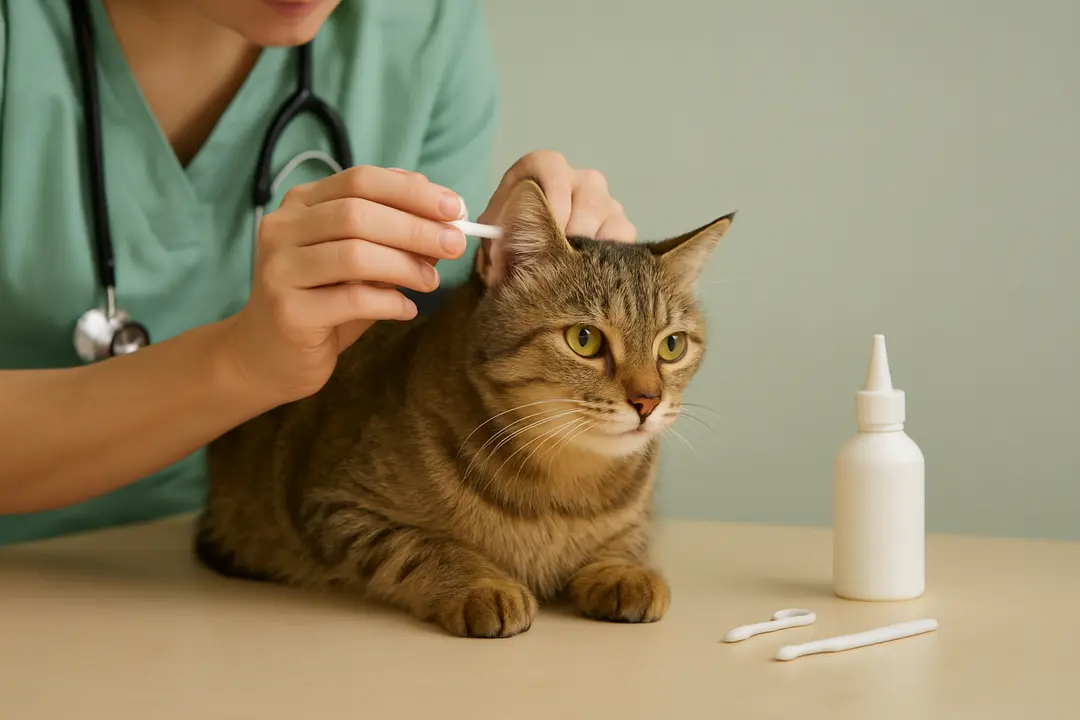
Your vet looks inside your cat’s ear and examines a sample of the debris to answer two questions: What’s bothering the ear now, and why did it start? The sample helps distinguish mites, yeast, and bacteria. The exam can reveal a blockage and helps your vet choose a treatment that’s safe for the eardrum.
When ear symptoms need urgent attention
For scratching, soreness, or discharge, contact your vet for a prompt ear exam. You don’t need to clean the ear or work out what the discharge is before you call. A change in how your cat walks, holds their head, or moves their eyes changes the next step:
- Go directly to an emergency veterinary hospital if your cat collapses or cannot walk. You can call on the way rather than delaying transport, as NC State Veterinary Hospital’s emergency service advises.
- Call your vet or an emergency veterinary service immediately for a sudden head tilt, unsteady walking, falling to one side, or new rhythmic eye movements while the head is still. Call even if the eye movements are the only change and your cat seems comfortable. Tell the clinic what started and whether your cat can stand and walk. Don’t wait for a routine ear appointment.
These signs can come from the balance system in the inner ear or the brain. They aren’t proof that an ear infection has spread. The Cornell Feline Health Center’s guide to balance problems explains why sudden changes need veterinary attention.
What to tell your vet before the ear exam
Dark, crumbly wax can occur with mites, but yeast and bacterial infections can look much the same. Even a careful owner can’t reliably tell them apart by sight. What you can do, without touching a sore ear, is give your vet a useful history:
- Which ear was affected first? Note when you first saw scratching or discharge, whether one or both ears bother your cat now, and whether this has happened before. Discharge that cleared and then returned in the same ear is worth distinguishing from discharge that never went away.
- What went into the ear? Bring the names or photos of any cleaners, mite remedies, or prescription drops you tried. Tell the vet what changed and whether you were able to give the treatment as directed. A medicine that was too painful to give is a different problem from one that didn’t work despite a full course.
- Where else have you noticed itching? Mention if your cat scratches other parts of their body; that may lead the vet to check for allergic skin disease. Also mention other cats or dogs at home with itchy ears. That matters if the vet finds mites.
What the vet looks for in the canal and eardrum
An otoscope is a lighted instrument that lets your vet look down the ear canal. The vet checks for swelling, debris, a foreign object, or a growth. If they describe otitis externa, they mean inflammation of the outer ear canal. That tells you where the problem is, not whether an infection caused it.
A useful question to ask is “Could you see the eardrum?” The eardrum separates the outer canal from the middle ear. If debris hides it, that doesn’t mean it’s torn, but your vet can’t assume it’s intact. Some ear medicines can cause harm if they pass through a tear. That’s one reason not to restart leftover drops, even in the same cat. VCA’s guide to ear infections in cats explains how the exam guides that choice.
If the canal is too sore to examine, or debris blocks the view, your vet may suggest sedation. It lets the vet clean and inspect the ear without making your cat hold still through a painful procedure. What’s behind the debris matters: an object needs to be removed, while evidence of trouble beyond the eardrum calls for an assessment of the middle ear rather than assuming the outer canal is the whole problem.
What an ear swab tells the vet, and when a culture helps
A swab collects the sample. What you learn depends on what the vet does with it. A microscopic check for mites, a stained slide, and a lab culture answer different questions.
| Test | What the vet looks for | How it guides treatment |
|---|---|---|
| Microscopic mite check | Mites in a sample of ear debris | Finding mites points to a cat-safe parasite treatment. Mites don’t rule out a second problem in the same ear. |
| Ear cytology | Yeast, bacterial shapes, and inflammatory cells on a thin, stained smear of debris | The vet can match medicine to yeast, bacteria, or both rather than guessing from the color of the discharge. |
| Bacterial culture and susceptibility test | Which bacteria grow from the sample and which antibiotics are likely to work against them | The result can guide the choice of antibiotic, particularly when a bacterial infection hasn’t responded as expected. |
Cytology can guide the decision at the visit. For example, seeing yeast can explain why an antibiotic alone wouldn’t address the discharge. Seeing bacteria gives your vet a reason to consider an antibiotic, but their shape on a slide doesn’t identify the best one. That’s where a culture can add information. The Clinician’s Brief guide to ear swabs explains what vets can see on a slide and how a repeat sample helps them assess recovery.
How the findings change the treatment plan
Mites need medicine that kills the parasite. Yeast calls for an antifungal, while a bacterial infection may need an antibiotic. Mixed findings may mean treating more than one problem. If your vet also prescribes medicine for inflammation, it serves a different purpose: easing swelling and discomfort while the cause is treated.
Finding yeast or bacteria can explain today’s discharge without explaining why the ear keeps flaring up. Mites can irritate the canal first, for example, with infection developing afterward. If an allergy keeps the ear inflamed, treating the current infection and managing the allergy are separate parts of the plan. The Merck Veterinary Manual’s guide to outer ear inflammation explains this distinction between the trigger and the infection that follows.
Suppose your cat scratches less after treatment, but discharge returns in the same ear. Two useful questions are “What’s on the swab this time?” and “Is anything blocking that canal?” A culture might help the vet change an antibiotic, but it can’t identify a blockage. One possible cause is an inflammatory polyp, a growth that can extend from the middle ear into the canal. Antibiotics may treat bacteria around a polyp, but they won’t remove it. The American College of Veterinary Surgeons’ guide to feline polyps describes how these growths cause ear trouble. Recurrence alone doesn’t mean your cat has one. If the vet finds a persistent blockage on one side, they may recommend a biopsy, which means taking a small piece of tissue to identify it.
How to give treatment at home and check progress
- Write down which ear gets which product. Ask your clinic to show you how to use the dispenser and explain what each medicine does. If your cat pulls away in pain and you can’t give the drops, contact the clinic rather than forcing them. VCA’s instructions for applying ear drops outline the technique.
- Ask whether to clean the ear at all. Cleaning is an individual part of the plan, not an automatic daily task. If your vet wants you to clean at home, ask which cleaner to use and when to use it in relation to the medicine. Don’t chase debris down the canal with a cotton swab or put peroxide or vinegar into a sore ear.
- Agree on a recheck before you leave. Less scratching is encouraging, but it doesn’t tell you what’s happening farther down the canal. Complete the prescribed course even if your cat seems better, as PDSA’s guide to cat ear infections advises. At the recheck, your vet can look again at the canal and eardrum and, if needed, compare a fresh slide with the first one.
If pain or discharge gets worse, or you can’t give the medicine as directed, tell your clinic rather than waiting for the recheck. Say which ear you treated, what you managed to give, and what changed. Those details help your vet decide whether you need help giving the drops, a new sample, or another look inside the ear.
Talk it through with Vicky
You can tell Vicky what you’re seeing right now, including which ear bothers your cat and what your vet found on the exam or swab. Vicky will bring in Dr. Ravi (Virtual DVM), our specialist in feline-friendly general practice, to help you understand the findings and decide what to ask your own vet.
Common questions
If one cat has ear mites, do my other cats or dogs need treatment?
Yes. Ear mites can spread between cats and dogs, so the treatment plan should include the other cats and dogs in the household. Ask your vet which parasite treatment to use for each pet rather than sharing one pet’s medicine.
What if my cat shakes their head right after I give the ear drops?
Follow the directions for the dispenser, massage the base of the ear gently only if your cat tolerates it, then allow your cat to shake their head. If you aren’t sure the drops went into the canal, check with your clinic before giving any more.
What does a negative mite test mean if my cat is still itchy?
It means the vet didn’t see mites in the sample they checked. Ask whether they also examined a stained slide for yeast, bacteria, and inflammatory cells. That’s a different test and may help explain the itching.
Can a photo or video show whether my cat needs mite drops?
A photo can show discharge, and a video can capture scratching or a change in how your cat walks. Neither lets the vet examine debris under a microscope or inspect the eardrum, so appearance alone can’t settle which medicine is appropriate.
How soon should my cat stop scratching after treatment starts?
There isn’t one timetable for every sore ear. Ask your vet what change to expect by the recheck based on what they found in your cat’s canal. If scratching worsens or treatment becomes painful, contact the clinic sooner.
Sources
- Merck Veterinary Manual — Otitis Externa (External Ear Infection) in Cats
- VCA Animal Hospitals — Ear Infections in Cats (Otitis Externa)
- Clinician’s Brief — Ear Swabs: Technique & Interpretation
- PDSA — Ear Mites in Cats and Kittens
- American College of Veterinary Surgeons — Nasopharyngeal Polyps
- PDSA — Ear Infections in Cats
- Vestibular Syndrome — Cornell Feline Health Center
- Nystagmus (Unintentional Eye Movement) in Cats — PetMD
- Emergency and Critical Care — NC State Veterinary Hospital
- Five Reasons to Go to the Animal ER NOW! — Schwarzman Animal Medical Center
- Applying Ear Drops to Cats — VCA Animal Hospitals



