
How can I tell if my kitten has ear mites, and how can a vet confirm it?
Learn which ear changes suggest mites, when a head tilt needs urgent care, and how your vet uses an ear scope and a sample to tell mites from infection.
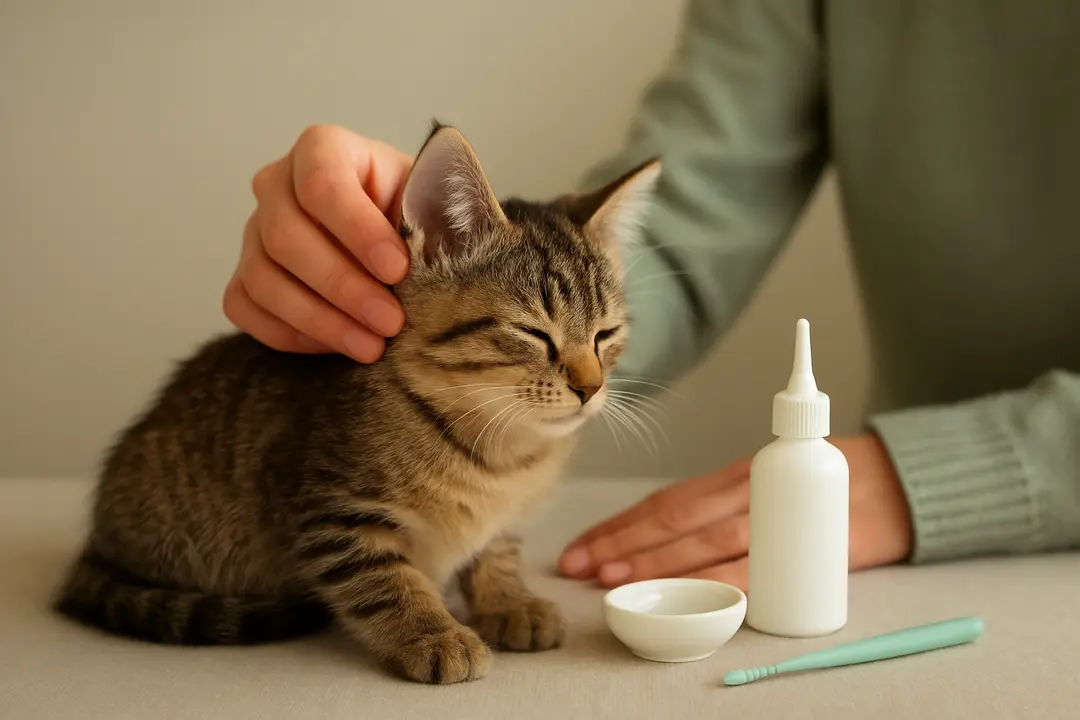
In this guide (7 sections)
Suspect ear mites if your kitten repeatedly scratches its ears or shakes its head and you see dark crumbs that look like coffee grounds. The crumbs are ear debris, not the mites themselves: wax, yeast, and bacterial infections can look much the same. Your vet can confirm mites by seeing one through a lighted ear scope or finding mites or their eggs in a sample of the debris.
Head shaking or a head tilt: when to call
If your kitten’s head stays tilted to one side, or your kitten stumbles or falls, call your vet now. If they can’t assess your kitten promptly, call an emergency veterinary clinic now rather than waiting for a routine ear appointment. A head shake is a brief movement; afterward, your kitten carries its head normally. A persistent tilt is a change in how your kitten holds its head, even while sitting still.
A pronounced tilt or loss of balance can signal a more serious problem than an itchy outer ear. The Cornell Feline Health Center’s guide to balance problems explains why these signs need immediate veterinary attention. Tell the clinic if you also notice the eyes flicking back and forth.
For repeated scratching, head shaking, or unusual discharge without a tilt or balance change, call your regular vet promptly to arrange an ear exam. If the ear seems very painful or the ear flap has swollen, call today and describe the change. PDSA’s guide to ear problems in cats distinguishes these ear changes from signs that may involve the deeper parts of the ear. If your kitten stops eating, call your vet promptly about that too; tell them your kitten’s age and when it last ate rather than assuming the ears explain it.
What dark earwax, scabs, and scratching tell you
Suppose you spot a few brown flecks while your kitten is resting on your lap. A little dark earwax can be normal, as Washington State University’s guide to examining a cat’s ears explains. A few flecks in an ear your kitten leaves alone are different from a buildup of crumbly material in an ear your kitten keeps stopping to scratch. The second pattern is a reason to book an exam, not a reason to buy mite drops.
Look at the skin as well as the debris. Redness inside the flap or scabs around its edge can help explain why your kitten is pawing at the ear. Kittens with mites may scratch hard enough to wound themselves. But an infected ear may also be red, have an unusual odor, or produce dark discharge. Even a sharp close-up photo can’t settle which cause is responsible. These problems can look alike even to a careful owner.
How to check your kitten’s ears before the visit
- Watch your kitten before touching the ears. Notice which side it paws at and whether it interrupts play or rest to scratch. If the movement happens in bursts, a short video can help your vet see what you mean by “shaking.” Don’t wait to record a video if your kitten is tilted or off balance.
- Look only where you can see comfortably. In good light, compare the two ear flaps and the openings to the canals. If your kitten allows it, gently lift each flap and note where you see crumbs, redness, swelling, or scratches. Stop if your kitten pulls away. You don’t need to see the eardrum or collect a sample yourself.
- Leave the ear canal alone. Don’t probe it with a cotton swab or put in oil, cleaner, or ear drops before the exam unless your vet directs you to. Leaving the material in place gives the vet something to inspect and sample. There’s a safety reason, too: VCA’s guide to ear infections in cats notes that some drops are unsafe if the eardrum is damaged.
What to tell the clinic about exposure and ear care
Start with what you actually saw: which ear looks different, when the scratching started, and whether discharge is building up or the skin is getting sore. If you’ve already cleaned the ear or tried a medicine, tell the clinic what you used and when. Have the name of any parasite preventive handy, too.
Mention recent contact with the kitten’s mother, littermates, or other cats and dogs. Kittens can acquire mites from their mother, and a history of close contact is useful even if you don’t know whether the other animal had mites. PetMD’s guide to ear mites in cats explains how that history fits alongside the ear exam. Exposure is a clue; it doesn’t replace finding the parasite.
How the vet confirms ear mites
The vet examines both ears with an otoscope, a lighted instrument for looking down the ear canal. Even if your kitten paws mostly at one ear, mites commonly affect both. The vet looks at the discharge, the skin lining each canal, and the eardrum if it’s visible. That deeper view is something you can’t get by lifting the ear flap at home.
If the vet sees a moving mite through the scope, that can confirm the infestation. A microscope isn’t mandatory in that situation. If the vet sees debris but no identifiable mite, the next useful step is to examine a small sample. There are two different checks a vet can do with ear debris, and they answer different questions:
| Check | What the vet does | What the result means |
|---|---|---|
| Mite check | Mixes a little debris with mineral oil on a slide and looks under low magnification for mites and eggs. | Finding the parasite or its eggs confirms mites. The oil goes on the microscope slide; it isn’t a home ear treatment. |
| Ear cytology | Stains a separate smear of debris and uses higher magnification to look for yeast, bacteria, and cells involved in inflammation. | The findings help the vet decide whether an infection is contributing to the irritation. This isn’t the same test as looking for mites. |
The Clinician’s Brief guide to interpreting ear swabs describes both methods. If you’re told that an ear swab was negative, it’s useful to ask what it was checked for. Not finding a mite in the first sample does not identify the debris as ordinary wax. The vet can use the canal exam and the stained smear to decide what else might explain the signs or whether another look for mites makes sense.
What to watch once you have an answer
Before you leave, ask what the vet found in each ear. Mites and infection aren’t competing diagnoses: bacteria or yeast can grow in an ear already irritated by mites. If both are present, ask how the plan addresses each and when the clinic wants an update. If mites are confirmed, also ask about the pets your kitten spends time with. PDSA’s ear mite guide recommends addressing other household cats and dogs as part of the plan.
At home, track comfort as well as appearance. Is your kitten stopping to scratch less often? Are new scabs forming? Is the discharge building up again? If the itching persists or returns, tell the clinic what changed and which prescribed treatments you were able to give. Continued scratching alone doesn’t tell you that mites survived, so ask about a recheck rather than repeating mite treatment yourself.
Talk it through with Vicky
You can tell Vicky what you’re seeing right now, from dark flecks in one ear to scratching that interrupts play. Vicky will bring in Dr. Ravi (Virtual DVM), our AI specialist in feline-friendly general practice, to help you organize your observations and questions. This is AI guidance, not a visit with a human veterinarian; confirming mites requires your kitten’s ear exam.
Common questions
Could my kitten have mites even if it hardly scratches?
How often your kitten scratches can’t confirm or rule out mites. If ear debris is building up, or a littermate has confirmed mites, tell your vet even if your kitten seems comfortable.
Do my other cat and dog need treatment if their ears look normal?
They may need to be included in the plan if your kitten has confirmed mites. Tell your vet which pets have been in close contact and ask what each one needs; don’t share the kitten’s ear medicine or use earwax color to decide who to treat.
When can my kitten rejoin my other pets after mite treatment?
Ask your vet whether to keep the pets apart and when they can have close contact again under your household’s treatment plan. Cleaner-looking ears alone don’t confirm that the mites are gone.
What if my kitten won’t let me give the prescribed ear drops?
Call the prescribing clinic and explain which part is difficult, such as lifting the flap of a sore ear. Ask for a demonstration and instructions about any treatment you couldn’t give rather than changing the schedule yourself.
If my vet says “otitis externa,” does that mean my kitten has mites?
Not necessarily. Otitis externa means the outer ear canal is inflamed; it tells you where the problem is, not what caused it. Ask whether the vet identified mites, yeast, or bacteria.
Sources
- Washington State University Veterinary Teaching Hospital — Examining and medicating a cat’s ears
- VCA Animal Hospitals — Causes of Ear Mites in Kittens
- VCA Animal Hospitals — Ear Infections in Cats (Otitis Externa)
- Clinician’s Brief — Top 5 Keys to Successful Management of Otitis Externa
- Clinician’s Brief — Ear Swabs: Technique & Interpretation
- Cornell Feline Health Center — Vestibular Syndrome
- Cornell Feline Health Center — Anorexia
- Ear mites in cats: signs, treatment, and prevention — Banfield Pet Hospital
- Ear mites in cats and kittens — PDSA
- Ear Mites in Cats — PetMD
- Ear problems in cats – an overview — PDSA
- Urgent Care for Loss of Appetite — VCA Animal Hospitals



