Why does my cat's eye look swollen, and how quickly does it need to be checked?
Learn when a swollen cat eye needs a same-day exam or an emergency visit, what to do after a chemical splash, and which details to tell your vet.
In this guide (7 sections)
- A swollen lid needs a same-day exam. These signs mean go now
- If a caustic cleaner splashed into the eye, rinse immediately
- How to tell the clinic which part looks swollen
- Common reasons a cat's eye looks swollen
- Protect the eye while you arrange the visit
- What an in-person exam can show that a photo can't
- Talk it through with Vicky
Call your vet today about new eye swelling and ask for a same-day exam. Often it's the eyelid or the pink lining around the eye that has swollen, but a scratch on the eye or a painful change in pressure can look similar. Go to an emergency veterinary hospital now if the eyeball is out of its socket, the eye itself has been badly injured, or your cat suddenly cannot see.
A swollen lid needs a same-day exam. These signs mean go now
| What you notice | Where to go |
|---|---|
| A puffy lid or swollen pink tissue, even if your cat still opens the eye | Call your vet for a same-day exam. Use veterinary urgent care if your clinic can't see your cat. |
| Squinting, holding the eye shut, pawing at it, a cloudy eye surface, or colored discharge | Seek urgent care today. Tell the clinic which of these signs you're seeing when you call. |
| The eyeball suddenly looks larger or sits farther forward | Seek urgent assessment. If it looks out of its socket, or you can't tell whether it's displaced, call an emergency hospital now. |
| An eyeball out of its socket, an object that has pierced the eye, a major injury to the eye itself, or sudden loss of sight | Go to an emergency veterinary hospital now. Don't pull out an embedded object or try to put the eye back in place. |
VCA's eye urgent-care guide distinguishes a swollen lid or sudden bulge from a displaced eyeball or severe trauma. The Merck Veterinary Manual's guide to eye emergencies also identifies sudden vision loss as a threat to sight that needs rapid assessment. If your vet is closed, call an open clinic for direction rather than deciding from a photo that the eye can wait until morning.
Look beyond the eye, too. A sting can cause swelling where it happened. But if your cat's face is swelling and your cat has trouble breathing or collapses, go to an emergency hospital immediately. PDSA's guide to allergic reactions in cats describes these signs. Ohio State's veterinary emergency guide also lists trouble breathing, collapse, and sudden blindness as emergencies. You don't need to have seen a sting or an accident to act.
If a caustic cleaner splashed into the eye, rinse immediately
- Start rinsing now and continue for 15–20 minutes. Use sterile normal saline if it's at hand. Lukewarm running tap water is also suitable; don't spend time looking for saline while the cleaner is still in the eye. ASPCA Poison Control's eye-rinsing guidance explains what to use for a chemical that can burn eye tissue.
- Arrange immediate veterinary care. If someone is with you, have them call your vet while you rinse. After flushing, go directly to a clinic that can examine the eye immediately, or to an emergency hospital if your vet can't. Veterinary Partner's first aid for eye injuries recommends flushing after a chemical splash and seeking immediate attention, not waiting to see whether the eye looks better.
- Identify the product if you can do so without delaying care. Have someone bring the package or take a picture of the label. Tell the clinic or animal poison control service the product name and strength, what got into the eye, what signs you see, and how long you rinsed. This rinse is first aid for a chemical splash, not a home treatment for every puffy lid.
How to tell the clinic which part looks swollen
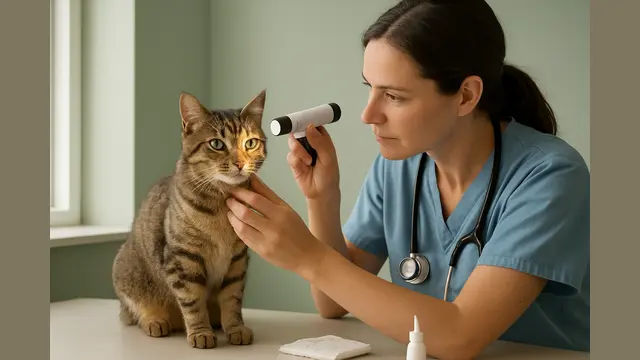
Look at both eyes while your cat is resting. You don't need to touch the eye or open the lids yourself. For example, a cat might wake from a nap with one eye looking smaller than the other. “The upper lid looks thick, but she opens the eye on her own” tells the clinic something different from “I can't see the surface because she keeps squeezing the eye shut.” Both warrant a call today.
- Outer lid: Is the puffiness above the eye, below it, or both? Notice whether it stays around the lid or extends across the face.
- Pink lining or inner corner: The thin pink tissue along the inside of the lids can swell. A pale or pink flap coming across from the corner nearest the nose may be the third eyelid, an extra lid cats have. Describe where the tissue starts rather than trying to move it.
- Front of the eye: If your cat opens the eye, note whether the normally clear surface looks cloudy. If there's fluid at the corner, describe it as watery or give its color. If you can't see the surface, say so.
- Position of the eyeball: A thick lid can narrow the opening around an eye. That's different from the eyeball itself sitting farther forward than the other one. Lead with any sudden change in position when you call.
Common reasons a cat's eye looks swollen
Conjunctivitis, or inflammation of the pink lining, is common in cats. It can make the lining or third eyelid look puffy without the eyeball itself getting bigger. The Cornell Feline Health Center identifies feline herpesvirus as a common infectious cause, but dust and chemical irritation can inflame the same tissue. Pinkness alone doesn't tell you which treatment your cat needs.
Trapped debris, a scratch, or a corneal ulcer can resemble pink eye. The cornea is the clear front surface of the eye; an ulcer is a sore in that surface. Sometimes the clearest sign at home is that your cat won't comfortably open the eye, not a scratch you can see. If you saw a claw catch the eye or saw something fly into it, tell the vet what happened rather than searching under the lid.
Some problems start inside the eye. Inflammation there can look similar from the outside. In cats, it can also be associated with glaucoma, a painful rise in pressure inside the eye that can threaten sight. A puffy lid doesn't establish that the pressure is high, and comparing the two eyes in a photo can't measure it.
Protect the eye while you arrange the visit
If your cat keeps rubbing the eye and you already have a protective cone, use it to keep the paw away. Don't delay a visit to find one. When you speak to the clinic, give the time you first noticed the change, which eye is affected, and whether your cat will open it. Mention any witnessed injury, splash, or sting, and whether the swelling has changed since you first saw it.
Ask your vet before using human eye drops or an ointment left over from a previous visit. In particular, steroid eye medicines can slow repair of the cornea, allow an ulcer to deepen, and aggravate herpesvirus eye disease. The American College of Veterinary Ophthalmologists explains why an ulcer check matters before steroid drops. If you've already put something in the eye, give the clinic its exact name.
What an in-person exam can show that a photo can't
The vet can examine the lids, the lining, and the surface of the eye to locate the problem. Two tests answer different questions:
- Is the surface damaged? A dye called fluorescein highlights breaks in the cornea. As PDSA's guide to corneal ulcers in cats explains, an ulcer can be too subtle to see without dye. The finding matters: treatment can range from prescribed drops to specialist surgery.
- Is the pressure inside the eye too high? The vet can measure eye pressure with a test called tonometry. If the problem is glaucoma, treatment is aimed at lowering that pressure. A surface dye test doesn't give the vet this information.
What to expect over the next few days depends on what the exam shows. Before you leave, ask which part of the eye is affected, how to use any prescribed medicine or cone, and when the vet wants to recheck the eye. Ask what improvement should look like for your cat. If the eye becomes cloudy or your cat starts holding it shut, report the change rather than waiting for the scheduled recheck.
Talk it through with Vicky
You can tell Vicky what you're seeing right now, including which part looks swollen and whether your cat opens the eye. Vicky will bring in Dr. Lena (Virtual DVM, DACVO), our team's AI veterinary ophthalmology specialist, to help you make sense of those observations. Don't wait for an online response before contacting your clinic or leaving for emergency care.
Common questions
Why is only one eye swollen? Could it still be an infection?
Yes. Infectious conjunctivitis can affect one eye or both. Swelling on one side can also come from local irritation, trapped debris, or an injury, so the number of eyes affected doesn't settle the cause.
Can my cat have a scratch or ulcer if there are clear tears but no pus?
Yes. Clear tears don't rule out a break in the cornea. If your cat is squinting or keeping the eye closed, don't wait for colored discharge before seeking an exam.
My cat is sneezing too. Could the eye problem spread to my other cat?
Some causes of conjunctivitis are infectious; irritation from dust or a chemical isn't contagious. Sneezing alone can't tell you the cause. Mention the sneezing and the other cat when you call so your vet can advise you about precautions.
Does colored discharge mean my cat needs antibiotic eye drops?
Color is useful to report, but it doesn't establish a bacterial infection. Viruses, irritation, and injury can cause similar-looking eye problems, so let your vet examine the eye before choosing drops.
Sources
- VCA Animal Hospitals — Urgent Care for Eye Issues
- Merck Veterinary Manual — Overview of Ophthalmic Emergencies in Small Animals
- PDSA — Allergic Reactions in Cats
- ASPCA Poison Control — Vet Tech Corner: Ocular Decontamination
- Cornell Feline Health Center — Conjunctivitis
- PDSA — Corneal Ulcers in Cats
- American College of Veterinary Ophthalmologists — Why Your Cat Should Not Receive Topical Steroid Eye Medication
- Merck Veterinary Manual — Acute Glaucoma in Small Animals
- Ohio State University Veterinary Medical Center — What Constitutes a Pet Emergency?
- Veterinary Partner — Eye Injuries: First Aid
- ASPCA — What to Expect When Calling ASPCA Poison Control
- VCA Animal Hospitals — Conjunctivitis in Cats