What should a pig's eyes normally look like, and which changes should a vet check?
Learn how to spot healthy pig eyes, tell a dry tear stain from fresh drainage, and decide which changes need a vet call or emergency care for your pig.
In this guide (8 sections)
- What healthy pig eyes look like
- Which changes need a vet, and how soon?
- How to clean a dry tear mark without treating the eye
- Why a squint or a cloudy patch matters even without discharge
- What if the eyes look clear but your pig seems unable to see?
- When several pigs have watery eyes
- What to tell the clinic and what to watch next
- Talk it through with Vicky
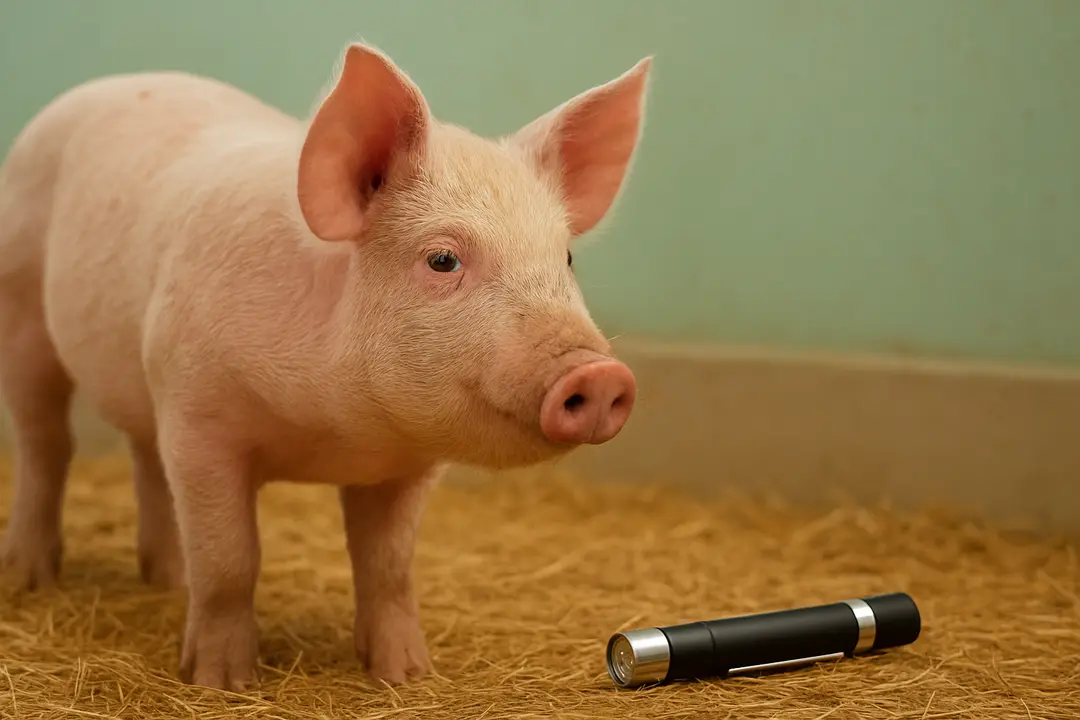
An awake pig should hold both eyes comfortably open; they should look bright and clear, without red, puffy lids or tears running down the face. A little dry residue on the cheek is different from an eye that keeps watering, which you should report to your vet. Call your vet today for squinting, an eye held shut, or new cloudiness; call an emergency veterinarian immediately for a serious eye injury.
What healthy pig eyes look like
Watch your pig during an ordinary activity, such as walking to the feeder. That gives you a chance to see how your pig holds both eyes before you touch the face. The University of Illinois swine health guide describes a healthy pig's eyes as bright and alert, with no redness or swelling of the lids. Look at three places:
- The eye itself. The cornea is the clear front surface. You should be able to see the iris (the colored part) and the pupil (the dark opening in the center) through it. A patch of haze across that view is not the same as a stain below the eye.
- The eyelids. Compare the two sides while your pig is awake. Look for a lid that is newly puffy or red. Notice whether your pig blinks once and looks around again, or repeatedly squeezes one eye shut.
- The cheek. Is there a small, dry mark on the skin, or can you see fresh liquid at the lid and a wet track below it? If both eyes have marks, check each eye separately. One may be watering while the other has only dried residue.
Which changes need a vet, and how soon?
| What you notice | What to do |
|---|---|
| A little familiar, dry residue; both eyes look clear and open comfortably | You can gently clean the surrounding skin. Look for fresh drainage the next time you see your pig. |
| New or persistent watering, repeated rubbing, red or swollen lids, lids sticking together, or yellow, green, or blood-tinged drainage | Call your veterinarian and describe the change. Say whether your pig can open the eye and whether the surface looks clear. |
| Repeated squinting, an eye held shut, or a new cloudy or blue-white patch on the eye | Call your veterinarian today. Don't wait for pus or for the whole eye to turn cloudy. |
| A suspected puncture, another serious injury to the eyeball, or an eyeball pushed out of its socket | Call an emergency veterinarian immediately. Don't stop to clean the eye or try to get a better look first. |
VCA's guide to urgent eye problems flags squinting and cloudiness for urgent care and distinguishes these from severe injuries. The Merck Veterinary Manual's guide to eye emergencies also identifies a cut through the cornea or an eyeball displaced from its socket as an emergency. You don't have to decide how deep an injury is before making the call.
How to clean a dry tear mark without treating the eye
Suppose you notice a brown streak below one eye at feeding time. Before wiping it, look at the upper end of the streak. A dry mark under a comfortable, clear eye may be leftover residue. A fresh tear running over that same mark tells you the eye is watering now. The color of the streak is less useful than that distinction.
For dried residue on the skin, follow the American College of Veterinary Ophthalmologists' eye-cleaning guidance: dampen clean gauze or a clean washcloth with warm water, let the moisture soften the crust, and gently lift it away. The aim is to clean the cheek, not to scrub off every trace of discoloration. Don't wipe the surface of the eyeball or pull stuck lids apart to see underneath.
If fresh liquid appears again, tell the clinic that you saw it return after cleaning. If the lids are stuck together, say that you can't see the eye rather than describing it as clear. Cleaning the skin doesn't treat the reason the eye is draining or painful.
Why a squint or a cloudy patch matters even without discharge
Squinting can be a sign of pain. One possible cause is a corneal ulcer, a wound on the clear front of the eye. A surface wound can cause tearing and cloudiness and can worsen quickly. Your pig doesn't need to have all of those signs for a squint to matter. Conversely, a cloudy patch isn't proof of an ulcer; it tells you where you see a change, not what caused it.
Your vet can examine the surface and, if a wound is suspected, use a dye called fluorescein to show where it is damaged. The American College of Veterinary Ophthalmologists explains how vets find corneal ulcers. This is why a description such as “there's a haze over the colored part” helps the clinic more than a guess that your pig has pinkeye. Don't start leftover eye drops or ointment unless your veterinarian directs you to. If you've already used something, give the clinic its name.
What if the eyes look clear but your pig seems unable to see?
Notice how your pig gets around a familiar pen. Newly bumping into the feeder or having trouble finding a way around a familiar barrier can signal a change in vision, according to Texas A&M's guidance on recognizing impaired sight. You don't need to move things around to test this. What matters is a change in how your pig handles a route it already knows.
If your pig suddenly seems unable to see, call your veterinarian and lead with that change, even if you can't see redness or haze. Describe what happened and when you last saw your pig move around normally. That's more useful than trying to decide on your own whether one eye or both have lost sight.
When several pigs have watery eyes
If you keep a group, your herd vet will want to know whether other pigs show the same change. Count pigs with fresh watering rather than counting every pig with an old cheek stain. Note their ages, which pens they're in, and whether you also see coughing, sneezing, runny noses, or pigs not coming up to eat as usual. If one pig has a serious eye injury, call about that pig first; the pen count can wait.
NADIS describes tear staining alongside respiratory signs in weaned pigs. A stained cheek alone doesn't identify a disease. The useful clue for your vet is the combination: for example, fresh watering in several weaned pigs that are also coughing is a different report from one pig holding one eye shut while its penmates look comfortable.
What to tell the clinic and what to watch next
Start with the finding that prompted the call, then tell the clinic when it began, which eye is affected, and what else you've noticed. If you don't know when it started, give the last time you saw both eyes looking normal. For a group, the American Association of Swine Veterinarians' guide to taking a herd history emphasizes the timing, number of affected pigs, their ages, and other signs.
After the exam, ask what improvement should look like for your pig and when the vet wants to recheck the eye. Track the sign that led you to call: is the eye staying open more comfortably, is there still a cloudy spot, or is fresh fluid still reaching the cheek? A cleaner face doesn't necessarily mean a more comfortable eye. If the squint or haze worsens, let the clinic know rather than waiting for the planned recheck.
Talk it through with Vicky
You can tell Vicky what you're seeing right now, including whether the change is on the cheek, at the lid, or across the eye itself. Vicky, our AI assistant, will bring in Dr. Lena (Virtual DVM, DACVO), our AI specialist in veterinary ophthalmology, to help you sort through those observations. For a painful eye or a suspected serious injury, contact your own veterinarian or emergency clinic directly.
Common questions
My pig is still eating but keeps one eye shut. Can the exam wait?
Call your vet today. Eating tells you about appetite, but it doesn't tell you whether the eye hurts. Mention that your pig keeps the eye closed even while coming up to feed.
Could watery eyes in one pen be from bedding or ventilation rather than contagious pinkeye?
Watery eyes alone can't distinguish a problem in the pen from illness. Tell your herd vet about any recent pen changes, whether pigs in other pens are affected, and whether you also see coughing, runny noses, or reduced appetite.
Does a crusted eye and a runny nose mean my piglet has a cold?
Not necessarily. Eye and nose signs can occur together in weaned pigs with respiratory illness, but they don't identify the cause. Contact your vet about both signs, including whether the lids stick together and whether littermates have similar changes.
Can I tell whether my pig sees past its facial folds?
Looking at the folds alone doesn't show how well your pig sees. Describe any new difficulty getting around familiar objects to your vet, along with whether the lids are more swollen or the eyes harder to see than usual.
Sources
- University of Illinois College of Veterinary Medicine — Swine Biosecurity, Module 1: Swine Diseases
- VCA Animal Hospitals — Urgent Care for Eye Issues
- American College of Veterinary Ophthalmologists — Corneal Ulcers
- Texas A&M Veterinary Medicine & Biomedical Sciences — Be on the Lookout for Vision Impairment in Pets
- Merck Veterinary Manual — Overview of Ophthalmic Emergencies in Small Animals
- NADIS — Porcine Reproductive and Respiratory Syndrome (PRRS) in Weaners
- American Association of Swine Veterinarians — Diagnostic Approach to Respiratory Disease in Swine: A Practitioner’s Perspective
- American College of Veterinary Ophthalmologists — How to Clean Your Pet’s Eyes
- University of Illinois College of Veterinary Medicine — Keeping an Eye Open for Corneal Ulcers
- PDSA — Eye Problems in Pets
- Mississippi State University Extension — Keeping Your Livestock Show Animals Healthy
- American Association of Swine Veterinarians — Diagnostic Approaches to Swine Central Nervous System Disorders: A Practitioner’s Perspective