Why does my cat press its paws back and forth on me or a blanket?
See what lap and blanket kneading can tell you about your cat’s comfort, how to make lap time easier, and when missing fabric means calling a vet right away.
In this guide (6 sections)
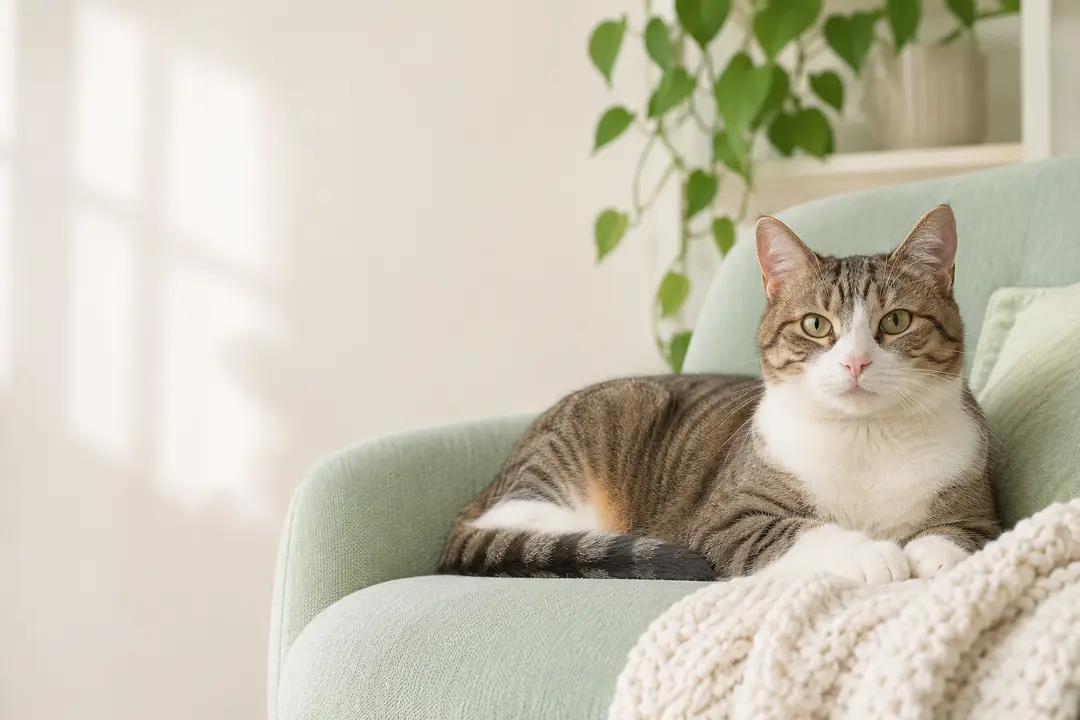
Your cat is kneading, sometimes called “making biscuits.” When your cat presses their paws into your lap or a blanket and looks relaxed, comfort is a good explanation. There’s usually no need to interrupt the paw movement; chewing off or swallowing part of the blanket is a separate concern.
What kneading tells you about your cat
Think of a cat who climbs onto a familiar lap, works their paws against the throw, and curls up there. It’s reasonable to read that scene as a cat getting comfortable. The American Veterinary Society of Animal Behavior’s guide to feline affection connects lap kneading with warmth and comfort. The ASPCA’s guide to cat body postures also includes kneading among the movements you may see in a relaxed cat.
What’s harder to know is whether the appeal is your company, the spot you’re sitting in, or the feel of the throw. Your cat can enjoy resting with you without every press of a paw being a message meant for you. And if those presses are uncomfortable on bare legs, you don’t have to work out your cat’s motive before you offer a different place to sit.
Look at the whole cat, not just the paws
If you’re wondering whether your cat is content or bothered, look at a familiar kneading session in context. Three observations are more useful than counting how many times the paws press down:
- Notice the rest of your cat’s posture. Is your cat resting at ease against you, or do they look tense? Describe what you see rather than deciding in advance that kneading means happiness or stress. A cat looking comfortable while resting on your lap is a better reason to think they’re relaxed than the paw movement alone.
- Look at what the mouth is doing. Pressing paws into cloth is different from gripping an edge with the teeth and tearing it. If both happen together, separate them in your mind: the kneading may be familiar, but the chewing needs its own decision. If you think your cat swallowed thread or fabric, call your veterinarian now.
- Compare this with your cat’s usual routine. Perhaps you’ve seen the same quiet ritual each evening for years. Or perhaps the pawing is new and your cat seems uneasy in a place where they used to rest. Neither the length of one session nor what happens immediately afterward tells you the cause. A change from what’s usual for your cat is the detail worth following up on.
If the claws hurt, keep the company and change the spot
First decide what you actually want to change. If you enjoy having your cat close but don’t like the feeling of claws on your knees, the goal can be “sit beside me” rather than “stop kneading.” You can keep your cat company without making your lap the only place on offer.
Give your cat a choice of resting spots when you sit down. For example, leave the space beside you open rather than waiting until the paws start to hurt and then trying to move your cat. If your cat chooses that space, reward the choice with something they enjoy, such as attention if they welcome it. You don’t need to handle the paws to show your cat where you’d like them to sit.
The Feline Veterinary Medical Association’s guide to unwanted behaviors recommends rewarding an acceptable alternative. That approach gives you a useful measure of success over the next few evenings: can you and your cat spend time together comfortably? Your cat can still knead in their chosen spot. If a particular blanket gets chewed, though, don’t offer that blanket as the alternative.
A wet blanket and a missing thread raise different questions
Imagine picking up the throw afterward and finding a damp corner. The damp spot tells you very little on its own. It doesn’t establish that your cat swallowed cloth, and a blanket that looks intact doesn’t prove that nothing went down. The most useful information is what you saw your cat do and whether you can account for any material they pulled loose.
- You saw paw pressing, not chewing. If your cat looked at ease and you have no reason to suspect swallowing, you can treat this as a question of comfort. You don’t need to take away a favorite resting place because your cat kneads there.
- You saw your cat chewing the fabric. Take the item out of reach. Note whether your cat mouthed the surface or bit through it, and whether a piece of cloth or stitching is missing. The Cornell Feline Health Center’s guide to destructive behavior distinguishes fabric chewing from other behaviors and recommends limiting access to things a cat may chew.
- Your cat may have swallowed some of it. Call your veterinarian now, even if your cat is acting normally. If your regular clinic can’t assess your cat promptly, use an emergency veterinary clinic. You don’t need to find the end of a thread or wait to see whether your cat gets sick before seeking care.
Swallowed material can get stuck in the digestive tract, and string can injure the intestine. The University of Illinois guide to swallowed objects explains why a missing object matters even before illness is obvious. As the American College of Veterinary Surgeons explains about digestive blockages, the signs can vary. Report vomiting, reduced appetite, or a painful belly if you’ve noticed them, but don’t use their absence to rule out a problem.
If thread or ribbon is hanging from your cat’s mouth or anus, don’t pull it. Go to an emergency veterinary clinic now. The visible end may be attached to material caught farther inside. Both the ASPCA Animal Hospital’s advice on protruding ribbon and the University of Illinois emergency guidance on swallowed string warn against tugging, because tension on the string can cause injury.
What to tell your veterinarian if the habit changes
If swallowing isn’t a concern but the behavior has changed or your cat seems anxious, arrange a behavior or health check with your veterinarian. Give the clinic a before-and-now comparison: where your cat used to knead, what looks different, when you first noticed it, and whether teeth as well as paws are involved. Saying that your cat now bites and pulls at the blanket edge gives your vet more to assess than saying your cat is “making biscuits too much.”
For possible swallowing, lead with what may have gone down and when, not with the history of kneading. Tell the clinic whether it was a piece of cloth, loose thread, or ribbon; what you actually saw; and what’s missing. It’s okay if you don’t know the length or amount. That uncertainty is useful to the team assessing your cat for an injury or blockage, and it’s not a reason to put off the call.
Talk it through with Vicky
You can tell Vicky what you’re seeing right now, whether a familiar lap habit has become uncomfortable or you’re unsure how to read your cat’s posture. Vicky will bring in Dr. Hana (Virtual DVM, DACVB), our virtual veterinary behaviorist, to help you think it through. For possible swallowed fabric or string, contact your veterinarian or an emergency clinic first.
Common questions
Does making biscuits mean my cat was taken from their mother too soon?
You can’t tell when your cat was weaned by watching them knead. In an adult resting on your lap, the movement can fit present-day comfort without telling you anything certain about kittenhood.
Why does my cat knead my lap only when I have one particular blanket on it?
You’ve noticed a preference, but not necessarily its cause. If you’re curious whether it’s the spot or the blanket, offer the same blanket beside you and let your cat choose, provided it isn’t something they chew.
Should I worry that my other cat never kneads me?
Kneading is one possible sign of relaxation, not a requirement for it. Look at how that cat normally rests with you rather than using another cat’s habit as a test of trust.
Is my cat trying to mark me or the blanket?
You can’t identify scent-marking as your cat’s intent from the paw movement alone. If your cat is resting at ease, comfort already fits what you’re seeing; you don’t need to assume they’re claiming the spot.
Sources
- American Veterinary Society of Animal Behavior — Unraveling Feline Affection: How to Tell if Your Cat Truly Loves You
- ASPCApro — Feline-ality: Cat Body Postures
- Feline Veterinary Medical Association — Preventing Unwanted Cat Behaviors
- Texas A&M Veterinary Medicine & Biomedical Sciences — Polishing Up On Animal Nail Care
- University of Illinois College of Veterinary Medicine — Help! My Pet Swallowed a —!
- American College of Veterinary Surgeons — Gastrointestinal Foreign Bodies
- ASPCA Animal Hospital — Seasonal Dangers: Chimi’s Close Call with Holiday Ribbon
- Feline Veterinary Medical Association — Training Techniques for Addressing Undesirable Behaviors
- Cornell Feline Health Center — Feline Behavior Problems: Destructive Behavior
- University of Illinois College of Veterinary Medicine — ER Expert Advises on Choking Emergencies
- ASPCA Animal Poison Control Center — My Pet Ate Something! When Should I Seek Help?