How can I tell normal grooming from licking caused by itching or urinary discomfort in my dog?
Compare when your dog licks, what the skin looks like, and how your dog pees to tell normal grooming from discomfort and know when to seek care.
In this guide (6 sections)
Normal grooming is brief: your dog cleans up after peeing or a sandy walk, then leaves the area alone. Repeated licking with scratching or chewing points more toward itch, while genital licking with a change in how your dog pees points more toward urinary discomfort. If your dog keeps trying to pee but produces nothing or only a few drops, go to an emergency veterinarian now.
Does the licking have a natural stopping point?
Look at what happens on either side of the licking. For example, a dog who passes a usual stream of urine, licks the genital area a few times, then goes back to sniffing is showing a common grooming pattern. A dog who comes inside, settles on the rug, then repeatedly gets up to lick the same area is showing a different pattern, even if each bout is short.
The distinction can be hard to spot, even when you know your dog well. Rather than counting licks, ask two questions: Did my dog finish cleaning and move on? Did they come back to that spot when there was no obvious reason to clean it? As VCA’s guide to genital licking explains, licking between bathroom trips deserves more attention than a brief cleanup right after one. Where your dog licks tells you where to look next, but not necessarily what hurts.
If your dog licks their privates, check how they pee
A request to go outside tells you little about whether your dog can pass urine comfortably. If you haven’t seen a problem peeing, go along on a usual bathroom trip and watch. If you’ve already seen repeated unsuccessful attempts, don’t wait for another trip to check again.
- Look for urine, not just the posture. Does your dog pass a stream and walk away, or keep squatting or lifting a leg and pushing without managing a pee? A few drops during repeated straining are not reassuring. The Merck Veterinary Manual’s guide to urinary emergencies identifies this as a possible sign of a blockage. Inability to pass urine needs emergency care, as PDSA’s guide to bladder problems also explains.
- Notice changes even when urine comes out. Your dog may still pass a stream but need to go more often, pee smaller amounts than usual, or seem uncomfortable doing it. Blood in the urine, dribbling, or a new indoor accident in a house-trained dog also warrants a call to your vet. Describe the change in peeing first, then mention the licking.
- Look at the skin your dog is cleaning. If the area is easily visible, note redness, swelling, or discharge. If you notice an unusual odor, say whether you smelled it as your dog peed or noticed it on the skin. It’s useful to tell the clinic if you can’t tell the difference. Sore skin deserves attention even when your dog pees normally; skin that looks normal doesn’t cancel out difficulty peeing.
If your dog licks a paw or patch of skin, start with that spot
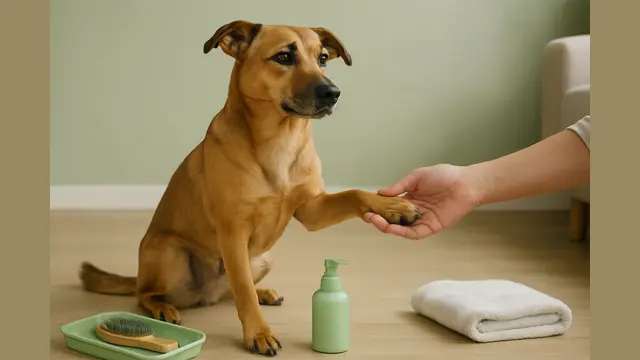
One paw, all of a sudden: A quick cleaning after a dirty walk is different from repeatedly chewing at one toe after the paw is clean. If your dog is comfortable letting you look, check the nails, the pads underneath, and the spaces between the toes. Look for a cut, an injured nail, or something caught against the skin. As the American Kennel Club’s guide to paw licking explains, a sudden focus on one paw can reflect an injury rather than itch. If you find a sore spot, tell your vet exactly where it is.
Licking along with scratching or biting: Watch whether your dog keeps working on one patch or moves among several. An itchy dog may lick instead of scratching, so the absence of scratching doesn’t rule out itch. Look for missing hair, flakes, and inflamed skin. An odor or discharge can accompany a skin infection, but neither tells you on its own what started the problem. The Merck Veterinary Manual’s guide to itching describes these different ways itch can look.
Nothing obvious on the skin: Notice what your dog gives up in order to lick. Briefly cleaning a paw before a nap is one thing; repeatedly waking up to chew it is another. If licking interrupts sleep or play, contact your vet even if you can’t see a cut or rash. You don’t need to wait for a bare patch to appear.
What can you watch at home, and what needs a vet visit?
It’s reasonable to watch brief grooming when your dog stops on their own, leaves the spot alone, and pees, rests, and plays as usual. At the next ordinary walk or rest period, notice whether that still holds. What changes the decision is not one extra lick but a pattern: returning to the same place, struggling to settle, or showing a change in the skin or in how they pee.
Arrange a veterinary assessment if the licking persists, the skin becomes sore, or you see a wound. Repeated licking can itself turn irritated skin into a painful sore, so redness doesn’t always tell you which came first. Don’t cut the fur around inflamed skin with scissors or give human medicine to see whether it helps. Ask your clinic what to do about the sore while arranging the visit. VCA’s first aid guidance for hot spots explains how continued licking can damage the skin.
What to tell your vet and what happens next
For a paw or skin concern, tell the clinic when the licking began, which spot your dog returns to, and whether it interrupts anything. A photo can show how a patch has changed; a short video can show whether your dog is licking, nibbling, or scratching when the behavior doesn’t happen in the exam room. PetMD’s guide to excessive grooming explains why those records can help. There’s no need to make your dog repeat the behavior to capture it.
For a urinary concern, start with the last normal pee you actually saw. Then describe what came out on later attempts, whether your dog strained, and whether you saw blood, leakage, or an accident. If you saw your dog squat but couldn’t see the urine, say that rather than guessing at the amount. Don’t delay emergency care to take a video or keep a log.
Licking, accidents, and frequent small pees can occur with a urinary tract infection, but the signs alone don’t confirm one. Your vet may do a urinalysis, which means testing a urine sample for signs of a problem. A urine culture checks whether bacteria grow from the sample and can guide the choice of antibiotic if one is needed. Cornell’s guide to urinary tract infections in dogs explains what these tests add to what you can see at home.
As you follow your clinic’s advice, track the change that mattered in the first place. For a skin concern, can your dog sleep without chewing, and how does the sore look compared with your first photo? For a urinary concern, are you seeing comfortable pees in your dog’s usual amounts? Less licking is worth reporting, but it isn’t the same as seeing urine pass normally again.
Talk it through with Vicky
You can tell Vicky what you’re seeing right now: where your dog licks, what the licking interrupts, and what happened the last time they peed. Vicky will bring in Dr. Andy (Virtual DVM), our AI specialist in general veterinary practice, to help you sort through those observations. If your dog is repeatedly straining without managing a pee, go directly to an emergency veterinarian.
Common questions
Is it normal for my dog to lick after a bowel movement, too?
A few licks to clean up right after a bowel movement can be normal. If your dog keeps returning to the area between bathroom trips, or you notice swelling, redness, or discharge, tell your vet.
Can my dog have urinary discomfort without crying?
Yes. A change such as straining, passing small amounts more often, or having new accidents matters even if your dog makes no sound. Tell your vet how your dog is peeing rather than waiting for a cry.
Does strong-smelling urine mean my dog needs antibiotics?
Not by itself. An unusual urine odor is worth reporting, but it doesn’t confirm a bacterial infection. Urine testing helps your vet decide whether an antibiotic is appropriate.
Can an antihistamine help me tell if my dog is itchy?
An antihistamine isn’t a reliable test for itch because dogs don’t respond consistently to these medicines. Ask your vet before giving any medicine, including an antihistamine.
Are face rubbing and foot chewing signs of the same itch?
They can be. Itchy dogs may rub their faces as well as lick or chew their feet. Mention both behaviors to your vet rather than assuming the paws are the only area bothering your dog.
Sources
- Why Dogs Lick Their Privates
- Excessive Licking, Chewing, and Grooming in Dogs
- Why Does My Dog Lick Their Paws?
- Itching (Pruritus) in Dogs
- Urinary Tract Infections
- Urinary Tract Infections (UTIs) in Dogs
- Urinary Emergencies in Dogs
- Urine and Bladder Problems in Dogs
- First Aid for Hot Spots in Dogs
- Why Does My Dog Lick Their Crotch?
- Pruritus: Itching and Scratching in Dogs
- Atopic dermatitis (atopy)