
What might a kitten need when it meows, and how should I respond?
Check what your kitten needs at mealtime, on its first night, or while nursing. Learn when to offer food, play, or comfort and when to get veterinary help.
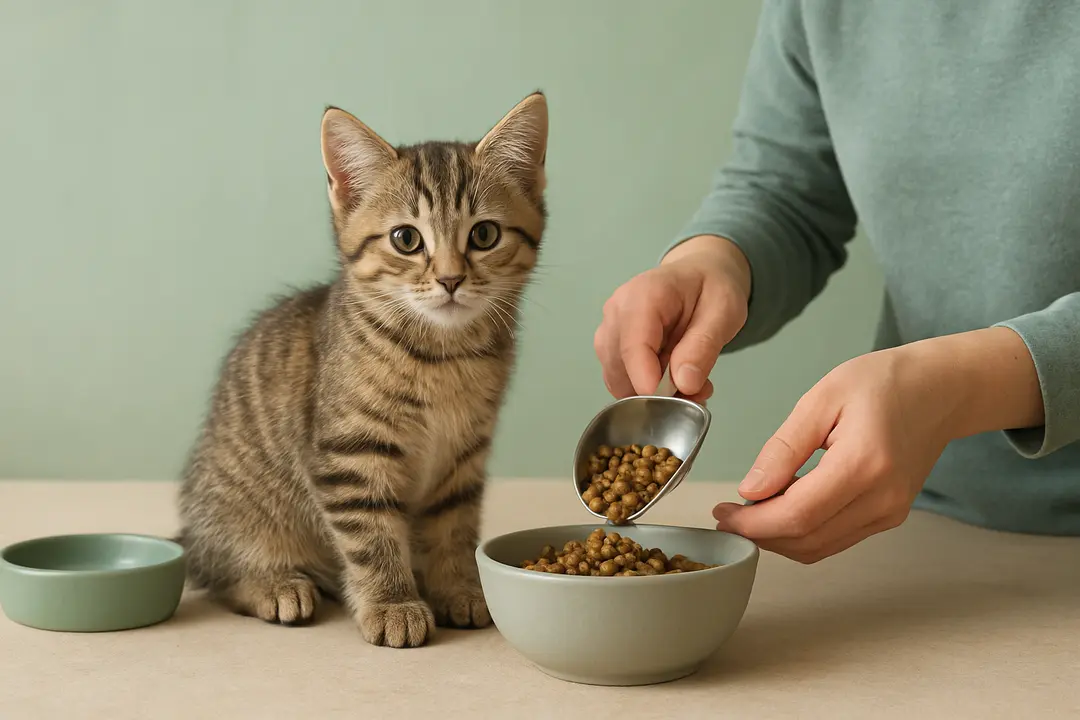
In this guide (7 sections)
- Look at what your kitten is doing, not just how it sounds
- If your kitten cries in the litter box, check whether it can pee
- What to check for a kitten that eats solid food
- How to comfort a meowing kitten on its first night
- A newborn that cries needs warmth and a feeding check
- When the meowing still doesn’t make sense
- Talk it through with Vicky
A kitten may meow to greet you or ask for food, company, or play; a kitten that still needs milk may be calling for warmth or help nursing. Look at where your kitten is, what happened just before the meow, and what it does next. Two situations need action now: repeated straining with little or no urine means an emergency vet visit, and a cold, persistently crying, or poorly nursing newborn needs urgent veterinary help.
Look at what your kitten is doing, not just how it sounds
You may recognize the sound your kitten makes when you get its food ready. But sound alone isn’t reliable for telling an ordinary request from pain or distress. VCA’s guide to kitten yowling recommends looking at body language and the setting. Does your kitten walk toward the bowl, bring you a toy, stay back when you reach for it, or keep returning to the litter box?
Imagine a newly weaned kitten spending its first evening in your kitchen. It has eaten, but it calls from the doorway when you leave. When you sit on the floor, it walks past the food and curls up beside you. That choice tells you more than the volume of the cry: quiet company makes sense here. If the same kitten later cries while squatting in the litter box, pay attention to the squatting rather than assuming it wants company again.
If your kitten cries in the litter box, check whether it can pee
Go to an emergency veterinarian now if your kitten repeatedly strains and produces only drops or no urine. If you see repeated straining but can’t confirm that urine is coming out, that’s enough to act. Don’t wait for a louder cry, another trip to the box, or for your kitten to look ill.
Straining to pee can look like straining to poop. You don’t have to tell the difference at home. As the Cornell Feline Health Center explains, the tube that carries urine out of the body can become blocked. The emergency clinic can check for a blockage and treat it if needed. Tell them what you saw: how often your kitten tried, whether you saw any urine come out, and the last time you know it peed normally. It’s okay if you don’t know that last detail.
What to check for a kitten that eats solid food
If your kitten is alert and isn’t straining, start with the things it can reach from where it is. Food, water, or a litter box on the other side of a closed door won’t help a kitten spending the night in one room.
- Check the meal, not just the bowl. When did you last see your kitten eat its kitten food? If a meal is due, offer it. If someone else fed the kitten, ask whether they saw it eat or only put food down. A regular meal schedule helps you answer that question without offering more food every time your kitten calls.
- Look at the room from the kitten’s level. Make sure it can reach fresh water, get into a clean litter box, and find a warm, quiet place to rest. Check with the doors in the positions they’ll be in when you leave. If the kitten walks toward something, see whether it can actually get there.
- Let your kitten show you what kind of attention it wants. Sit nearby. A kitten that approaches and lies down beside you may want your presence more than a game. If it’s alert and interested in a toy, offer some play together. If it backs away from your hand, stop reaching and let it choose whether to come closer.
- Notice what happens afterward. Does your kitten eat, play, or rest and then return to its usual activities? That gives you a clue for next time. If it leaves a meal untouched and keeps crying, that’s a different observation from finishing dinner and meowing when you walk out. Don’t keep offering food as a test when the crying remains unexplained.
How to comfort a meowing kitten on its first night
It’s common to wonder whether going back to a new kitten will teach it to cry. You can check on it without turning every call into a meal or a game. Start with a quiet room and keep the essentials easy to find. Cats Protection’s first-night advice is to get down to the cat’s level and let it approach. Sitting beside a hiding place offers company; reaching into it to pull the kitten out for a cuddle takes away its choice.
If the kitten settles while you’re there, quiet company is a reasonable response. You don’t have to keep it awake to comfort it. If it stays back, give it space. And if it keeps crying even with you beside it, reconsider the idea that being alone explains the sound.
Over the next few days, make time for attention before your kitten has to ask. For example, offer a game while it’s awake and quiet, or sit down for a visit when it isn’t calling from the doorway. The San Francisco SPCA’s guidance on meowing recommends regular play and attention during quiet moments once a cat’s needs are met. There’s no need to scold a kitten for calling. The goal is a routine you both recognize, not a silent kitten.
A newborn that cries needs warmth and a feeding check
For a kitten that still depends on milk, check two things together: Does it feel warm, and is it actually nursing? Being tucked beside its mother isn’t the same as getting a feed. Watch the individual kitten rather than assuming it nursed because the rest of the litter did. VCA’s guide to raising kittens advises checking warmth and frequent nursing and getting a kitten examined as soon as possible for excessive crying.
Call your veterinarian or an emergency veterinary clinic now if a newborn feels cold, is too weak to nurse, refuses a feed, or cries continuously. Don’t wait for the next scheduled feeding or a routine appointment. Cats Protection’s hand-rearing guide explains that a milk-dependent kitten has little energy in reserve. PetMD’s guide to illness before weaning also identifies coldness, ineffective nursing, weakness, and continuous distress cries as reasons for immediate help.
If the kitten feels cold, offer gentle warmth, such as holding it against your body, while arranging care. Don’t try to bottle-feed a chilled kitten first. Alley Cat Allies’ newborn kitten care guide cautions against feeding a cold kitten. Tell the clinic whether the mother is present, whether the kitten feels cold, and when you last saw that kitten nurse or take milk. If you didn’t see a feed, say so rather than guessing.
When the meowing still doesn’t make sense
Call your veterinarian if the crying is new and unexplained, persists after you’ve checked the basics, or keeps happening during the same activity. You don’t need to decide whether your kitten is in pain before calling. An exam gives your vet a chance to look for discomfort or illness rather than assuming the crying is a behavior problem.
A short account is more useful than trying to imitate the meow. Give your kitten’s age, whether it eats solid food or still needs milk, and what it was doing when the crying started. Mention changes in appetite, energy, or litter-box use, as well as any vomiting or diarrhea. For a kitten that settles and returns to its usual routine, noting what helped gives you a point of comparison if the pattern changes.
Talk it through with Vicky
For help understanding an everyday meowing pattern, tell Vicky what you’re seeing right now. Include where your kitten calls and what it does when you approach. Vicky will bring in Dr. Hana (Virtual DVM, DACVB), our veterinary behaviorist, to help you choose a response. For urgent signs, contact your own veterinarian or an emergency clinic directly.
Common questions
My kitten meows when I come home and then walks away. Did it need something?
A meow can be a greeting. If your kitten greets you and goes back to its usual activity, you don’t need to follow it with food or pick it up.
Does crying when I leave the room mean my kitten has separation anxiety?
Not by itself. A kitten settling into a new home may want company. Notice whether it chooses to rest near you when you return and whether it also cries when you’re already there.
Can I tell a playful meow from a painful one by its pitch?
Pitch isn’t a reliable test for pain. Bringing you a toy and starting a game points toward play; crying repeatedly while trying to do something, such as pee, is a reason to pay attention to that action rather than the sound.
My cats share a litter box. Should I wait to find out which one peed?
No. If your kitten repeatedly strains and you can’t confirm that it’s passing urine, go to an emergency veterinarian now. A clump from another cat doesn’t rule out a blockage in your kitten; don’t wait to identify the clump or decide whether the straining is constipation.
Sources
- Why is my kitten yowling so much? — VCA Animal Hospitals
- Why do cats meow? — VCA Animal Hospitals
- What to expect on the first night with your new cat — Cats Protection
- Raising Kittens — VCA Animal Hospitals
- What to do when your kitten has diarrhea — VCA Animal Hospitals
- Dyspnea (Difficulty Breathing) — Cornell Feline Health Center
- Feline Lower Urinary Tract Disease — Cornell Feline Health Center
- Urethral Obstruction in Cats — MSPCA-Angell
- Excessive Meowing — San Francisco SPCA
- Fading Kitten Syndrome: Signs and When to Get Help — PetMD
- Hand-rearing kittens — Cats Protection
- Caring for Neonatal Kittens — Alley Cat Allies



