Why does my cat or kitten keep meowing, and how can I tell what they need?
Use your cat’s usual routine, body language, and litter box habits to tell a request for food or company from signs that your cat or kitten needs a vet.
In this guide (6 sections)
A familiar meow may be a greeting or a request for food, access, play, or company. To work out which, start with what’s normal for your cat, watch where they go, and see what they do next. If your cat keeps squatting or straining to pee but passes only drops or no urine, go to an emergency vet now.
Meowing at the litter box: check whether urine comes out
A cat standing at a closed door to the litter box may be asking you to open it. A cat getting into position to pee, straining, stepping out, and trying again is showing you something different. What matters is whether that cat can pass urine, not how loudly they cry.
Repeated attempts that produce little or nothing can mean a urinary blockage. A few drops do not make it safe to wait. Cornell’s guide to feline urinary problems explains why a suspected blockage needs immediate treatment. Straining to pee can look like straining to pass stool, as the Schwarzman Animal Medical Center’s guide to urinary blockage points out. If your cat keeps trying and you can’t tell which it is, don’t assume constipation. Tell the emergency clinic what you saw rather than waiting for another attempt.
If you saw your cat pass their usual amount of urine without straining, check that the box is clean and easy to reach. That may explain why a cat hesitates to enter. It doesn’t explain new, repeated cries while using the box; arrange an exam if that’s happening.
How to tell what your cat is asking for
You don’t need to learn a different sound for every need. A normally talkative cat greeting you at the door with soft eyes and an upright tail gives you one set of clues. A usually quiet cat making the same sound while hiding or moving stiffly gives you another. For a cat that isn’t showing an urgent sign, follow one bout of meowing from start to finish:
- Notice what happened just before the first meow. Did you come home, shut a door, stop playing, or walk toward the kitchen near mealtime? Check whether the usual meal is due and whether fresh water and the litter box are available. Don’t assume that because your cat found you in the kitchen, the request is for food.
- Watch where your cat goes. Give them a chance to lead. A relaxed cat that walks to a toy and looks back gives you a reason to offer play. A cat that follows you to your chair and settles beside you may have wanted company. Flattened ears, hiding, or guarded movement can mean stress or discomfort; those are reasons to look beyond a request for attention.
- Try the response that fits. Open the way to the box, serve a meal that’s due, or spend a few minutes together. Notice what your cat does with the opportunity. Walking through the door and using the box tells you more than a brief pause in the noise. If the calling continues, don’t keep offering food to test whether hunger is the cause.
- Compare today with the usual pattern. A move, a new person at home, or a change in your schedule can change when your cat seeks you out. But a change at home doesn’t rule out pain or illness. VCA’s guide to unusual vocalizing recommends an exam when the calling is out of character. If it’s new, persistent, or unexplained, call your vet rather than treating it as a habit to break.
A crying newborn needs a different response from a weaned kitten
For a kitten still nursing, watch a feed, not just the spot where the kitten is lying. Being beside the mother doesn’t tell you that the kitten is getting milk. A newborn that nurses well will usually settle and sleep between feeds. One that repeatedly searches for a nipple, sucks weakly, and keeps crying may be getting too little milk or may be unwell. Cats Protection’s kitten care guide describes the difference. You don’t need to wait through another feed if the kitten already looks sick.
Call your vet right away about a persistently crying newborn and ask where the kitten can be examined. If the kitten is weak, feels cold, or cannot nurse, seek in-person veterinary help now. If your regular clinic can’t see the kitten promptly, go to an emergency vet. Tell them when you last saw the kitten nurse well. PetMD’s guide to signs of illness in newborn kittens explains how quickly a sick kitten can decline. If you found the kitten outside, advice to watch for the mother applies to healthy kittens. Best Friends’ guide for found kittens directs finders to get help for a visibly sick or injured kitten rather than leaving it to wait.
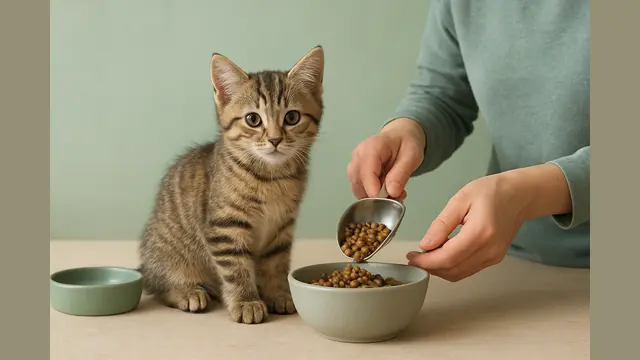
For a newly adopted, weaned kitten—one already eating kitten food without nursing—consider what the room feels like from the kitten’s point of view. Even the route from the bed to the box may be unfamiliar. Set up a quiet starter room with food, fresh water, and a litter box the kitten can step into easily. A towel carrying a familiar scent can help make the space less strange. Let the kitten explore more of the home gradually.
Suppose your new kitten eats, uses the box, and rests while you read nearby, then cries when you leave at bedtime. It’s reasonable to go back and sit quietly. See whether the kitten chooses to join you and settles again. That’s a clue that company helps, not a reason to assume every cry is loneliness. If the kitten keeps crying even with you there, or the behavior is otherwise unusual, describe it to your vet.
Why your cat wakes you before breakfast
A predictable dawn wake-up can develop in a careful household. Think about what your cat gets when you get out of bed: even if breakfast comes from a feeder later, the meow may have brought you into the room. For a healthy adult cat whose needs are met, it helps to separate when food arrives from when you give attention.
- Give meals and play their own times. A timed feeder can serve a portion of the usual food without requiring you to get up. Schedule play at a time you can keep, rather than starting a game in response to the first morning call.
- Choose a quiet pause for attention. If this is a familiar habit and you’ve ruled out distress or an unmet need, greet or pet your cat during a break in the meowing. The goal is to reward the quiet moment, not to ignore all communication.
The San Francisco SPCA’s guidance on early-morning meowing supports scheduled play, timed feeding, and attention during quiet pauses. Over the next few mornings, watch whether your cat goes to the feeder and settles or eats and then comes looking for you. That distinction is more useful than counting meows. If a familiar breakfast call turns into calling throughout the day, reconsider the cause rather than waiting longer for quiet.
When an older cat starts yowling at night
An older cat that used to sleep through the night but now wanders from room to room crying needs a veterinary appointment, not a new breakfast routine. Age-related changes in thinking and awareness, called cognitive decline, can cause nighttime wandering and calling. The sound alone can’t tell you that’s the reason. Pain, thyroid disease, and kidney problems are also possible explanations for unusual vocalizing.
Look at the daytime picture. Is your cat still eager for meals but losing weight? Are you filling the water bowl more often and seeing more urine in the box? VCA’s senior cat guide notes that increased drinking and urination can accompany kidney disease. Passing more urine overall is different from making repeated attempts that produce only drops; the latter is the emergency sign.
When you call your clinic, start with what changed and when. Describe where your cat goes at night, how they move, and whether they settle when they find you. Mention differences in weight, appetite, drinking, or litter box use, even if they didn’t start on the same night as the crying. Your vet can use those observations and a physical exam to decide what to investigate. You don’t need to work out the diagnosis before making the appointment.
Talk it through with Vicky
For help making sense of a nonurgent pattern, you can tell Vicky what you’re seeing right now. Include your cat’s age, where the meowing starts, and what happens next. Vicky, our AI assistant, will bring in Dr. Ravi (Virtual DVM), our AI specialist in feline-friendly general practice, to help you sort through those clues.
Common questions
My cat keeps meowing after being fed. Does that mean the meal wasn’t enough?
Not necessarily. Meowing isn’t a measure of how much food your cat needs; notice whether they return to the bowl or lead you somewhere else. If your cat is eating eagerly but losing weight, tell your vet rather than assuming a larger meal is the answer.
There’s urine in our shared litter box. Could the cat that’s crying still be blocked?
Yes. A wet spot could be from another cat. If the cat you’re watching repeatedly strains and passes only drops or no visible urine, go to an emergency vet now.
Can a female cat have a urinary blockage, too?
Yes. Blockage is more common in males, but females can also be affected. Repeated attempts to pee with little or nothing coming out are an emergency in either sex.
My new kitten hides and meows. Should I bring them out to comfort them?
For an otherwise well, weaned kitten, offer company without making them come out. Sit quietly in the starter room, keep food, water, and the box within reach, and let the kitten approach and explore at their own pace.
My newborn kitten feels warm but won’t stop crying. Does warmth mean they’re okay?
No. Warmth alone doesn’t tell you that a kitten is getting enough milk or is well. Call your vet right away about persistent crying and say whether you’ve seen the kitten suck strongly and settle after nursing.
Sources
- Feline Lower Urinary Tract Disease — Cornell Feline Health Center
- Urethral Obstruction in Cats — Schwarzman Animal Medical Center
- Litter Box Problems — ASPCA
- Raising Kittens — VCA Animal Hospitals
- Fading Kitten Syndrome: Signs and When to Get Help — PetMD
- Helping Senior Cats Age Gracefully — VCA Animal Hospitals
- Excessive Meowing — San Francisco SPCA
- The Cat’s Meow! Caterwauling in Cats — VCA Animal Hospitals
- Cat Body Language — Cats Protection
- Found a Kitten? Here’s What to Do Right Now — Best Friends Animal Society
- Kitten Care — Cats Protection
- Bringing Home Your New Kitten — VCA Animal Hospitals