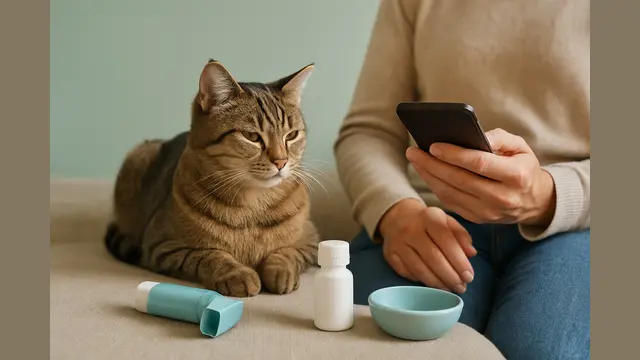
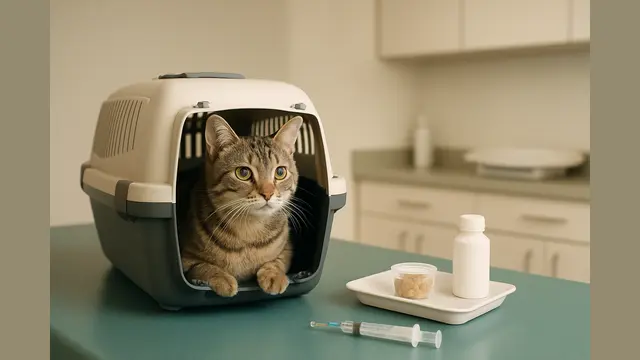
Why is my cat's lip swollen, and when does the swelling need urgent care?
Check which breathing and swallowing changes mean emergency care, what a swollen upper or lower lip can tell you, and what to report to your cat’s vet.
In this guide (7 sections)
A sting, an allergy-related sore, chin acne, a bite wound, or an infected tooth can all make your cat’s lip swell. Go to an emergency vet now if your cat is struggling to breathe, cannot swallow water or saliva, has pale or blue gums, or collapses. A small, unchanged spot in a cat that breathes, swallows, and eats comfortably can usually be assessed by your regular vet, unless you suspect a harmful exposure.
When a swollen lip means an emergency
Watch your cat at rest without lifting the lip. Breathing through an open mouth or using the whole body to draw each breath means go now. You do not need to see inside the mouth or check gum color before leaving. If the gums are already visible and look pale or blue, that is also an emergency sign.
Swallowing is a separate check from breathing. A cat may want a drink, go to the bowl, and still be unable to swallow. If you see that happen, or saliva is pooling or spilling out because your cat cannot swallow it, leave for the emergency clinic even if breathing still looks normal. Do not offer more water to test it or try to look down the throat. As the Merck Veterinary Manual explains in its guide to throat inflammation in cats, swelling that interferes with swallowing can also narrow the airway.
Three exposures that change what to do
- A bee or wasp sting: A sting on the outside of the lip can cause a bump within minutes. If you think your cat was stung inside the mouth or throat, call an emergency vet now, before breathing changes. If swelling is spreading rapidly from the sting across the muzzle or face, go directly to the clinic. Battersea’s guide to stings in cats explains why the location and spread matter more than the size of the first bump.
- A bite on a live electrical cord: Seek emergency veterinary care even if your cat is alert and the lip has only a small burn. A shock can injure more than the mouth: fluid can build up in the lungs hours later. Normal breathing right after the bite does not rule that out. The Merck Veterinary Manual’s electrical injury guide describes this risk.
- A possible poison: If the swelling followed chewing a possibly toxic plant or contact with a household chemical, call your vet or an animal poison control service now. Do not wait for other symptoms, give a home remedy, or make your cat vomit unless a vet directs you to. Save the label or packaging if available. If your cat has trouble breathing, cannot swallow, or loses consciousness, go directly to the emergency clinic. The ASPCA’s poisoning guidance explains what information helps identify an exposure.
When to call your regular vet
Call your clinic today if the swelling is increasing, your cat seems painful or unusually tired, or you notice substantial drooling, bleeding, pus, foul breath, or refusal of food or water. Tell the clinic whether your cat is turning away from the bowl or is trying and failing to swallow. The first needs prompt attention; the second is an emergency.
If you find a small, stable swelling and your cat is otherwise comfortable, call your regular clinic when it opens to book an exam. There is no single safe rule to “wait two days” for a swollen lip. A photo can help you track a new lump while you wait for the appointment, but it cannot tell you what the lump is. Call back if it grows, opens, bleeds, or starts to affect eating.
What the location and timing can tell you
A raw spot on the upper lip. A shallow sore along one or both sides of the upper lip can be an indolent ulcer, sometimes called a rodent ulcer. It is one form of allergy-related inflammation in cats. Its position is useful to your vet, but it does not identify a particular allergy or prove that the spot is an ulcer. The Merck guide to these inflammatory skin conditions explains why a sore that damages the lip or persists despite treatment may need closer investigation.
A puffy lower lip with black dots or pimples on the chin. Several small blackheads or raised spots on the skin below the lip can point to feline acne. That looks different from a single lump under smooth skin, so describe which you see rather than assuming any swollen bottom lip is acne. Do not squeeze the bumps or apply human acne medicine. Texas A&M’s feline acne guide notes that squeezing can hurt and spread infection, and products meant for people can harm cats.
Swelling on one side with a change in chewing. A tooth or gum problem can make the cheek or muzzle look puffy even when the lip itself has no obvious sore. Bad breath, drooling, bleeding gums, or chewing mostly on one side are clues. Cats can hide dental pain, so this is an easy change to miss, even for a careful owner. How your cat ate breakfast can be more useful to the clinic than whether the bowl ended up empty.
A tender lump that appears days after a possible bite. A bite abscess is a pocket of infection under the skin. It can take two to four days to become noticeable, so think back beyond the day you first saw the swelling. An abscess may open and drain, leaving the cheek looking smaller. Tell the vet about both the original lump and the drainage: a smaller lump does not establish that the infection has cleared.
What to check without touching the sore
If your cat is comfortable and has no emergency signs, these details can help your clinic decide what to check first:
- Record the starting point. Note when the lip last looked normal and where you first saw the change. A front or side photo in good light can show whether a spot has stayed at the lip edge or spread toward the cheek. Take only the view your cat allows without handling the sore.
- Describe the last meal or drink you saw. Report one-sided chewing, walking away from food, or drool you would not normally see. If you have not seen your cat drink since you noticed the swelling, say so rather than offering water as a test.
- Separate what you saw from what you suspect. Seeing your cat chase a wasp is different from seeing it enter the mouth. A possible fight several days ago is worth mentioning even if you never saw a bite. Give the clinic that sequence along with any change in energy or appetite. Skip the notes and photos if your cat needs emergency care.
What the vet can find out and what to watch next
Your vet can examine the lips, chin, teeth, and gums together. If the swelling appears to come from a tooth, dental X-rays can show what is happening below the gumline. For a distinct lump, a vet may collect cells with a needle or recommend a biopsy, which means taking a small tissue sample. VCA’s guide to oral swellings in cats explains why that distinction matters: an injury, a tooth infection, a cyst, and a tumor can look alike but need different treatment.
What to expect over the next few days depends on the cause. A bite abscess may need drainage; a persistent upper-lip sore may need a tissue sample rather than another round of the same treatment. Before you leave the clinic, ask what improvement should look like for your cat and when the vet wants to recheck the spot. Keep the first photo for comparison, and report new pain, growth, bleeding, discharge, or difficulty eating rather than waiting for the planned recheck.
Talk it through with Vicky
If your cat is breathing and swallowing comfortably, you can tell Vicky what you are seeing right now. Include where the swelling began and whether it has changed since the last meal. Vicky will bring in Dr. Ravi (Virtual DVM), our feline-friendly general practice veterinarian, to help you sort out what to report to your clinic. For emergency signs, go directly to an emergency vet.
Common questions
Can an indoor cat get a rodent ulcer without touching a mouse?
Yes. “Rodent ulcer” is another name for an indolent ulcer, an inflammatory sore often found on the upper lip. The name does not mean your cat had contact with a mouse.
Can I give my cat Benadryl for a swollen lip?
Ask your vet before giving any medicine, including an antihistamine such as Benadryl. A puffy lip does not prove an allergy. If your cat cannot swallow or is having trouble breathing, seek emergency care rather than waiting for medicine to work.
Will changing my cat’s bowl tell me if the swelling is chin acne?
No. Improvement after a bowl change does not establish what caused the swelling. Blackheads or pimples are useful clues to show your vet, but a distinct lump should be examined rather than assumed to be acne.
Does my cat need a biopsy if the lip sore keeps coming back?
Not necessarily. Show your vet where it recurs and whether it ever heals completely. If an ulcer is damaging the lip or does not respond to treatment, a biopsy can help distinguish inflammation from other causes; recommending one does not mean your cat has cancer.
Sources
- Cats Protection — Bee or wasp stings in cats
- Merck Veterinary Manual — Pharyngitis in Cats
- Merck Veterinary Manual — Lightning Strike and Electrical Injury
- ASPCA — What to Do if Your Pet Is Poisoned
- PDSA — Dental Disease in Cats
- PDSA — Cat bite abscesses
- Texas A&M Veterinary Medicine & Biomedical Sciences — Managing Feline Acne
- Merck Veterinary Manual — Eosinophilic Skin Diseases in Cats
- PDSA — Lump monitoring
- VCA Animal Hospitals — Oral Swellings in Cats
- Electrocution in Cats — PetMD
- What to do if your cat is stung by a bee or a wasp — Battersea