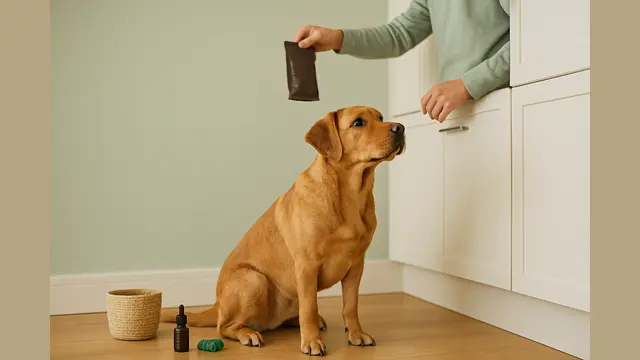
Why is my dog's poop green, and when should I call a vet?
Find out when you can watch one green stool, which changes mean your dog needs a vet, and why possible rat or snail bait exposure means calling now.

In this guide (7 sections)
- Could your dog have reached bait? Call before checking the next stool
- When to watch green poop and when to call your vet
- Is the stool green from grass or food?
- What does watery green poop with mucus mean?
- What to check at home after one formed green stool
- What to tell the clinic and when a stool sample helps
- Talk it through with Vicky
Grass or food coloring can tint your dog’s poop green. If your adult dog passes one formed green stool, feels well, and has no suspected exposure to poison, you can watch the next bowel movement; call your vet if the change persists, diarrhea keeps happening, or your dog seems unwell. If your dog may have swallowed rat, mouse, slug, or snail bait, call a veterinarian or ASPCA Animal Poison Control now, even if your dog is acting normally.
Could your dog have reached bait? Call before checking the next stool
What your dog could have eaten matters more than the shade of green. A chewed bait package or a dog seen eating something where bait was put down is reason to make the call. You don’t need proof that your dog swallowed it. Green poop alone doesn’t establish poisoning, and normal brown poop doesn’t clear a dog who may have eaten bait.
VCA’s guide to outdoor toxins identifies both rodent bait and some slug and snail baits as hazards. Tell the veterinarian or poison specialist which product your dog could have reached and when. Keep the package if you have it so you can read the label during the call. The ASPCA’s poisoning guidance recommends getting professional advice before trying any home treatment. Do not make your dog vomit unless a veterinarian directs you to. As Preventive Vet explains for rat and mouse bait, signs can be delayed. Waiting for your dog to look sick is not a safe test.
When to watch green poop and when to call your vet
If there is no suspected bait exposure, make the decision based on the consistency of the stool and how your dog feels, not color alone. Here’s how that looks in practice:
| What you notice | What to do |
|---|---|
| One stool holds its usual shape. There’s a plausible explanation such as grass, and your adult dog is eating, drinking, and behaving normally. | Watch the next bowel movement. If the unusual color continues, call your regular vet even if the poop stays formed. |
| Your dog passes watery stool repeatedly, loses interest in food, drinks differently, vomits along with the diarrhea, or becomes unusually quiet. | Stop monitoring at home and call your vet today. If your dog is lethargic—much less alert or active than usual—call when you notice it rather than waiting until the end of the day. |
| You see a red streak on formed poop, or the stool looks black and tar-like rather than green. | Call your vet promptly and describe exactly what you see. Black, tar-like stool can be a sign of bleeding farther up the digestive tract. Don’t wait for another stool to confirm it. |
| Your dog has bloody diarrhea, collapses, appears to be in severe pain, or keeps vomiting and can’t keep water down. | Seek urgent veterinary help. Contact an emergency clinic if your veterinarian cannot help immediately; lead with that sign rather than the green color. |
Texas A&M’s guide to stomach trouble in dogs highlights frequent diarrhea and changes in appetite, drinking, or energy as reasons for veterinary care. Puppies can lose water quickly, so call your vet about a young puppy with diarrhea rather than using the monitoring plan for a well adult. A weak or lethargic puppy needs urgent help. Ohio State’s veterinary emergency guide also flags bloody diarrhea, collapse, extreme pain, and vomiting that won’t stop.
Is the stool green from grass or food?
Think about what you actually saw. A formed brown stool with green blades running through it is different from a puddle that is green throughout. If your dog grazed on grass during a walk, visible pieces make grass a plausible explanation for the first stool. In the second example, the useful observation is that your dog has watery diarrhea. Even if you watched your dog eat grass, don’t let that explain away repeated diarrhea.
Recent food or a chew with coloring can also account for a modest change in shade. Think back to what was new before the color changed, including treats between meals. The guide to dog stool appearance explains how diet and dyes can affect color. A match between the chew and the poop is a clue, not proof. It’s the difference between saying “my dog had a new green chew yesterday” and assuming the chew explains why your dog now feels ill.
What does watery green poop with mucus mean?
Mucus can look like a slick or jelly-like coating. One possible cause of greenish diarrhea with mucus is Giardia, a tiny parasite that lives in the intestine. Dogs can be exposed through contaminated water or in places where dogs share space, such as kennels. If your dog has diarrhea after a boarding stay or after drinking from an outdoor water source, mention it to your vet. That history helps the vet decide whether testing makes sense; it doesn’t identify the cause on its own.
Another possibility is colitis, which means inflammation of the large intestine. As PDSA’s guide to colitis in dogs explains, several things can cause this inflammation, and the diarrhea may contain mucus or blood. You don’t need to distinguish colitis from a parasite at home. It’s more helpful to tell the clinic whether your dog passed one soft stool with a coating or kept asking to go out and passed only small amounts each time.
What to check at home after one formed green stool
If your dog meets the watch-at-home criteria, you don’t need a color chart. Three observations will help you decide what to do next:
- Record what changed. Note when your dog last passed their usual brown poop and when you saw the green stool. Take a photo while it’s fresh if you can. Record whether it held its shape, whether the green was in pieces or throughout, and whether you saw mucus or blood. A plain description is more useful than guessing at a diagnosis.
- Check your dog between trips outside. Keep clean drinking water available. Notice whether your dog wants their usual meal, drinks as usual, and shows their normal interest in what’s going on. If your dog starts vomiting or loses interest in food or activity, call your vet instead of waiting for the next poop. Don’t give human diarrhea medicine without veterinary direction; some medicines can harm dogs or worsen the underlying problem.
- Compare more than the color next time. A return to a formed brown stool while your dog continues to feel well is reassuring. A change from green and formed to brown and watery is not the same improvement. Note any extra trips outside and whether the poop is becoming looser. Report that pattern if you call, even if the green has disappeared.
What to tell the clinic and when a stool sample helps
Start with the reason you’re calling now. For example, “The first poop was formed with grass in it, but the next two were watery, and my dog turned down breakfast” gives the clinic a clearer picture than “the poop is dark green.” Give your dog’s age, when the change started, and any recent change in food, chews, or surroundings. For a puppy, tell the clinic whether vaccinations are complete.
Ask whether the clinic wants a photo, a fresh stool sample, or both. A photo shows what you mean by “slimy” or “almost black,” even if the next stool looks different. A sample can answer a question the picture cannot: are there microscopic signs of a parasite? For example, VCA’s guide to Giardia in dogs describes stool testing for tiny forms of the parasite called cysts. If your dog needs urgent care, go for care rather than waiting for your dog to produce a sample.
Talk it through with Vicky
If your dog feels well but you’re unsure how to describe the change, you can tell Vicky what you’re seeing right now. Vicky will bring in Dr. Andy (Virtual DVM), our general practice veterinarian, to help you sort through the stool changes and what to tell your clinic. For possible poisoning or emergency signs, contact a veterinarian or emergency service directly.
Common questions
Could a green dental chew explain both the color and the softer poop?
Coloring in a chew could explain a modest change in shade, but it doesn’t tell you why the stool is softer. If you call your vet, describe the chew and the change in texture separately, especially if the stools are getting looser or more frequent.
How many green stools should I wait for before calling?
There’s no single stool count that works for every dog. Watching the next poop is reasonable after one formed green stool in a well adult with a likely food or grass explanation and no suspected toxin exposure. Call if the color persists; don’t wait for a set number if your dog feels ill or may have reached bait.
What if my dog keeps squatting but only green slime comes out?
Tell your vet about the repeated attempts, how much stool or mucus comes out, and whether your dog seems painful. Mucus can occur with inflammation of the large intestine and doesn’t identify a particular infection. Seek urgent help if your dog appears to be in severe pain or has bloody diarrhea.
Does one negative stool test rule out Giardia?
No. A single sample can miss Giardia cysts. If the diarrhea continues, let your vet know about the ongoing signs and ask whether another sample would help.
Does green diarrhea mean my puppy has parvovirus?
Green color doesn’t identify parvovirus. Puppies that haven’t finished their vaccinations are vulnerable to it, and puppies with diarrhea can lose water quickly. Call your vet about the diarrhea and give your puppy’s age and vaccination history.
Sources
- What to Do if Your Pet Is Poisoned — ASPCA
- Summer Toxins to Avoid with Your Pet — VCA Animal Hospitals
- When to See a Veterinarian — Merck Veterinary Manual
- When to See a Veterinarian for a Dog’s Stomach Ache — Texas A&M Veterinary Medicine
- How to Tell If Your Dog’s Poop Is Healthy — American Kennel Club
- Giardia in Dogs — VCA Animal Hospitals
- Colitis in Dogs — PDSA
- Eight Home Remedies for Diarrhea and Two That Could Be Dangerous for Your Pet — VCA Animal Hospitals
- What to Do If Your Dog or Cat Has Eaten Rat Poison — Preventive Vet
- Metaldehyde (Slug and Snail Bait) Poisoning — VCA Animal Hospitals
- What Should My Dog’s Poop Look Like? — PetMD
- What Constitutes a Pet Emergency? — Ohio State University Veterinary Medical Center