Can kittens eat adult cat food, and when are they ready to switch?
Check whether the food in your cat’s bowl meets a kitten’s needs, learn when to switch to adult food, and see how to introduce the new recipe gradually.
In this guide (7 sections)
If your weaned kitten took a few bites of your adult cat’s food, offer their usual kitten food at the next meal. For regular meals, choose a cat food labeled complete and balanced for growth or all life stages; food labeled only for adult maintenance isn’t designed to meet a growing kitten’s needs. Plan the switch to adult food at about one year of age, or when your cat finishes growing if that comes later.
What to feed today if you bought adult food by mistake
Say you’ve opened a can for your three-month-old kitten and noticed the word adult on the front. You still have the kitten kibble they usually eat. Before you open another can or make a trip to the store, check the small print on both packages. The question is whether either food can serve as your kitten’s whole diet, not whether dinner is wet or dry.
If the can is for adult maintenance only and the kibble is complete and balanced for growth, give your kitten the familiar kibble. You don’t need wet food to make that meal complete. Set the adult cans aside for your older cat or see whether you can exchange the unopened ones. On the other hand, if the can says the food is complete and balanced for all life stages, it’s suitable for kittens, too. If it’s a new recipe for your kitten, introduce it gradually.
A stolen mouthful and a kitten regularly eating the older cat’s dinner are different feeding problems. If adult-maintenance food has become your kitten’s main food, tell your vet which recipe you’ve been serving, for how long, and what else your kitten actually eats. A photo of the label is more useful than the brand name alone.
Where to look on a US cat food label
Find the nutritional adequacy statement, usually near the nutrition panel on the bag or can. It’s the sentence that says whether the recipe can be the cat’s sole diet and, if so, at what stage of life. It may mention the Association of American Feed Control Officials (AAFCO). Read through to the life stage: a food can be “complete and balanced” for an adult without being complete and balanced for a kitten.
| Wording on the label | What to do |
|---|---|
| Complete and balanced for growth, or growth and reproduction | You can use it as your kitten’s regular food. |
| Complete and balanced for all life stages | It meets the needs of a growing kitten as well as an adult cat. |
| Complete and balanced for adult maintenance | Save it for a cat that has finished growing. |
| For intermittent or supplemental feeding only | Don’t use it as the whole diet. |
Check the statement on the exact recipe you plan to feed. For example, if you buy both cans and kibble from one brand, the statement on the bag doesn’t tell you what’s in the cans. When shopping online, look for a readable photo of the back label. The FDA’s guide to complete and balanced pet food explains what the statement tells you that the ingredient list does not.
Why kittens need more than a high protein number
A kitten is building new tissue and bone. Protein supports that tissue growth, calcium and phosphorus support developing bones, and a fatty acid called DHA supports brain and vision development. An adult food may contain those same nutrients. What you need to know is whether the amounts and balance meet the requirements for growth. VCA’s guide to choosing kitten food explains why the life-stage statement is a better guide than any one ingredient.
Moisture also makes the protein numbers on a can and a bag hard to compare. The percentage on the package includes the water in the food. A wet recipe can show a lower protein percentage than kibble partly because the can contains more water. Comparing the two with the water taken out, called a dry-matter comparison, addresses that difference. Even then, a protein number won’t tell you whether the food supplies the right balance of minerals. You don’t need to do the math to choose a suitable kitten food.
When to switch from kitten food to adult food
Weaning is the move from milk to food a kitten can eat. It is not the move from growth nutrition to adult nutrition. A kitten who can chew the same kibble as your older cat has shown you something about texture, not whether they’ve finished growing.
For most cats, the first birthday is a useful time to consider adult-maintenance food. For a large breed such as a Maine Coon, maturity may take about 18 months. If your cat is still growing at a year, keep feeding a growth or all-life-stages diet rather than switching because the calendar says so. VCA’s guidance on switching to adult food puts the switch at about a year or at maturity, whichever comes later.
Once your cat is mature, check what you’re feeding before buying something new. If the current recipe is for growth only, this is the time to plan a change. If it’s complete and balanced for all life stages, you may be able to keep the same recipe. In that case, the useful question for your vet is how much to feed your adult cat, not how to persuade them to eat a different dinner.
How to introduce the new food and know what your cat ate
- Start while you still have some familiar food. Offer mostly the old food with a small amount of the new recipe in place of part of the meal. That’s easier to do when you aren’t down to the last scoop.
- Change the mix in steps. For example, move from mostly old food to a mix of old and new, then mostly new food, before serving the new recipe alone. These are stages in a gradual change, not a requirement to reach the next stage at a particular meal.
- Look at what’s left. A cat who picks out the familiar kibble and leaves the new pieces hasn’t made the same switch as one who eats the mix. Don’t increase the new food’s share on the assumption that your cat ate everything you put down. If you’re unsure what to offer next, tell your vet which food your cat accepted and which they left.
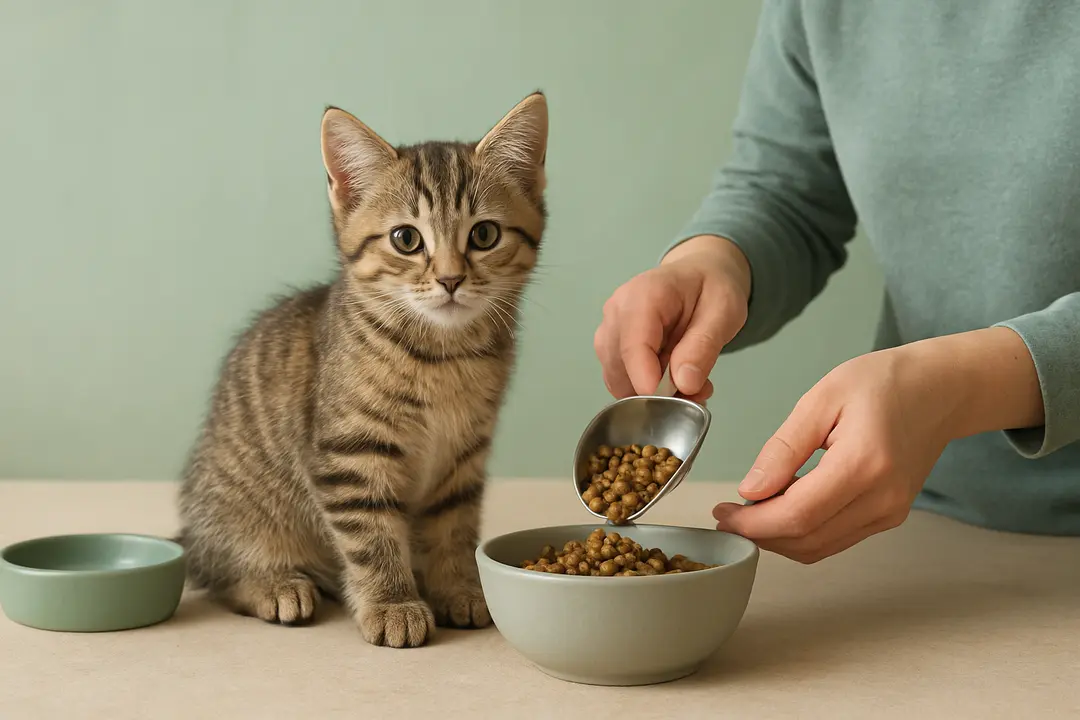
In a home with more than one cat, an empty bowl doesn’t tell you who finished dinner. Give each cat a portion in a separate feeding spot where you can see what each one eats. This matters even if both cats eat the same all-life-stages food: the kitten finishing both portions can hide the fact that the older cat is eating less. PetMD’s guide to feeding cats separately explains how separate meals help you spot that difference.
When digestive trouble needs a vet
If your cat develops digestive upset during the switch and it doesn’t settle, call your vet rather than continuing to change the mix. Tell the clinic when you introduced the food, what your cat ate, and when the symptoms started. Don’t assume vomiting is from the food because the timing fits.
If your kitten is vomiting and seems weak, or the vomiting won’t stop, go to an emergency veterinary clinic now. Don’t wait for another meal to see if the old food helps. The Cornell Feline Health Center’s vomiting guide explains why frequent vomiting or vomiting with weakness needs prompt evaluation. Ohio State’s pet emergency guide identifies nonstop vomiting and a weak, lethargic kitten as reasons to seek emergency care.
Talk it through with Vicky
You can tell Vicky what you’re seeing right now. Share your kitten’s estimated age, the life-stage wording on the food, and what they’re eating from each bowl. Vicky will bring in Sam (Virtual PhD (Animal Nutrition)), our animal nutritionist, to help you decide what to feed now and how to plan the switch.
Common questions
Can I switch at 10 months if my kitten already looks full-sized?
No. Looking as big as an adult cat is not a reason to switch at 10 months. Keep feeding a growth or all-life-stages food until about one year of age, and longer if your cat is still growing.
Should I switch to adult food when my kitten is spayed or neutered?
Spaying or neutering isn’t the milestone for switching foods. If your kitten is still growing, choose a recipe that meets growth needs rather than an adult-maintenance food.
How do I know when to switch a rescue kitten if I don’t know their birthday?
Bring any age estimate from the adoption record and any dated weights to your vet. Ask whether your cat has reached maturity; you don’t need to guess an exact birthday or adult weight to have that conversation.
Can I serve adult wet food every night if my kitten also eats kitten kibble?
If the can is for adult maintenance only, don’t count on kitten kibble to make the combined diet complete for growth. To feed both wet and dry food regularly, look for a growth or all-life-stages statement on each recipe.
What if my kitten prefers the older cat’s food?
If the older cat’s recipe is complete and balanced for all life stages, it can be an option for your kitten. If it’s for adult maintenance only, look for a growth or all-life-stages recipe with a similar texture and introduce it gradually.