Can my pet bird eat oats, and where do they fit in its diet?
See which oats to choose for a budgie or cockatiel, how to serve a small taste, and what to do if your bird picks out the oats and leaves its pellets.
In this guide (6 sections)
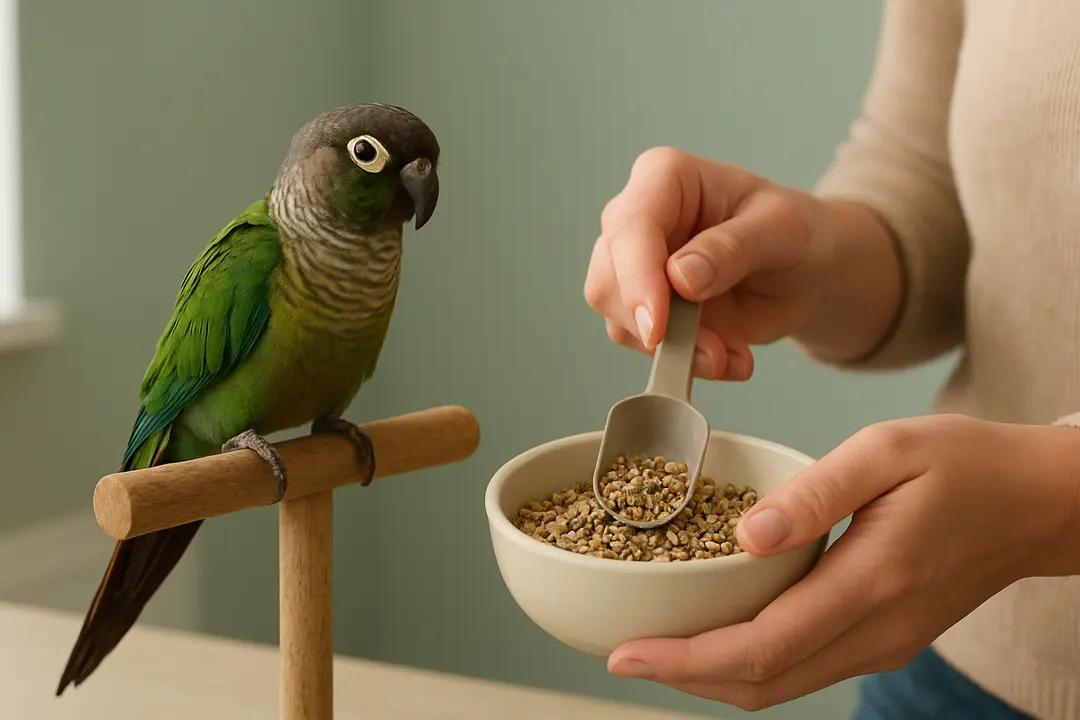
Yes. If you have a healthy grain-eating parrot such as a budgie or cockatiel, you can offer a small taste of plain oats cooked in water. Oats supply energy and fiber, but they’re an optional whole grain: they belong alongside your bird’s usual pellets and vegetables, not in place of them.
Start with the diet for your kind of bird
For a budgie or cockatiel, breakfast doesn’t need to look like yours. Species-appropriate pellets are made to provide a balanced mix of nutrients. For many pet parrots, they form the foundation of the diet, with vegetables, a little fruit, and limited amounts of whole grains for variety. The Best Friends Animal Society parrot diet guide includes cooked oats among those grains. It doesn’t suggest feeding a bowl of oatmeal as a meal.
Why does the distinction matter? An oat is a whole grain: its outer layers provide fiber, and much of the kernel is starch, which supplies energy. Those are useful contributions, but they don’t make oats a balanced food on their own. Budgies and cockatiels naturally eat seeds, yet a captive diet built around favorite seeds and grains can still be incomplete. Lafeber’s guide to feeding parrots puts whole grains in the small-extras part of the diet.
If your bird is a different species, check its own feeding plan first. In particular, don’t use a budgie’s breakfast as a menu for a lory or lorikeet. If you’re not sure whether grains belong in your bird’s diet, there’s no need to offer oats while you find out.
Which oats can you share from your kitchen?
Read the ingredient list rather than relying on the word oatmeal. It can mean oats you cook yourself or a ready-flavored breakfast with other ingredients already mixed in. For sharing, look for a list that says oats and stops there.
| What’s in your kitchen | How to decide |
|---|---|
| Plain old-fashioned rolled oats | Cook them in water. You can use the same batch for yourself if you set aside the bird’s taste before seasoning yours. |
| Plain quick oats | These work for water-cooked oatmeal, too. A shorter cooking time is not the same thing as added flavoring. |
| Flavored instant oatmeal | Keep the packet for yourself. Sugar or salt can be part of the mix even when you can’t see a topping. |
| Granola or sweetened oat cereal | Visible rolled oats don’t make the whole product plain. Choose single-ingredient oats instead. |
University of Illinois Extension’s guide to oats explains that rolled and quick oats are nutritionally similar whole grains that provide soluble fiber. The more useful choice at the store is plain versus flavored, not old-fashioned versus quick. At home, the same principle applies to the finished dish: the World Parrot Trust’s guidance on human foods advises against sharing prepared foods high in added fat, salt, or sugar.
How much oatmeal belongs in a small bird’s diet?
Think of it as letting your bird taste breakfast, not serving a second breakfast. Put a small amount in a separate dish rather than filling a bowl for your bird to eat from all morning. If the oats disappear first, that tells you your bird likes them; it isn’t a reason to refill the dish. There’s no established oatmeal serving here that you need to measure in flakes or beak-sized bites.
Count the grains your bird already eats. A cockatiel that picks oats from its usual mix has already had some, even if you didn’t serve them separately. Cooked oats mixed into chopped vegetables count, too. Changing the dish or using oats as a foraging treat doesn’t turn them into a different category of food.
The best portion check is what the oats replace. If your budgie eats its usual pellets and vegetables and occasionally tries plain oatmeal, the grain is acting as an extra. If breakfast has become a wait for the oatmeal dish while the pellets go untouched, skip the added oatmeal and take a closer look at the regular diet. You can keep the shared breakfast routine: offer your bird its familiar balanced food while you eat yours.
How to serve cooked oats and when to take them out
- Choose the bird’s portion before finishing your own. Cook single-ingredient oats in water. Use a clean spoon to set a small taste aside before adding milk, butter, salt, brown sugar, or syrup to your bowl. If breakfast is already mixed, save sharing for a day when you can start with plain oats.
- Use a dish you can remove. A separate treat dish lets you see whether your bird tried the oats. It also means you can take out the moist food without throwing away a bowl of dry pellets. If your bird leaves the oatmeal untouched, don’t sweeten it to encourage a taste.
- Set a reminder when you put the dish down. Lafeber’s cage food-safety guide recommends removing perishable foods, including cooked grains, within 30–60 minutes. Take them out sooner in hot weather because bacteria can grow more quickly. If you’re heading out and won’t be there for cleanup, offer the oats another time.
- Discard the leftovers and wash the dish. Treat a mixture containing cooked oats as moist food, even if the oats have absorbed the visible liquid. Don’t leave it in the cage for your bird to return to later in the day.
What if your bird picks out the oats and leaves the pellets?
Picture a budgie working its way across a dish that contains both pellets and favorite grains. It visits the dish several times, so it looks as though it has eaten a good breakfast. When you look more closely, the oats are gone but the pellets are still there. That’s selective feeding: choosing particular foods from a mix. It’s easy to miss, even when you’re careful about what goes into the bowl.
VCA Animal Hospitals’ budgie feeding guide recommends checking what your budgie eats, not only what you offer. At the next regular meal, watch which items your bird takes. Look again before you top up the dish. If you share oats on another occasion, keeping them separate makes it easier to tell whether your bird also ate its usual food.
If your bird routinely leaves the pellets, the question for your avian veterinarian is bigger than whether oatmeal is allowed. Bring the name of the usual food or a photo of its label. Describe which parts you’ve actually seen your bird swallow and which are left at the end of a meal. That gives your vet a better starting point for a feeding plan than saying your budgie is “on pellets” because the mix contains them. Don’t assume a bird that has never accepted pellets will start eating them because you remove its favorites.
Picking out one favorite is different from losing interest in food altogether. If your bird suddenly turns away from familiar foods it normally eats, contact your avian veterinarian about the change rather than testing its appetite with more oatmeal. Tell the clinic when you last saw it eat normally and whether it’s as active as usual. VCA’s guide to appetite and activity changes in birds explains why those observations matter.
Talk it through with Vicky
You can tell Vicky what you’re seeing right now: what kind of bird you have, what’s on the oat package, and what your bird actually eats from its usual dish. Vicky will bring in Dr. Wren (Virtual DVM, DABVP (Avian)), our Avian & Exotics Veterinarian, to help you decide where oats fit.
Common questions
Can my budgie eat dry rolled oats straight from the carton, or should I soak them?
Choose plain oats cooked in water. That’s the preparation recommended for parrots; the same guidance doesn’t establish that dry flakes or flakes soaked without cooking are suitable for your budgie.
Should I buy oat groats or steel-cut oats instead of rolled oats?
There’s no need to buy a special cut to give your bird an occasional taste. The feeding guidance favors a small amount of plain cooked grain, not one cut of oat over another. If you already have single-ingredient rolled or quick oats, use those.
Can I mix cooked oatmeal into my bird’s vegetable chop?
Yes, if whole grains fit your bird’s diet. Use a small amount of plain cooked oats and remove the entire moist mixture within 30–60 minutes, sooner in hot weather. Don’t use dry flakes to soak up liquid as a substitute for removing leftovers.
Can I strain maple-and-brown-sugar oatmeal to make it plain?
No. Straining a flavored packet isn’t a reliable way to separate the oats from the added ingredients. For a breakfast you can share, start with plain oats and add the maple flavoring or sugar only to your own portion.
Is my cockatiel missing anything if it won’t try oatmeal?
Oatmeal is optional. If your cockatiel eats its usual balanced diet and declines the oats, you don’t need to replace them with another cereal or add a topping to make them more appealing.
Sources
- The Best Parrot Diet (and Toxic Foods to Avoid) — Best Friends Animal Society
- Know your oats this Oatmeal Month — University of Illinois Extension
- Feeding Budgies — VCA Animal Hospitals
- “Healthy” Foods Your Bird Should Stop Eating Today — Lafeber Company
- Human Foods: Are Some Dangerous for Parrots? — World Parrot Trust
- Don’t Leave These In Your Pet Bird’s Cage — Lafeber Company
- Anorexia and Lethargy in Birds — VCA Animal Hospitals
- Feeding Your Parrot a Healthy Diet — Lafeber
- Why Eat Whole Grains? — Penn State Extension
- 24/7 Animal Poison Control Center — Pet Poison Helpline