Is it normal to find a shed cat whisker, and when is whisker loss a concern?
Found a cat whisker on the floor? See how to tell normal shedding from breakage, check your cat’s cheeks and chin, and decide when to call your vet.
In this guide (6 sections)
Yes. Finding a single shed whisker on the floor or bedding is normal, and no treatment is needed if your cat is acting well, the muzzle looks unchanged, and the skin looks healthy. Call your vet if many whiskers disappear suddenly, a cheek looks increasingly thin, or you notice a bald patch, sore skin, or repeated face rubbing or scratching.
Why a healthy cat sheds whiskers
A long, curved whisker left on your lap after your cat gets up from a nap can look like something your cat shouldn't have lost. But whiskers shed and regrow. Even seeing one fall out tells you little beyond what happened to that one hair. As PetMD’s guide to cat whiskers explains, occasional shedding is expected, and a temporary difference between the two sides of the face can be normal.
Whiskers, also called vibrissae, are sensory hairs. The visible hair is the shaft. When it moves, that movement reaches nerves in the follicle, the deep pocket in the skin where the whisker grows. This helps your cat sense objects near the face, as VCA explains in its guide to whisker function. A naturally shed whisker needs no attention, but the ones still in place serve a purpose. Don't shorten them to make the two sides match.
Is it a shed whisker or a broken one?
Look at what's still on your cat's face rather than trying to work it out from the hair you picked up. An apparently full-length whisker on a pillow and several clipped-looking ends still attached to one cheek are different findings.
| What you notice | What it suggests | What to do |
|---|---|---|
| A long, loose whisker; both cheeks look as usual | This fits normal shedding. | Leave the whiskers alone. You don't need to find the spot it came from. |
| Several short whiskers with abrupt or uneven ends on one cheek | The shafts may have broken rather than fallen out. | Note which cheek is affected and whether your cat rubs it. Ask your vet about the damaged whiskers. |
| A gap that also includes missing ordinary fur | There is a change in the coat, not only in whisker length. | Contact your vet about the bare patch, even if you haven't found any loose whiskers. |
A shortened hair with a fractured or split tip is a clue to shaft damage, not proof of how it happened. You don't need to pull one out to inspect the end. Clinician’s Brief on examining hair shafts specifically advises against plucking whiskers, even when collecting hairs for a veterinary exam.
How to check your cat's cheeks and chin
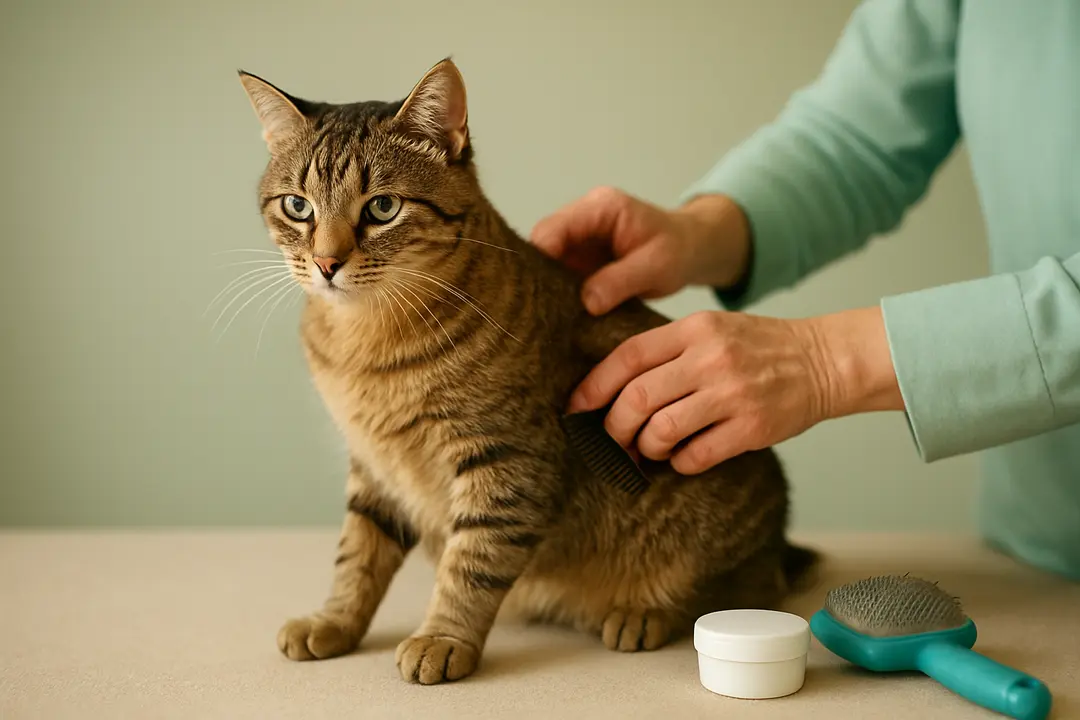
Choose a time when your cat is relaxed and you can see the face in good light. A look from the front and then from each side is more useful than trying to count whiskers on a moving cat.
- Compare each cheek with its usual appearance. The whisker pads are the rounded areas beside the nose. Is one a little less full than the other, or is there a section that used to have long whiskers and now has mostly stubs? An older photo can help you tell a new change from a slight difference you hadn't noticed before.
- Look at the ordinary fur and skin. Follow the edge of the whisker pad with your eyes. Look for redness, scabs, a patch with no fur, or skin that's wet with discharge. When your cat lifts their head, check the chin and the edges of the lips for bumps or blackheads. You can describe a skin change to your clinic without having to identify it.
- Watch for repeated rubbing or scratching. Notice whether your cat keeps returning to the same spot. A short video can show your vet which part of the face your cat is rubbing. VCA’s guide to itchy skin in cats explains that repeated rubbing or scratching can signal itch. That behavior is worth reporting even if the whiskers themselves look intact.
- Separate the day you found the whiskers from the day you noticed a change. For example, finding three on a blanket when you wash it doesn't tell you that all three fell out that morning. If the cheek itself looks different, take a photo and note the date. If it's getting thinner, tell the clinic about that change rather than waiting until you've collected a particular number.
What an itchy face, a bald patch, or chin bumps can mean
A loose whisker by itself isn't evidence of a skin disease. If you also see changes in the skin or coat, the question for your vet is what could explain those signs. They matter whether or not they're related to the whisker you found.
- Itch or patchy fur loss: Allergies can cause itching, and ringworm, a fungal infection, can cause hair loss. Mites can also cause skin problems that look similar. As the PDSA guide to skin problems in cats explains, redness, scabs, fur loss, or weeping skin are reasons to contact your vet. A patch near the whiskers doesn't identify the cause.
- Blackheads or bumps on the chin or lips: These can occur with feline chin acne. Plugged follicles can itch, and a cat may rub the chin. The affected skin can also become infected and painful. Texas A&M’s guide to feline acne explains why these changes deserve an exam. Point out where you see the bumps rather than assuming acne made a whisker fall out.
When to call your vet and what to expect
One shed whisker in an otherwise well cat is not, by itself, a reason to go to an emergency clinic. For sudden, extensive loss, damaged whiskers, or a change in the surrounding skin, start by calling your regular veterinary clinic. There isn't a whisker count that tells you to go to an emergency clinic now. Describe how your cat looks and acts so the clinic can advise you on timing; don't wait for more whiskers to fall out if the skin already looks sore.
When you call, lead with the clearest change. For example, “The whiskers on the left cheek look cut short, and my cat keeps scratching that side” tells the clinic more than “I found two whiskers.” Say when you first noticed it, whether it's getting more pronounced, and whether there's a change on the chin or in the nearby fur. If you actually saw the whiskers get clipped or damaged, mention that separately from anything you're unsure about.
At the exam, your vet can look at the shafts that remain and check the skin beneath the surrounding fur. If there's a bare or crusty patch, your vet may recommend testing rather than choosing a treatment from its appearance alone. Texas A&M’s overview of feline skin conditions explains why problems that look alike can need different care.
After normal shedding, regrowth doesn't require treatment. You don't need to inspect the muzzle every day or tug on neighboring hairs to see if they're loose. If you've noticed a gap, a photo gives you something to compare with later. Cats Protection’s whisker guidance recommends a vet check if many whiskers disappear suddenly, are damaged, or don't grow back.
Talk it through with Vicky
You can tell Vicky what you're seeing right now: a loose whisker on the bedding, short ends on one cheek, or a change in the skin. Vicky will bring in Dr. Nadia (Virtual DVM, DACVD), our AI specialist in veterinary dermatology, to help you sort out what to describe to your own vet.
Common questions
How many whiskers can my cat lose before I should call the vet?
Don't use the number you find as a cutoff. A few whiskers picked up together don't establish illness, while a visibly thinning whisker pad or a new itchy, bald patch is worth a call even if you've found only one.
Why are my cat’s whiskers shorter on just one side?
Normal shedding and regrowth can leave the two sides looking a little uneven for a time. Several whiskers on one side that end abruptly, as though clipped, suggest shaft damage instead. If that's a new change, describe it to your vet.
Will a whisker grow back if I accidentally clipped it?
Whiskers are naturally replaced, so a clipped whisker can eventually be replaced by a full-length one. Leave the short shaft in place and don't trim the opposite side; if several whiskers were damaged or a gap persists, ask your vet to check.
Could my other cat be chewing my kitten’s whiskers during grooming?
Short or broken ends alone can't tell you whether another cat chewed them. If you see chewing during grooming, tell your vet what you observed, which cheek is affected, and whether the kitten also rubs or scratches that spot.