Do all cats shed, and how can I tell normal shedding from unusual hair loss?
A full brush can be normal; a new bald spot is different. Learn how to check your cat’s coat and skin, when to keep brushing, and when to call your vet.
In this guide (7 sections)
- A brushful of fur and a thinning coat are different findings
- Why one cat can leave much more fur around the house
- How to check your cat’s coat and skin at home
- Why hair can go missing even when there’s no rash
- When to book a vet visit and when to go now
- What to tell your clinic about a coat change
- Talk it through with Vicky
Yes, all cats with fur shed some of it, including shorthaired and low-shedding cats. Look at the fur that’s still on your cat: a full brush can be normal if the coat remains evenly covered, the skin looks healthy, and your cat is comfortable. A new thin or bald spot deserves a veterinary check, even if you’ve barely found a hair on the couch.
A brushful of fur and a thinning coat are different findings
Picture lifting a soft clump of hair off your cat’s favorite chair. You run a hand along your cat’s back and sides. Once the fur settles, it covers the same areas it always has. Now picture the opposite: there’s hardly any fur on the chair, but when your cat stretches out, you notice a patch of belly that used to have hair and is now nearly bare. It’s the second finding that calls for an appointment.
Shedding is how a coat replaces old hairs. As Cats Protection’s guide to shedding explains, even cats that seem not to shed can leave behind fine hairs that are hard to see. You don’t need to work out how many hairs your cat loses each day. The useful question is whether shedding has changed the look of the coat or whether something about the skin seems to bother your cat.
Why one cat can leave much more fur around the house
A long strand shows up across a cushion in a way a short hair might not. Gather those strands into a pile and they can look like a lot of fur without there being more individual hairs. Coat density matters, too. As PetMD’s guide to year-round coat care notes, how much shedding you notice depends partly on the coat you’re looking at. Two cats can share a home and leave very different amounts of visible fur.
The undercoat, the layer of fur beneath the outer hairs, can come loose in soft clumps during a seasonal coat change. Indoor cats often shed throughout the year rather than having an obvious start and finish to shedding season. Finding fur again soon after grooming doesn’t mean you missed something or did a poor job. Brushing collects hair that’s loose; it isn’t meant to stop the coat from renewing itself.
How to check your cat’s coat and skin at home
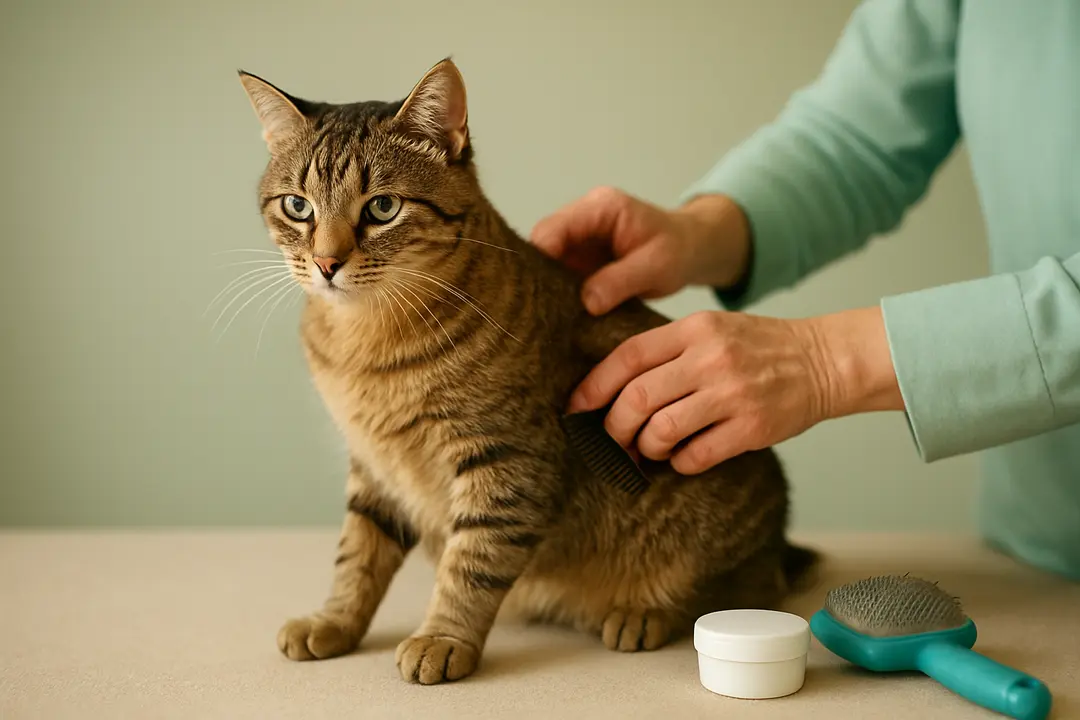
Use a moment when your cat is relaxed, such as during petting or gentle brushing. You can start with the area that caught your eye. There’s no need to pull on the hair to see how much more will come out.
- Look with the fur lying naturally. Smooth it into its usual position and let it settle. Seeing a line of skin where you’ve parted the hair is different from seeing skin through an area the fur used to cover. A patch doesn’t have to be completely bald to count as a change.
- Describe what looks different. Is the coat evenly full, sparse in one spot, or thinning over a wider area? If there’s hair left in the spot, does it look unusually short, almost like stubble? Note the location, such as the lower belly or the inside of a hind leg, without assuming you know why the hair is short.
- Gently separate the hair to see the skin. Look for irritation or broken skin. Routine brushing is also a chance to notice a bump, a tender area, or signs of parasites, as VCA’s cat grooming guide explains. If your cat pulls away from a sore spot, stop rather than brushing over it again.
- Watch your cat’s grooming. Notice whether your cat keeps returning to lick or scratch one place. If you haven’t seen that happen, there’s no need to guess. “There’s less hair on the belly, but I haven’t seen my cat licking it” is a useful description in its own right.
If the coat looks unchanged, the skin looks healthy, and your cat is comfortable, continue gentle brushing and look again during ordinary grooming. If you do notice a change, you can take a dated photo with the fur resting naturally. A photo is optional; don’t wait to collect a series of pictures before calling about a new bald patch.
Why hair can go missing even when there’s no rash
Vets use the word alopecia to mean hair loss. It describes what you see, not what caused it. Texas A&M’s guide to shedding and feline hair loss distinguishes normal tufts of shed fur from a change in coverage. It also explains why a vet may look for several different causes of a thin patch:
- Parasites or allergies: Itching can lead a cat to scratch or groom an area repeatedly. Your vet may check for parasites such as fleas and consider an allergy rather than treating the missing hair as the whole problem.
- A fungal infection: A fungal skin problem is another possible cause of patchy hair loss. The location or shape of a spot alone doesn’t tell you whether it’s an infection.
- Licking in response to discomfort: Cats may overgroom because an area itches or hurts. A bare belly tells you where the fur is missing, not whether your cat is anxious. It’s worth having your vet look for a physical cause.
The skin beneath a licked area can look surprisingly ordinary. Cats Protection’s advice about skin and grooming recommends an exam for a cat that has licked areas bald even without scabs or dry skin. You don’t need to wait for a rash to make the appointment.
When to book a vet visit and when to go now
Book a regular veterinary exam for a new bald patch, thinning that persists or spreads, irritated skin, or repeated scratching or licking. If shedding seems to have changed suddenly and you can’t tell whether coverage has changed too, describe what you see to your clinic. A sudden pile of loose undercoat and a newly bare area are different observations; tell them which one prompted the call.
Seek urgent veterinary care for a wound that appears infected, such as an open sore draining pus. Go to an emergency veterinary hospital now for a very large or deep wound, such as a tear with a large flap of skin or one that may extend into the chest or belly. These are skin injuries, not shedding problems. VCA’s wound triage guidance and PDSA’s guide to skin injuries explain the distinction between wounds that need urgent attention and those that need immediate emergency care.
If the skin is broken, don’t put cream, ointment, or disinfectant on it unless your veterinarian directs you to. These products can interfere with healing, as VCA’s guide to open wounds in cats explains.
What to tell your clinic about a coat change
Start with what you noticed and where: “There’s a thin area on the inside of the left hind leg” or “I’m finding clumps, but I can’t see a gap in the coat.” Say when you first noticed it, whether the area has widened, what the skin looks like, and whether you’ve seen licking or scratching. If you’ve applied anything to the skin, tell the clinic what you used.
At the visit, your vet can examine the hair and skin and look for a source of itch or pain. Ask what changes to watch for next and when they’d like an update. For ordinary shedding, the aim over the next few grooming sessions isn’t an empty brush. It’s a cat whose coat keeps its usual coverage and whose skin stays comfortable.
Talk it through with Vicky
If you’re unsure whether you’re seeing loose undercoat or a newly thin area, tell Vicky what you’re seeing right now. Vicky will bring in Dr. Nadia (Virtual DVM, DACVD), our veterinary dermatologist, to help you sort out what you’ve noticed and what to do next.
Common questions
Is any cat truly non-shedding, and do hairless cats still produce dander?
Any cat with fur sheds some hair. A hairless cat may leave little or no visible fur, but still sheds dander. Dander is made of dead skin cells, not tiny strands of hair.
Is it normal for my indoor cat to shed in winter?
Yes. Indoor cats often shed year-round, so finding loose hair in winter isn’t by itself a sign of illness. A newly sparse patch warrants a check in any season.
Can my cat be licking fur off even if I never catch it happening?
It’s possible, but a thin patch alone doesn’t prove your cat is licking it. You don’t need to catch your cat in the act before booking an exam; tell your vet where the hair has changed and what grooming you’ve actually seen.
Could a scaly bald patch be ringworm rather than shedding?
Ringworm is a fungal infection, and fungal infections are one possible cause of patchy hair loss. You can’t identify the cause from the scales or the shape of the patch alone. Arrange a veterinary exam rather than treating it as a seasonal coat change.