Dog limping on a back leg: joint or nerve?
Is your dog taking weight off a sore leg or struggling to place the paw? Learn what to look for, when to seek urgent care, and what an X-ray can miss.

In this guide (7 sections)
- When a back-leg limp needs urgent care
- Is your dog avoiding weight or misplacing the paw?
- The paw, knee, hip, and back can all cause a limp
- What you can safely check before the appointment
- What the vet checks, and what a normal X-ray means
- What to watch for over the next few days
- Talk it through with Vicky
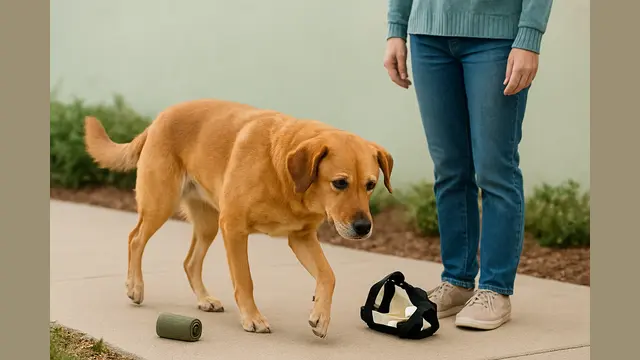
Watch how the back paw lands: a dog protecting a painful leg may land on the pads but quickly take weight off that foot. Repeated toe scraping, landing on the top of the paw, or crossing the back feet suggests trouble controlling the leg and warrants a prompt call to your vet. These are clues, not a diagnosis: a sore nail can look like a sore joint, and a spinal problem can cause pain as well as weakness.
When a back-leg limp needs urgent care
Go to an emergency veterinary hospital now if your dog suddenly cannot stand or walk without help, has lost the use of a back leg, or has a leg that looks broken. Go after major trauma, such as being hit by a vehicle or falling from a height, even if your dog can take a few steps. Don't try to straighten the leg or make your dog walk to show how bad it is. Both VCA's urgent-care guide to limping and Ohio State's veterinary emergency guide identify injuries and loss of mobility that need emergency care.
If your dog has back-leg weakness and is straining but cannot pass urine, go to an emergency hospital. A spinal problem can affect the ability to empty the bladder as well as the ability to walk. When you call about weakness, mention any new loss of bladder or bowel control, too.
Call your vet right away for severe pain, refusal to put the foot down, or sudden or worsening weakness. A dog that can stand and hop on three legs is different from one that needs your support to stand, but refusal to use a leg still needs urgent assessment. For new toe dragging or walking on the top of a paw, call promptly rather than waiting to see whether the other leg becomes affected.
If your dog still puts weight on the leg, places the paw normally, and has none of those urgent signs, call your regular clinic for advice on when to come in. Describe even a limp that comes and goes. A milder step tells you something useful about how your dog is moving, not how serious the underlying injury is.
Is your dog avoiding weight or misplacing the paw?
If your dog is already up and moving safely, notice two parts of a natural step: where the paw lands and what happens when the leg takes weight. There's no need to take your dog for a test walk.
| What you notice | What to tell your vet |
|---|---|
| The pads face down. Your dog touches the toes to the ground or takes weight off the leg as soon as the foot lands. | Describe how much your dog uses the foot. This pattern can mean something in the leg hurts, but it doesn't pinpoint the joint, muscle, or paw. |
| The toes scrape as the leg comes forward, or the paw folds under so its top touches the ground. | Say which of these you see. Landing on the top of the paw is called knuckling; it's different from holding the foot up. |
| One back foot crosses in front of the other, or your dog stumbles when placing a foot. | Tell the clinic about the misplaced steps, whether one or both feet are involved, and whether your dog can still walk unaided. |
It can be hard to see the difference, even when you know your dog's usual walk well. “The right back toes scrape before the foot comes down” is more useful than guessing “it's the hip.” If all you saw was a short step and you're unsure how the foot landed, say that.
The paw, knee, hip, and back can all cause a limp
The paw is an easy place to overlook. A split nail, cut pad, or something caught between the toes can make putting weight on that foot painful. If you see no injury there, that doesn't settle the joint-or-nerve question. A muscle strain farther up the leg can also cause a one-sided limp.
In the knee, possibilities include a kneecap that slips out of position and an injury to the cruciate ligament, a band of tissue that helps keep the knee stable. Arthritis in a joint such as the hip can cause stiffness and limping. PDSA's guide to limping and stiffness describes these different causes. A limp that started during a walk doesn't prove a strain, any more than stiffness on getting up proves arthritis.
In the back, a damaged disc can press on the spinal cord and interfere with control of the feet. That can cause scuffing, weakness, back pain, or a combination. The useful question isn't “Does my dog seem sore enough for it to be a joint?” It's “Is my dog taking weight off the foot, having trouble putting it where it belongs, or doing both?”
What you can safely check before the appointment
- Look at the foot only if your dog tolerates it. Check the pads, nails, and spaces between the toes for a visible injury or trapped material. Skip the inspection if your dog is in severe pain. Don't pull the leg, bend the knee to test it, or massage it to find the sore spot. VCA's first-aid guide for limping dogs explains why moving an injured limb can make a fracture or dislocation worse.
- Write down the first change and the latest one. Did the limp start suddenly, or did you first notice stiffness over several mornings? Is it the same back leg each time? Note what you've already seen after rest or activity. If the limp first appeared on stairs, tell your vet that rather than asking your dog to climb them again.
- If it happens naturally, save a short video. A clip can show the step you find hard to describe, especially if the limp comes and goes. Cornell's guide to the veterinary visit for a limping dog explains how the history, activity pattern, and home video help with the exam. Don't delay a call or trip to the hospital to get footage.
- Ask the clinic about activity and pain relief. Explain whether your dog can get up without help before asking what movement is appropriate while you wait. Check with your vet before giving any medicine, including a human pain reliever or medication left over from another dog. The FDA's guide to pain relievers for pets specifically cautions against treating a limp with what's already in the medicine cabinet.
What the vet checks, and what a normal X-ray means
Your vet may watch your dog stand and walk, then examine the foot and leg. An orthopedic exam looks at the bones, joints, and tissues that support them. For example, the vet can check how the knee moves and whether it feels stable. A neurologic exam looks at how the nervous system controls movement, including how your dog places the feet. These aren't competing exams; the same dog may need both.
Testing depends on what the vet finds. X-rays can reveal a broken bone or changes in a joint, but they don't show every cause of a limp. If the knee seems unstable, a normal X-ray doesn't rule out a ligament injury. VCA's overview of lameness testing explains why the hands-on exam still matters and why an injury to soft tissue may need a different test.
If your dog keeps misplacing a paw, the question may be about the spinal cord rather than the knee. Plain X-rays don't show the spinal cord or nerves. An MRI is a scan that can show those structures in detail, as PDSA's guide to slipped discs explains. If the limp continues despite normal X-rays, ask, “Which part of the exam points to the leg or the back, and what would the next test help us decide?”
What to watch for over the next few days
If your vet advises care at home, ask what activity is allowed, what improvement to look for, and when to return. Track weight and placement separately: is your dog putting more weight on the leg, and is the paw landing pads-down? That gives your clinic a clearer update than “the limp looks a little better.”
Report a limp that keeps returning, including when you last saw it and whether it still looks the same. A change from favoring a leg to dragging the toes is a reason to call promptly rather than wait for a scheduled recheck. If your dog suddenly needs help to stand or walk, go to an emergency hospital.
Talk it through with Vicky
You can tell Vicky what you're seeing right now, even if you're unsure whether the foot is sore or landing awkwardly. Vicky will bring in the right specialist from our team, such as Dr. Diego (Virtual DVM, DACVSMR), our Sports Medicine & Rehabilitation Specialist, or Dr. Sofia (Virtual DVM, DACVIM (Neurology)), our Veterinary Neurologist. For emergency signs, go directly to an emergency veterinary hospital.
Common questions
Can a spinal problem affect just one back leg?
Yes. A spinal cord disorder can affect one side more than the other, so normal steps with the other back leg don't rule it out. Tell your vet which foot is stumbling or scraping and whether that changed suddenly.
Should I call if my dog only knuckles once in a while?
Yes. If you see the top of the paw land on the ground during an ordinary step, call your vet about it even if the next few steps look normal. You don't need to turn the paw over yourself to test it.
Could it be a knee ligament injury if my dog still walks and doesn't yelp?
Walking without a yelp isn't a test of whether the knee ligament is intact. Tell your vet how your dog uses the leg; checking knee stability during the exam is more informative than trying to provoke a painful response at home.
Why does my dog skip a few steps and then walk normally?
A few skipped steps aren't enough to tell which part of the leg is involved or whether the knee is unstable. Note whether it happens on getting up or during activity, whether it's always the same foot, and how the paw lands when your dog starts using it again. Share that pattern with your vet even if the skip is gone by the appointment.
Sources
- Cornell University College of Veterinary Medicine — What to expect when taking your limping dog to the veterinarian
- Texas A&M Veterinary Medicine — Understanding Degenerative Myelopathy in Dogs
- VCA Animal Hospitals Urgent Care — Pain or Limping
- American College of Veterinary Surgeons — Intervertebral Disc Disease
- Cornell University College of Veterinary Medicine — Fibrocartilaginous embolism (FCE) in dogs
- PDSA — Limping and stiffness in dogs
- VCA Animal Hospitals — First Aid for Limping Dogs
- U.S. Food and Drug Administration — Get the Facts about Pain Relievers for Pets
- VCA Animal Hospitals — Testing for Lameness
- PDSA — IVDD/slipped disc in dogs
- What Constitutes a Pet Emergency? — Ohio State University Veterinary Medical Center
- Paralysis in Dogs: Causes, Symptoms, and How To Manage It — PetMD