
How can I tell whether my limping dog needs a vet right away?
Learn when a limp means an emergency even if your dog can walk, when to call for a same-day exam, and how to check a sore paw without testing the leg.
In this guide (6 sections)
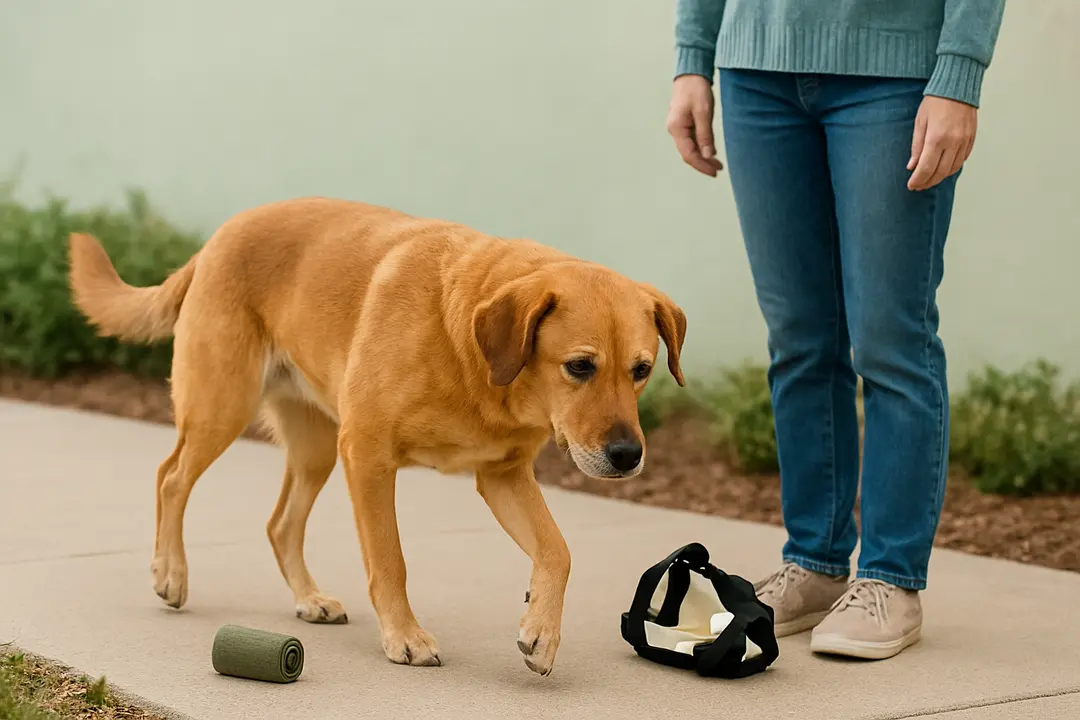
Go to an emergency vet now if your dog is limping after a major accident, even if they can walk, or if they can’t stand without help, are newly dragging a leg, or seem to be in severe pain. If your dog can walk on three legs but won’t put the fourth paw down, call a vet now for a same-day exam. If the limp is slight and your dog still puts weight on the paw, stop exercise and ask your clinic whether a short period of rest at home is appropriate.
Check what happened before you judge how your dog walks
If your dog was hit by a car or had another major accident, head to an emergency veterinary hospital. A dog can walk away from an accident with injuries you can’t see. Tell the hospital about the accident first, even if a sore paw is the only thing you’ve noticed. Don’t spend time checking the nails or asking your dog to walk across the room.
Even without a known accident, go to an emergency hospital if you see any of these signs:
- Your dog collapses, has trouble breathing, or can’t stand or walk without help.
- Your dog suddenly loses the use of a leg and drags it instead of picking the paw up.
- A leg looks crooked after an injury, or you can see bone through a wound.
- Your dog seems to be in severe pain. You don’t need to wait to see how long it lasts.
Keep your dog as still as you can for the trip. If you need help getting them into the vehicle, call the hospital for instructions. Don’t straighten a crooked leg or try to make a splint. Cornell’s guide to emergency signs explains why an accident, sudden loss of leg function, or signs such as breathing trouble need attention beyond a check of the sore leg.
If there are no emergency signs, watch whether the paw takes weight
Use a movement your dog makes on their own, such as standing up beside you. There’s no need to take a test walk. Look at what happens as your dog steps: does the leg support the body, or do the toes only brush the floor?
| What you see | What to do |
|---|---|
| Your dog can stand and get around on three legs but keeps one paw lifted. | Call your vet now for an exam today. If your clinic is closed, call urgent care or an emergency hospital for direction rather than waiting until morning. |
| The toes touch down, but your dog immediately shifts weight off that foot. | Tell the clinic exactly that when you call. Touching the floor isn’t the same as using the leg to stand or step. |
| Your dog takes weight on all four feet but has a slightly uneven step and otherwise seems comfortable. | Stop the walk or play session. If there was no major accident and there are no other concerning signs, ask your vet about brief rest and what change should prompt an exam. |
VCA’s guide to urgent care for limping makes a useful distinction: a dog who can get around on three legs may be seen at urgent care, while a dog who can’t get up or walk without help needs an emergency hospital. A serious wound also warrants an immediate call, whether or not the dog is using the paw.
Suppose your dog comes back from a chase holding up a hind paw, eats dinner, and lets you touch the leg. Those details are worth reporting, but the important one is still the paw held off the floor. Limping usually means pain or weakness, and dogs don’t always cry when they hurt. PDSA’s advice on limping and stiffness recommends contacting a vet immediately when a dog won’t put a leg down. You don’t have to find a painful spot to justify that call.
What you can safely check on a sore paw
A cut pad, a damaged nail, or something caught between the toes can make a dog favor a leg after a walk. These are things you might be able to see without moving the leg. For a mild limp, let your dog settle in a comfortable position before you look. Skip the check if it would delay urgent care.
- Look at the pads you can see. Note any cut or bleeding and which pad it’s on. You don’t need to press the pad to see if it hurts.
- Look at the nails and between the toes. Note a broken nail or a visible object. Describe what you see rather than digging into the paw to find out how deep something goes.
- Stop if your dog resists or seems uncomfortable. It’s useful to tell the clinic, “I couldn’t see the underside of the paw.” You don’t need to finish the inspection.
A normal-looking paw tells you only that you didn’t see an obvious injury there. The problem could be farther up the leg. Don’t bend the knee, turn the hip, or squeeze along the bones to test them. VCA’s first aid guidance for limping dogs cautions that moving a broken bone or a joint that has slipped out of place can worsen the injury, even if your dog doesn’t react.
How to rest a mild limp and tell whether it’s improving
If your clinic advises rest, use a leash for short bathroom trips, including in a fenced yard where your dog might otherwise run. Skip long walks, fetch, rough play, jumping on furniture, and unnecessary stairs. The aim is to meet your dog’s needs without repeatedly loading the sore leg to see how well it works.
On the next necessary outing, compare like with like. Is your dog taking more weight on the paw than on the last trip, about the same, or less? Is there swelling you didn’t see before? Those observations are more useful than whether your dog is excited to go outside. Don’t lengthen the walk to see if the limp goes away.
Call back if the limp worsens, pain or swelling increases, or you don’t see the start of improvement. If your dog stops putting the paw down, call right away. PetMD’s overview of limping in dogs notes that a mild new limp may improve with rest, but worsening or lack of prompt improvement calls for veterinary advice. Agree on a time to update your clinic rather than assuming you should wait overnight or through a weekend.
What to tell the clinic and what to expect at the visit
Start the call with what happened and what your dog can do now. “Left hind leg, started after a run, now standing on three legs” gives the clinic more to work with than “I think it’s a sprain.” If you didn’t see the start of the limp, say when you last saw your dog walking normally. Mention any accident, even if your dog got up afterward.
Tell the clinic whether the limp is constant or comes and goes, whether it’s changing, and what you saw on the paw. Mention any medicine already given. Ask your vet before giving any pain reliever; that includes human medicines and prescriptions left over from another dog. The FDA’s guide to pain relievers for pets explains why the choice needs to be made for the individual dog.
Your vet will use that history and a physical exam to decide what to check next. As VCA’s guide to lameness explains, X-rays can help evaluate bones and joints when a fracture is a concern, but not every limp needs imaging. Before you leave, ask how much activity is allowed, what improvement to look for, and when to call if it doesn’t happen. That gives you a plan for your dog rather than a guess about how many days a limp should last.
Talk it through with Vicky
If you’re unsure how to describe a mild limp, you can tell Vicky what you’re seeing right now. Vicky will bring in Dr. Diego (Virtual DVM, DACVSMR), our Sports Medicine & Rehabilitation Specialist, to help you put those observations into words for your clinic. If your dog has an urgent sign, contact your veterinarian or emergency hospital directly.
Common questions
My dog limps after getting up but walks normally at the clinic. Does the vet need to see it happen?
You can call about a limp even if it comes and goes. A short video of your dog getting up or moving naturally at home can help your vet see what you mean. Don’t make your dog repeat the movement to get a recording.
Can I tell a sprain from a broken bone or a torn knee ligament at home?
Not reliably. The way your dog holds the leg helps you describe the limp, but it doesn’t identify the injured part. Leave bending or testing the joint to your vet.
Can I give my dog ibuprofen or naproxen while waiting to be seen?
Don’t give either unless your veterinarian specifically directs you to. Call for a pain relief plan for this dog; if you’ve already given a medicine, tell the clinic what it was and when you gave it.
What if I can’t tell which leg my dog is favoring?
Say what you can see, such as an uneven step after getting up, and tell the clinic you’re unsure which leg it is. You don’t need to lift each paw in turn or make your dog walk farther before calling.
Sources
- Emergencies in Dogs — VCA Animal Hospitals
- Broken Bones in Dogs: Diagnosis and Recovery — PetMD
- Limping and stiffness in dogs — PDSA
- Exercise Restriction in Dogs — VCA Animal Hospitals
- First Aid for Limping Dogs — VCA Animal Hospitals
- Get the Facts about Pain Relievers for Pets — U.S. Food and Drug Administration
- Urgent Care for Pain or Limping — VCA Animal Hospitals
- When to go to the ER — Cornell Riney Canine Health Center
- Why Is My Dog Limping? — PetMD
- What to expect when taking your limping dog to the veterinarian — Cornell University College of Veterinary Medicine
- Lameness in Dogs — VCA Animal Hospitals


