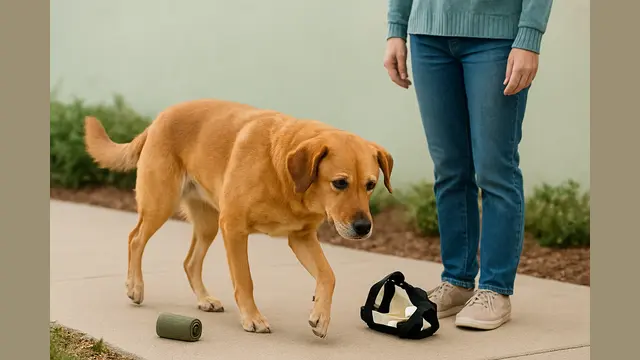
What is limp tail syndrome, and when should a vet check my dog's suddenly drooping tail?
Learn when a drooping tail needs a vet exam or emergency care, what to check without bending the tail, and how dogs recover from a tail-muscle strain.

In this guide (7 sections)
Call your vet about a suddenly drooping or painful tail, even if your dog went swimming yesterday. Limp tail syndrome, also called limber tail, is a painful but usually temporary strain of the muscles near the base of the tail; a break or a lower-back problem can look similar. If your dog is otherwise comfortable, walks normally, and passes urine normally, your regular clinic can advise you on when to come in.
When a drooping tail needs emergency care
Go to an emergency vet now if you notice any of the following. In these situations, what happened to your dog, or what else your dog can no longer do, matters more than whether the tail still moves.
- Major trauma, severe pain, or heavy or uncontrolled bleeding. If your dog was hit by a vehicle, go even if the tail is the only thing that looks wrong. Serious injuries aren't always visible. Cornell's guide to emergency care and Texas A&M's veterinary emergency service explain which injuries and signs need immediate attention.
- Sudden weakness in the back legs, a dragging leg, inability to stand or walk, or new loss of bladder or bowel control. Don't assume your dog is moving oddly because the tail hurts. These changes can point to a problem affecting the spinal cord or nerves, which can worsen quickly. The Animal Medical Center's guide to spinal disc disease and PetMD's guide to sudden loss of movement describe these signs.
- Repeated attempts to pee with no urine or only drops coming out. This is different from taking a while to get into position and then passing a normal stream. A few drops don't rule out a blockage. The American College of Veterinary Surgeons explains urinary obstruction and why it needs immediate treatment. Don't wait for another bathroom break.
If it's after hours and you can't tell which situation you're seeing, call an emergency clinic and describe it. Lead with the most concerning change: “My dog is dragging a back leg” tells the team more about the immediate problem than “My dog isn't wagging.”
What limp tail syndrome looks like
Picture a dog greeting you the morning after a long game of fetch. Usually you hear the tail thump against the floor. Today your dog walks over as usual, but the tail hangs down, and instead of sitting beside you, your dog stays standing. Yesterday's exercise makes muscle soreness worth considering. It doesn't tell you for certain why the tail has dropped.
The medical term is acute caudal myopathy, meaning a muscle problem in the tail that comes on suddenly. When the muscles near the base are overworked, lifting or swinging the tail can hurt. The whole tail may hang down, or the first few inches may stick out from the body before the rest drops. Reluctance to sit can be a clue to pain even if your dog doesn't cry out.
As Cornell's guide to limber tail explains, the amount of activity matters. Think about what was unusual for your dog: an afternoon of retrieving rather than a few throws, a longer swim than usual, or a hunting trip after time off. A sore tail after a favorite activity can happen even when you've been careful.
What to check without bending the tail
If there are no emergency signs, a few observations can help your vet decide what to examine. You don't need to make your dog perform a movement or find the exact spot that hurts.
- Work out when the change appeared. Note the last time you saw the tail carried normally and the first time you noticed the droop. Include the previous day's activity, even if your dog seemed comfortable afterward. Mention any accident you saw. If the tail was already down when you got home, say that rather than guessing how the injury happened.
- Watch an ordinary greeting. Notice where the droop starts and whether any part of the tail moves on its own. Describe what you see: “The base lifts, but the rest hangs down” is more useful than trying to label the injury. Don't lift the tail, straighten it, or press along it to test for pain.
- Watch your dog get up and settle. Can your dog stand and walk on all four legs but hesitate to sit? Or is a back leg suddenly weak or dragging? The first observation helps your vet assess discomfort; the second changes the plan to emergency care. There's no need to ask for repeated sits or take your dog for a test walk.
- Notice the result of a bathroom break, not just the posture. If your dog goes outside to pee, look for an actual stream. If you couldn't see whether urine came out, tell the clinic you're not sure. Be specific about repeated attempts that produce nothing or only drops, rather than reporting that your dog “went a few times.”
How your vet tells a muscle strain from other causes
There's no single test that proves a dog has limber tail. Your vet puts the activity history together with the physical exam. Knowing that the droop appeared after exertion helps, but so does knowing whether your dog can walk normally and whether sitting or moving the tail seems painful.
A tail bone can fracture (break), or a tail joint can dislocate (move out of its normal position). Both are reasons not to try to straighten a drooping tail at home. Your vet may also check the lower back and the anal glands, the small sacs beside the anus. Pain in those areas can resemble tail pain. VCA's guide to limber tail and its look-alikes explains why the exam may extend beyond the part of the tail that droops.
What you can do for pain while arranging care
Pause swimming, fetch, and other strenuous exercise. Give your dog a quiet place to rest in whatever position is comfortable. If the clinic asks how sore your dog seems, describe a movement your dog now avoids. You don't need to trigger a painful response to show that something has changed.
Ask your vet before giving any pain medicine. Don't reach for ibuprofen, acetaminophen, or a prescription left over from another dog. The FDA's guide to pain relievers for pets explains why medicines in the home can be harmful. If the exam points to a muscle strain, your vet may prescribe an anti-inflammatory medicine for your dog along with rest.
What recovery looks like after a confirmed strain
Many dogs recover within a few days; some take up to about two weeks. That's a healing period after diagnosis, not a waiting period before the first call. Before leaving the clinic, ask how long your dog should rest and when your vet wants an update if there's no clear improvement.
At home, compare everyday movements with what you saw when the problem began. Is it easier for your dog to sit comfortably? Is the tail starting to lift on its own during a greeting? Those changes are more useful to report than how far you can move the tail by hand. If pain is getting worse rather than easing, contact your vet instead of waiting for the planned recheck. The emergency signs above still apply, even if your dog has already been seen for a strain.
Talk it through with Vicky
You can tell Vicky what you're seeing right now, including what your dog did yesterday, how the tail hangs, and whether your dog is walking and peeing normally. Vicky will bring in Dr. Diego (Virtual DVM, DACVSMR), our Sports Medicine & Rehabilitation Specialist, to help you prepare questions for your vet. For emergency signs, go directly to an emergency clinic.
Common questions
Can my dog get swimmer's tail without swimming, or after swimming in warm water?
Yes. The name refers to one activity that can overwork the tail muscles, not a requirement for cold water. A demanding swim in warm water or unusually strenuous exercise on land can also fit the history.
Does a small wag rule out a broken tail?
No. A small wag tells you that part of the tail moves, not whether a bone or joint is injured. Let your vet examine it rather than testing how far it bends.
Does my dog need an X-ray for limber tail?
Not always. An X-ray can help your vet look for a broken bone or a joint that's out of place. It isn't a stand-alone test for a tail-muscle strain.
Why did my dog seem fine after exercise but wake up with a limp tail?
Muscle soreness may first become noticeable the morning after strenuous activity. Tell your vet about yesterday's outing and whether the tail was still moving normally afterward; that timing is useful even if you didn't see an injury.
What if my dog already takes medicine for pain?
Tell the prescribing vet what your dog takes and describe the new pain. Don't add a human pain reliever, give extra medicine, or use another dog's prescription without your vet's direction.
Can my dog play fetch again as soon as the wag comes back?
A returning wag is an encouraging change, not a test of readiness for strenuous play. Follow your vet's rest plan and ask when your dog can resume fetch or swimming.
Sources
- Limber tail in dogs (acute caudal myopathy) — Cornell University College of Veterinary Medicine
- Acute Caudal Myopathy (Limber Tail) — VCA Animal Hospitals
- When to go to the ER — Cornell Riney Canine Health Center
- Paralysis in Dogs: Causes, Symptoms, and How To Manage It — PetMD
- Urinary Stones — American College of Veterinary Surgeons
- Get the Facts about Pain Relievers for Pets — U.S. Food and Drug Administration
- Swimmer’s Tail in Dogs — Veterinary Partner
- Emergency Medicine — Texas A&M Veterinary Medical Teaching Hospital
- What to Do in a Dog or Cat Emergency — Merck Veterinary Manual
- Intervertebral Disc Disease (IVDD) in Dogs — The Animal Medical Center
- First-aid for poisonous substances — Cornell University College of Veterinary Medicine