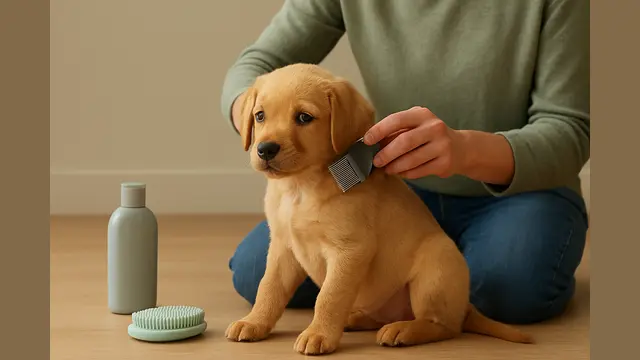
How can I get fleas off my dog and keep them from coming back?
Find out how to kill fleas on your dog, protect every pet, and clean the places fleas develop. Learn what to check if live fleas appear after treatment.

In this guide (7 sections)
Use a flea treatment labeled for your dog’s species, age, and current weight to kill the fleas on your dog. To keep them from coming back, keep every dog and cat in your home on suitable year-round protection, wash their bedding regularly, and vacuum the places they rest. Those steps reach different parts of the same infestation.
First, check whether your dog needs urgent care
If your dog has a heavy flea infestation and has pale gums or seems markedly weak, go to an emergency veterinary clinic now. Don’t wait for flea medicine to help. Fleas feed on blood, and a heavy infestation can cause life-threatening blood loss, especially in a puppy.
If your dog lets you, gently lift the lip to look at the gums. If your dog is already weak, you don’t need to finish inspecting the gums or counting fleas before you leave. Tell the clinic what you noticed and that you’ve seen fleas. As the Merck Veterinary Manual’s guide to anemia in dogs explains, pale gums and weakness can signal anemia, meaning too few red blood cells. A veterinarian needs to assess how serious it is and what caused it.
Choose a treatment for the fleas on your dog
Start with what your dog has already received. Check for a flea collar, and write down the name and date of any flea tablet, shampoo, or liquid you’ve used. For example, if your dog is wearing a collar and still scratches after a flea shampoo, another product isn’t the next thing to try. Take photos of both labels so your vet can see the ingredients before advising you on a change.
When comparing treatments, look for three answers on the package:
- Is it suitable for this dog? Check that the product is for dogs and that your dog meets its age and weight requirements. Don’t assume a product that suits your older dog will also suit a new puppy.
- What does it do? If you’re seeing live fleas, look for a treatment that kills adults. One example is nitenpyram, a fast-acting flea tablet. How quickly a medicine kills the fleas already on your dog is a different question from how long it protects your dog.
- What is the plan after this treatment? Check the stated protection period and directions for the next treatment. If you can’t tell whether a product meets both your immediate and ongoing needs, ask your vet before adding anything else. The FDA’s flea product safety guidance explains why the directions for the particular product and pet matter.
Protect every dog and cat, even the indoor cat
Make one household plan, but choose protection for each pet individually. Suppose your dog sleeps on the sofa with a cat who never goes outside. If you treat only the dog because that’s where you saw a flea, you’ve left out a pet that uses the same resting place. Your indoor cat needs consistent protection, too. Never put a dog-only flea product on a cat.
For each pet, record the product name, when it was last used, and when the next treatment or collar replacement is due. If one pet is already protected, include that pet on the list without moving the treatment date forward. The goal is for every pet to have coverage, not for every pet to receive medicine on the same date.
Set a reminder for each due date while you have the label in hand. This is especially useful if two pets use different products: your dog’s reminder won’t necessarily tell you when your cat’s protection needs renewing. Tufts explains why consistent protection matters for indoor pets, even after fleas are no longer visible.
Wash bedding and vacuum where your pets rest
Think through where your dog spent yesterday. The blanket at the foot of your bed, the rug beside your desk, and the sofa cushion your dog shares with the cat all belong on your cleaning list. Flea eggs fall from the coat, so the places where your dog settles can matter as much as the bed you bought for them.
- Wash the bedding your pet actually uses. Include washable bed covers, blankets, and throws. If your dog sleeps on your bed, include that bedding as well. Follow the fabric care instructions and return these items to the laundry regularly.
- Vacuum rugs and upholstered furniture. Work around your pet’s favorite spots, including underneath furniture and along the cushions where your pet lies. If the dog bed sits on a rug, lift the bed to reach the rug rather than cleaning only the cover.
- Make the routine repeatable. Keep a short list of the resting places you’ve identified, including any used only by another pet. Revisit those spots while you keep up each pet’s protection. One big clean doesn’t replace either part of the plan.
Both Texas A&M’s flea control guide and the ASPCA’s advice on fleas in the home pair care for the pets with cleaning their surroundings.
Why live fleas can appear after treatment
Finding another flea does not necessarily mean the medicine failed. Before you treated your dog, eggs may already have fallen into the bedding or carpet. Young fleas called larvae develop there. They then form protected cocoons, from which new adults can emerge weeks or even months later. That newly emerged adult wasn’t on your dog when you treated the fleas you could see.
This can happen even when you’ve been careful. The Cornell guide to fleas explains why clearing an established infestation is a matter of weeks to months rather than a single treatment. That’s a reason to keep protection going, not a reason to wait months for help if your dog is uncomfortable.
What to check over the next few weeks
Track two things separately: Are you seeing fewer live fleas? Is your dog’s skin getting more comfortable? Note the date when you see a live flea and whether the scratching is easing or leaving sore spots. Those observations help you decide what to do next.
| What you notice | What to do next |
|---|---|
| You see a live flea before the next treatment is due. | Check each pet’s treatment record and revisit shared sleeping places. A flea sighting isn’t a reason to shorten the labeled interval. |
| You keep finding fleas despite regular cleaning and protection for every pet. | Ask your vet to go over the products, treatment dates, and resting places with you. Bring the labels rather than relying on the package colors or brand names. |
| You see fewer fleas, but your dog keeps scratching, develops sores, or loses hair. | Arrange a veterinary visit. The skin may need care of its own; adding another flea killer won’t tell you whether there’s a skin infection. |
When you call about itching, tell the clinic when it started, what you’ve actually seen in the coat, and whether the skin is looking better or worse since treatment. A picture of a sore can show how it has changed. Your vet can examine the skin and decide whether your dog needs treatment beyond flea control.
Talk it through with Vicky
You can tell Vicky what you’re seeing right now, whether that’s a live flea after treatment or scratching that hasn’t eased. Include what each pet has received and when. Vicky will bring in Dr. Nadia (Virtual DVM, DACVD), our AI specialist in veterinary dermatology, to help you sort out your next step.
Common questions
Are black specks in my dog’s coat enough to tell if treatment failed?
No. Save a sample or take a clear photo for your clinic, and note whether you also saw a moving flea. Even a live flea can be one that recently emerged from the surroundings, so don’t use specks alone to decide that another treatment is due.
Can I stop flea prevention in winter if I’m not seeing fleas?
Keep suitable prevention going year-round for every dog and cat. Cocoons can persist in indoor furnishings, so neither cold weather outside nor a clear-looking coat tells you that no more fleas will emerge.
How should I choose flea medicine if my dog has a health condition?
Ask your own veterinarian which product fits your dog’s health history rather than choosing by age and weight alone. Have your dog’s current weight and the labels of any flea products already used available when you call.
What if my cat may have been exposed to my dog’s flea treatment?
If a dog-only flea liquid may have gotten on your cat, call your veterinarian or an animal poison control service now. Have the package with you so you can identify the product and explain what happened.
Sources
- Cornell University Riney Canine Health Center — Fleas
- Tufts Cummings School of Veterinary Medicine — Is Winter Flea Prevention for Pets Necessary?
- FDA — FDA Approves Generic Nitenpyram Tablets to Treat Flea Infestations in Dogs and Cats
- Pet Poison Helpline — What’s New in Flea/Tick Control? Battling Bugs with Tasty Tidbits
- ASPCA Animal Poison Control — Using Flea Medications Safely: Top 5 Tips for Pet Parents
- Pet Poison Helpline — Common Flea and Tick Toxicity Questions and Answers
- Texas A&M College of Veterinary Medicine — Treating and Preventing Fleas
- ASPCA — Fleas and Ticks
- Merck Veterinary Manual — Anemia in Dogs
- Fleas in Dogs and Cats
- Veterinarian Advice For Keeping Pets Flea-Free
- Safe Use of Flea and Tick Products in Pets