How can I get rid of fleas on my dog and keep them from coming back?
Learn how to check your dog for fleas, choose treatment for each pet, clean their resting spots, and tell whether your flea control plan is working.
In this guide (5 sections)
Treat every dog and cat in your home with a flea product suited to that pet, and start cleaning the places they sleep on the same day. To keep fleas from coming back, follow each product’s prevention schedule and repeat the cleaning as new fleas emerge. If you see a flea on a dog you’ve already treated, check what you used and when before giving anything else.
Check for fleas and flea dirt
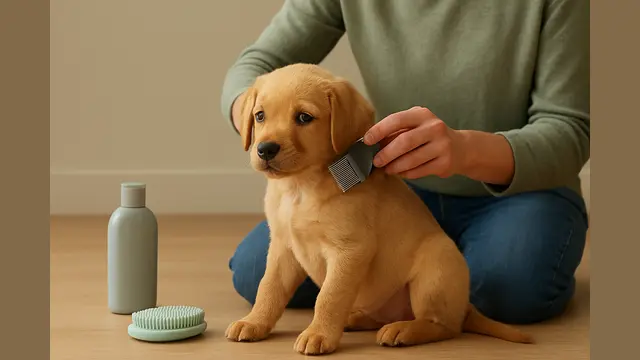
Part the hair at the base of your dog’s tail and on the insides of the hind legs. Run a fine flea comb through those areas over a damp white paper towel. Look for a moving flea, but pay attention to the grit caught between the comb’s teeth, too.
Black specks that leave a rusty-red stain on the damp towel suggest flea dirt: flea droppings that contain digested blood. Ordinary dirt doesn’t give you that same clue. If you find neither fleas nor flea dirt, itching alone isn’t a good reason to apply another flea treatment. If you do find a flea, it counts even if your dog hardly scratches. The VCA guide to checking for fleas explains where to look and how to recognize flea dirt.
A weak dog with pale gums needs veterinary care now. If gums that are usually pink look pale and your dog is weak or unusually low on energy, call your vet for immediate care. If they can’t see your dog right away, go to an emergency veterinary clinic rather than waiting for a regular appointment. These can be signs of anemia, meaning too few red blood cells. A heavy flea infestation can cause blood loss, particularly in a puppy, but don’t assume fleas are the cause. The Merck Veterinary Manual’s guide to anemia explains the signs of blood loss, and PDSA’s guide to pale gums explains why a change in gum color warrants immediate veterinary contact.
Choose treatment for each pet, including the ones that don’t scratch
The goal is to have every dog and cat covered at the same time, not to give every pet a new treatment today. An indoor cat belongs in the plan; so does a dog whose prevention is already up to date. Before opening a package, make a list for each pet: current weight, product last used, date given, and next treatment due.
- Match the label to the animal. Check the species, age, weight range, and health precautions. A product intended for your dog is not a substitute for one labeled for your cat. If you have a young puppy or aren’t sure a product fits, give your vet the puppy’s age and current weight and ask them to help you choose.
- Ask two questions: How fast does it kill fleas, and how long does it keep working? These are different jobs. For example, VCA’s guide to nitenpyram describes a tablet that starts killing adult fleas in about 30 minutes but works for only about a day or two. That can address fleas on your dog today without protecting against the ones that emerge weeks from now. Other products last much longer. Read the interval on the exact package rather than assuming that all chews or all spot-ons last a month.
- Make sure you can use it as directed. For a spot-on liquid, check where to apply it and what the label says about bathing. Record the treatment date as soon as you give it, then put the next due date on your calendar. That way, a second person caring for your dog won’t have to guess whether treatment is due.
If a treatment is still within its labeled interval, don’t shorten the interval or add a different flea medicine on your own. The ASPCA’s guide to using flea medications safely recommends checking with your veterinarian before combining products. Have both packages handy so your vet can check what’s in them.
Clean the places fleas develop, even if you have no carpet
Some of the fleas you’re trying to get rid of aren’t on your dog. Immature fleas collect in pet beds, rugs, and upholstery. A comb can remove fleas from the coat, but it can’t reach the ones developing under your dog’s favorite chair. Start with a walk through your home: where does each pet nap during the day, and where do they sleep at night?
- Wash the bedding. Gather the pet beds or removable covers, blankets, and washable rugs your pets use. Include the throw on the couch or the bedding on your bed if that’s where your dog sleeps. Follow the care instructions and wash pet bedding weekly while you’re working on the infestation.
- Vacuum the resting spot and the area around it. Vacuum rugs, carpet edges, upholstery, and the floor under furniture. On a couch, get under the cushions as well as the surface your dog lies on. On a hardwood floor, pay attention to the edges, gaps, and area beneath the dog bed. A room without carpet can still have a well-used blanket or chair worth cleaning.
- Discard the vacuum waste after use and repeat the vacuuming frequently. It helps to pair the two jobs: when you lift a bed to wash its cover, vacuum underneath before putting it back. Texas A&M’s flea control guide explains why repeated vacuuming and weekly bedding washes are part of treating the pets, not an alternative to it.
Cleaning doesn’t mean you need to spray every surface. If you’re considering a household insecticide, check the label for where it can be used and when pets may return. For an established infestation, a licensed pest professional can help you decide which areas need treatment. Tell them where your pets spend their time and what cleaning you’ve already done.
What to do if you still see live fleas after treatment
A flea on your dog this morning may not have been there when you gave the treatment. Adult fleas can emerge from protected cocoons months later, as Cornell’s guide to fleas explains. A newly emerged flea can get onto a treated dog and be visible before it dies. This can happen even when you’ve used the product correctly and kept up with the laundry.
Control of an established household infestation can take weeks to months. That’s not a reason to ignore fleas for months. Compare like with like: comb the same parts of your dog’s coat at each check and write down the date and what you find. Use the pattern to decide what to do next:
- Fewer fleas over successive checks: Keep up the cleaning and scheduled prevention. One clear comb check is encouraging, but it doesn’t tell you that all the cocoons in the home are gone.
- About as many fleas as before, or more: Ask your vet to review the plan. Bring the package and your treatment record. Explain how you applied or gave the product, whether your dog was bathed around that time, which other pets are covered, and where your dog spends time. Those details help your vet check the fit, timing, and application and consider exposure to new fleas. Guidance on early flea retreatment explains why to review these details rather than giving an extra treatment.
- Fewer fleas, but your dog keeps chewing or has sore skin: Make a veterinary appointment for the skin problem. Chewing and hair loss near the tail or thighs can occur with an allergy to flea bites, and damaged skin can develop an infection that needs treatment. Tell the clinic both parts of the story: what you’re finding with the comb and whether the skin is getting better or worse. More flea medicine is not a substitute for checking those sores.
Talk it through with Vicky
You can tell Vicky what you’re seeing right now. Include what came out on the comb, the name and date of the last treatment, and whether any patches of skin look sore. Vicky will bring in Dr. Nadia (Virtual DVM, DACVD), our team’s AI veterinary dermatology specialist, to help you sort through the flea and skin questions.
Common questions
Will a flea bath or dish soap get rid of fleas? Can I bathe my dog after a spot-on?
Washing your dog doesn’t address the fleas developing in bedding, rugs, or upholstery, so a bath alone won’t clear a household infestation. After a spot-on treatment, follow that exact product’s bathing instructions rather than using a waiting period you remember from another product.
Can my indoor cat groom my dog after a flea treatment?
For a spot-on, check the dog product’s instructions about contact with other pets before you apply it. Keep your cat from licking or rubbing against the treated area for the period the label directs. If your pets are hard to separate, ask your vet to help you choose a product that suits your household.
Does a chew with the same ingredient as a spot-on last just as long?
Not necessarily. For example, one fluralaner spot-on has a 12-week interval, but not all oral fluralaner products share that schedule. Use the instructions for the formulation you actually gave your dog.
Do I need to treat my whole yard for fleas?
Don’t assume a flea on your dog means the whole lawn needs spraying. Start with the pets and the places they rest. If the problem persists, tell a licensed pest professional where your dog rests outdoors and ask whether those areas need treatment.
Can I stop flea prevention when winter arrives?
Cold weather isn’t evidence that the fleas in your home are gone. Adults can still emerge from protected cocoons months later, so follow your pet’s prevention schedule and ask your vet before changing it.
Sources
- CDC — Getting Rid of Fleas
- VCA Animal Hospitals — Nitenpyram
- PetMD — Can I Reapply Flea Treatment Early?
- Pet Poison Helpline — Common Flea and Tick Toxicity Questions and Answers
- ASPCA — How to Safely Treat Your House with Insecticides
- Cornell University College of Veterinary Medicine — Fleas
- Merck Veterinary Manual — Anemia in Dogs
- PDSA — Are My Dog’s Gums Pale?
- VCA Animal Hospitals — How to check your pet for fleas
- Texas A&M Veterinary Medicine & Biomedical Sciences — Treating and Preventing Fleas
- VCA Animal Hospitals — Fluralaner
- ASPCA Animal Poison Control Center — Using Flea Medications Safely: Top 5 Tips for Pet Parents