How can I tell if my cat has intestinal worms, even if I don't see worms in the litter box?
Learn which changes in weight, appetite, and stool can point to worms, when your cat needs urgent care, and how a vet checks a sample for parasite eggs.
In this guide (7 sections)
- When to go to an emergency vet and when to call your clinic
- What worms look like, and where you might see them
- Signs to check when there's nothing visible
- How to bring your vet a useful stool sample
- What a negative fecal test means
- How exposure and follow-up shape the treatment plan
- Talk it through with Vicky
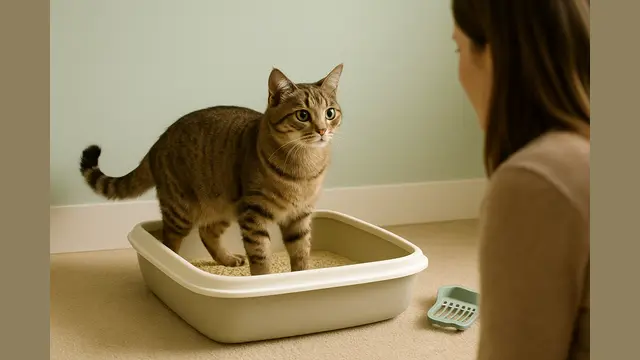
Not seeing worms in the litter box does not rule them out: adult roundworms live in the intestine, their eggs are microscopic, and some infected cats look healthy. Watch for weight loss despite eating well, diarrhea that keeps coming back, or a kitten with a round belly that isn't growing well. If you notice these changes, call your vet about an exam and a fresh stool sample rather than waiting to see a worm.
When to go to an emergency vet and when to call your clinic
Go to an emergency veterinary hospital now if your cat collapses, struggles to breathe, or is so weak that standing or walking is difficult. Profuse diarrhea with marked weakness is an emergency, as are white or very pale gums in a weak cat. Don't wait for a photo, a stool sample, or a test result. These signs need attention whether or not worms are involved. The Merck Veterinary Manual's guide to emergency signs and VCA's guidance on vomiting and diarrhea can help you distinguish a sick cat from one with a change in the litter box alone.
Get urgent veterinary advice if your cat vomits repeatedly, passes several watery stools, or has blood in the stool. Mention black, tarry stool specifically: it can contain digested blood even though it doesn't look red. Call an emergency clinic now if you see thick, black, tarry stool.
Call your regular clinic for an appointment if your cat otherwise seems well but is losing weight, keeps passing soft stool, or leaves rice-like pieces on the bed. A kitten with a swollen belly and poor growth also needs a veterinary check. You can make that call before you have anything to show the vet.
What worms look like, and where you might see them
You can scoop the box carefully every day and still miss the most useful clue. A tapeworm segment may turn up where your cat sleeps. An adult roundworm occasionally passes in vomit rather than stool. Here's what to look for without having to identify the parasite yourself:
| What you see | What it might mean | What helps your vet |
|---|---|---|
| A piece shaped like a grain of rice on bedding or on the fur under the tail | It could be a tapeworm segment. | Photograph it where you found it. Note whether new pieces keep appearing. |
| A long, cream-colored piece like a strand of spaghetti in stool or vomit | That appearance can fit an adult roundworm. | Take a clear photo and say whether your cat passed it in stool or brought it up. |
| Formed stool with no visible pieces | Looking at stool can't tell you whether it contains parasite eggs. | Report any changes in your cat's weight, appetite, or growth even if the stool looks normal. |
If the piece is on a blanket, a picture of the blanket is enough; there's no need to make a frightened cat pose for a photo under the tail. The useful details are its shape, where you saw it, and when. Cats Protection's guide to worms in cats explains why bedding and the fur around the rear can offer clues that aren't in the box.
Signs to check when there's nothing visible
- Compare appetite with weight. Is your cat finishing the usual meals, or asking for more, but getting thinner? Tell your vet both parts. If you already have weights from different dates, share them. Increased appetite and weight loss can occur with worms, but eating well doesn't confirm or rule out an infection.
- In a kitten, compare belly size with overall growth. A rounder belly isn't the same as healthy growth. A kitten with roundworms can have a swollen abdomen while gaining less weight than expected. Tell the clinic if your kitten's belly looks bigger, the rest of the body isn't growing as expected, or you're also seeing diarrhea. PDSA's overview of feline worms describes these signs and why a kitten's age and weight matter for treatment.
- Describe the pattern of loose stool or vomiting. Write down when it started, how often it happens, and whether the stool is soft or watery. If your cat still eats and plays between episodes, mention that too. Worms are one possible cause of diarrhea, not the only one. Knowing that the problem has returned several times gives the vet information that a single stool sample cannot.
How to bring your vet a useful stool sample
Call first and ask whether the clinic wants a sample for the visit. Start with the change that prompted the call: for example, your cat is eating as usual but getting thinner, or you've found rice-like pieces on the bed twice. Then ask how the clinic would like you to collect and deliver the stool.
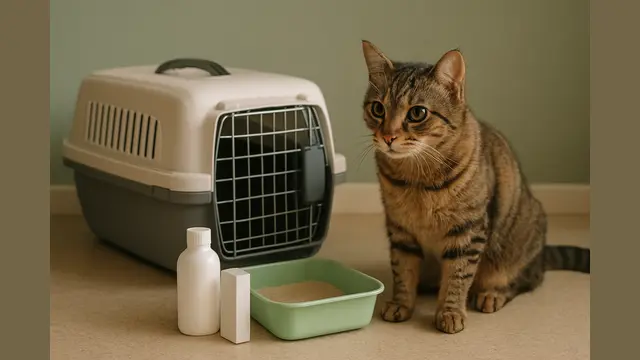
- Collect freshly passed stool with as little litter as possible. You don't need to find a piece that looks like a worm. For an egg check, even ordinary-looking stool can be useful.
- Use a clean container with a tight-fitting lid. Note when your cat passed the stool. If more than one cat uses the box, tell the clinic whether you actually saw which cat passed it; don't label a shared-box sample as coming from one cat if you're unsure.
- Bring the history along with the sample. Have any photos, previous stool-test results, and the name and date of any worm treatment handy. A photo of a piece on bedding and a sample from the litter box show the vet two different things. One need not replace the other.
What a negative fecal test means
At the visit, your vet can put the exam findings together with your cat's history and a stool test. A common test called a fecal flotation, or fecal float, lets the clinic look for parasite eggs under a microscope. A negative result means no eggs were found in the sample examined. What to do next depends on why you suspected worms in the first place.
- If your vet suspects roundworms: Young worms that aren't laying eggs yet can be missed. Your vet may want to examine another stool sample. Ask when to collect it rather than assuming that a sample from the next trip to the box will settle the question. VCA's explanation of fecal flotation describes this limit of the test.
- If rice-like pieces keep turning up: Show your vet a photo even after a negative test. A piece your cat left on a blanket wasn't necessarily in the stool the clinic examined. Banfield's tapeworm guide explains how a picture can help when stool testing misses an infection.
- If the main concern is ongoing diarrhea or weight loss: Ask your vet to reassess that change, not only whether your cat needs another worm test. A negative test doesn't explain persistent symptoms, and persistent symptoms don't prove the test missed a worm.
How exposure and follow-up shape the treatment plan
Tell your vet if your cat hunts or has had fleas. Cats can pick up roundworms by eating infected rodents, and kittens can get a common roundworm through nursing, as the Cornell Feline Health Center's guide to intestinal parasites explains. Those details help your vet choose a plan suited to your cat rather than guessing from the stool's appearance. If tapeworms are suspected, ask about flea control alongside worm treatment to help prevent reinfection.
Before you leave the clinic, agree on what you'll watch and when to check back. For loose stool, record whether it's becoming formed or remains watery. For a kitten that hasn't been growing well, ask when your vet wants the next weight check. For suspected tapeworms, note any new segments you see after treatment. Following the change that first concerned you is more useful than treating an empty-looking litter box as proof that the problem is gone.
Talk it through with Vicky
You can tell Vicky what you're seeing right now, whether it's a rice-like piece on a blanket or a change in your cat's weight despite a good appetite. Vicky will bring in Dr. Ravi (Virtual DVM), our feline-friendly general practice veterinarian, to help you decide which details to share with your clinic and what to ask about testing.
Common questions
Can my indoor cat have worms even if she eats, plays, and poops normally?
Yes. Some cats with roundworms have no outward signs, and staying indoors now doesn't rule out an earlier exposure. If your cat seems well, ask your vet what testing makes sense for her history and lifestyle.
Are the rice-like specks on my cat's bed tapeworm eggs?
If they're from a tapeworm, the visible pieces are segments of the worm, not individual eggs. Shape alone isn't proof, so a photo of the specks can be useful to your vet.
Should I refrigerate my cat's stool sample if I can't take it in right away?
Call the clinic with the time the stool was passed and the time you can deliver it. Ask whether they want you to refrigerate that sample or collect a fresher one closer to the visit.
Does the dewormer my cat already received cover tapeworms?
That depends on the product. Give your vet its name before giving another treatment so they can check which parasites it targets. For a kitten, the choice must also suit the kitten's age and current weight.
Sources
- Roundworm Infection in Cats — VCA Animal Hospitals
- Fecal Flotation — VCA Animal Hospitals
- Worms in Cats — PDSA
- Worms in Cats — Cats Protection
- Tapeworms in Dogs and Cats: What Pet Owners Should Know — Banfield Pet Hospital
- Diarrhea in Cats — VCA Animal Hospitals
- Initial Triage and Resuscitation of Small Animal Emergency Patients — Merck Veterinary Manual
- When to See a Veterinarian — Merck Veterinary Manual
- Gastrointestinal Parasites of Cats — Cornell Feline Health Center
- Urgent Care for Diarrhea or Vomiting — VCA Animal Hospitals
- Examining Your Pets Stool — Texas A&M Veterinary Medicine & Biomedical Sciences
- How to Take Veterinary Photos of Your Pet — PDSA