Why does my cat pee on my bed, and how can I tell whether it's a health or litter box problem?
Learn when a cat peeing on the bed needs urgent care, how to recognize spraying or leaks, and what to check about urine output and litter box access.
In this guide (7 sections)
- First, is your cat passing urine?
- What the trips, clumps, and water bowl can tell you
- Was it a squat, a spray, or a leak?
- Why the comforter, if your cat still uses the box?
- Check the route to the litter box as well as the box itself
- What your vet may check, and what to do if it happens again
- Talk it through with Vicky
If your cat repeatedly strains to pee and produces only drops or nothing, go to an emergency veterinarian now. Otherwise, a puddle on the bed can mean that peeing hurts, your cat is producing more urine than usual, or your cat prefers the soft bedding or has trouble using the litter box. These can overlap: tell your regular vet about a new or recurring accident, even if your cat still uses the box.
First, is your cat passing urine?
A few drops do not rule out a blockage. If your cat keeps squatting and straining with little to show for it, don't wait until morning or for one more trip to the box. A wet comforter from earlier tells you that urine came out then, not that your cat can empty their bladder now. VCA's guide to urinary signs in cats identifies repeated straining with little or no urine as a reason for immediate care. Cornell's guide to lower urinary tract disease explains why a urinary blockage needs immediate treatment.
If your cat is passing urine without that repeated straining, call your regular clinic promptly about the change in habits. Start with the last time you saw this cat pass a usual amount. If you saw a box visit but not what came out, say that. You don't need to wait for another accident to make the call.
What the trips, clumps, and water bowl can tell you
When you say your cat is “peeing more,” you might mean more trips, more urine, or more accidents. Those are different clues. Texas A&M's guide to marking and urinary problems recommends noticing posture, discomfort, and the amount of urine. Here's how to describe what you're seeing:
| What you notice | What it can mean | What to tell the clinic |
|---|---|---|
| More trips, with smaller clumps than usual | Inflammation in the lower urinary tract, which includes the bladder, can make a cat pass small amounts often. | Say whether your cat seems uncomfortable and whether urine comes out on each attempt. Repeated straining with only drops or nothing is an emergency. |
| Larger clumps or puddles, along with more drinking | Kidney disease and diabetes can change how much a cat drinks and pees. | Mention both changes, even if your main concern is the bed. |
| A usual-looking pee, but on the comforter | The surface or access to the box is worth checking. A puddle alone doesn't tell you whether peeing hurt. | Describe where your cat squatted and whether you've also seen comfortable trips to the box. |
Use your cat's usual habits for comparison; you don't need a precise measurement. In a home with several cats, separate what you know from what you found. “I saw her squat on the quilt, but I don't know which cat made the clumps in the box” gives the clinic something it can use without guessing.
Was it a squat, a spray, or a leak?
A squat and a puddle on a flat duvet are typical of a cat using the bed as a toilet. Standing with the rear toward an upright surface, sometimes with a raised, quivering tail, is more typical of spraying, or urine marking. A small mark on the headboard after you saw your cat back up to it is a different observation from several squats that each produced a few drops. Cats Protection's guide to spraying recommends a vet check and advises against punishment.
There's a third possibility if you notice wet bedding where your cat rested. Incontinence means urine leaks rather than the cat deliberately stopping to pee. You might see urine escape while your cat is lying down or walking, or notice damp fur around the genitals. A wet patch after a nap isn't enough to tell: if you didn't see your cat stand, squat, or leak, describe the patch without guessing at the posture. The Merck Veterinary Manual's guide to urination problems explains how a vet can investigate a possible leak.
Why the comforter, if your cat still uses the box?
Picture a cat that pees in the box in the morning and squats on a folded quilt that evening. It's understandable to take the morning trip as proof that the box works. But knowing where the box is and feeling comfortable peeing there aren't the same thing.
If peeing hurt in the box, your cat may start avoiding the place where it hurt. Some cats also prefer a soft surface and use it when it's available, while continuing to use the box at other times. Cornell's guidance on feline house soiling describes both patterns. This can happen even when you're careful about keeping the box clean.
Notice whether the accident follows the place or the fabric. If your cat has used the same quilt on the bed and on the floor, mention it. That's a reason to consider a surface preference, not proof that the quilt is the cause or that your cat is free of pain.
Check the route to the litter box as well as the box itself
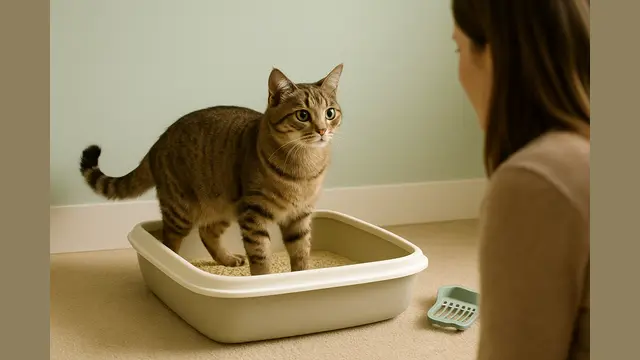
While arranging the vet check, look at the setup from where your cat starts. The useful question isn't only “Is there a clean box?” It's “Could my cat reach it and squat comfortably when they needed it?”
- Walk the route from the bed. Is the door open when your cat needs the box? If you have several cats, does one often sit in the only doorway to it? Even two boxes can share a single hard-to-reach entrance. If that's what you see, offer a box in a separate, quiet location.
- Watch how your cat gets in. Can your cat step over the side and turn around with room to squat? If a stiff cat hesitates at a high rim, consider a roomy box with a lower entrance. Tell your vet which movement looked difficult rather than assuming your cat dislikes the litter.
- Notice what your cat actually chooses. If access looks easy, note which boxes and litter surfaces your cat uses for urine, not only which ones they visit. Include the successful trips. Knowing your cat used an accessible box comfortably is useful even if there was also an accident on the bed.
What your vet may check, and what to do if it happens again
When you call, lead with urine output. Then describe when the change started, posture, signs of discomfort, and any change in thirst. Mention blood you saw in the urine or crying you heard during a trip. “She peed a usual amount this morning, but cried while squatting this afternoon” gives your clinic a clearer picture than “She's stopped using the box.”
The investigation usually starts with an exam and a urinalysis, a test of the urine. Depending on what those show, your vet may suggest a urine culture to check for bacteria, blood tests, or imaging to look at the urinary tract. Painful urination does not automatically mean a bacterial urinary tract infection. Bladder inflammation can occur without infection, and bacterial infection is uncommon in otherwise healthy adult cats.
If the first test is reassuring but you find another puddle, ask which test was done and what it answered. A culture that found no bacteria and an observation that your cat prefers the duvet answer two different questions. Neither, on its own, explains every accident. Follow your vet's plan and report what's changed: perhaps your cat now uses the lower-entry box, still chooses one blanket, or has started making more trips with smaller clumps. If those trips become repeated straining with little or no urine, seek emergency care rather than continuing to try box changes.
Talk it through with Vicky
You can tell Vicky what you're seeing right now, including the last pee you witnessed and how your cat gets to the box. Vicky will bring in Dr. Ravi (Virtual DVM), our feline-friendly general practice specialist, to help you sort through those observations and prepare questions for your clinic. For repeated straining with only drops or no urine, go directly to an emergency veterinarian.
Common questions
Why does my cat choose my partner's side of the bed?
The side of the bed doesn't establish that your cat is upset with anyone. Notice whether a particular soft throw or folded blanket is usually on that side; a preference for the fabric is one possibility worth mentioning to your vet.
My cat still poops in the litter box. Doesn't that rule out a box problem?
No. Passing stool there shows that your cat uses the box, but it doesn't tell you whether peeing there feels comfortable. When your clinic asks about the last normal pee, distinguish it from the last time you saw your cat in the box.
Does blood in my cat's urine mean a UTI?
Blood alone doesn't identify a bacterial urinary tract infection. Tell your vet what you saw and whether urine is coming out; urine testing, sometimes including a culture, can help distinguish infection from inflammation without bacteria.
Should I add a litter box, move the one I have, or change the litter?
Match the change to the difficulty you see. If another cat blocks the approach, a box in a separate location offers another route; if stepping over the rim is difficult, a lower entry addresses that problem in a way a litter change wouldn't.
If I close the bedroom door and the bed stays dry, is the problem solved?
A dry bed behind a closed door doesn't tell you where your cat peed or whether it hurt. Look for comfortable trips that produce a usual amount of urine, and tell your regular vet about the change in habits even if the bedding is no longer wet.