How can I safely keep my cat from peeing in the same spot outside the litter box?
Learn when peeing outside the box needs urgent care, how to remove urine from each affected layer, and where to add a litter box your cat can reach.
In this guide (6 sections)
If your cat keeps trying to pee and produces only drops or no urine, go to an emergency veterinarian now. If your cat is passing urine but accidents are new or keep happening, arrange a veterinary exam. At home, the safest way to address a favorite spot is to clean every layer the urine reached and offer an easy-to-reach litter box nearby, rather than spraying the area with a deterrent.
First, check what comes out when your cat tries to pee
A puddle on the rug tells you your cat passed urine at the time of that accident. What matters for the emergency decision is what happens now. If your cat repeatedly squats or strains with little or nothing coming out, don't wait until morning or for another puddle. The tube that carries urine out of the bladder may be blocked. A blockage can be life-threatening, and male cats are particularly prone to it. Cornell's guide to urinary problems in cats and the American College of Veterinary Surgeons' guide to urinary blockage explain why those repeated attempts need emergency attention.
If your cat is passing puddles, tell your clinic when the accidents started, whether peeing seems painful, and whether you've seen blood. Mention larger puddles or more drinking than usual, too. A painful bladder, an illness that increases urine volume, and difficulty climbing into a box can all look like a litter box problem. Your vet will usually start with an exam and a urinalysis, a test of the urine. As VCA's guide to house-soiling explains, those checks help distinguish problems that need different solutions.
What peeing in the same spot can tell you
If you see it happen, notice three things: your cat's posture, the amount of urine, and where it lands. A cat standing with a raised, quivering tail and spraying a little urine against a wall may be scent marking. A cat who squats on a flat bath mat and leaves a puddle looks more like a cat emptying their bladder. Neither pattern tells you whether peeing hurts. If all you found was a wet patch, tell your vet that; you don't need to guess at the posture.
Use the location to decide what to check next. For a mark below a window, look for an outdoor cat that visits the other side. For a puddle on a mat, lift the mat and check underneath, then walk from the mat to the litter box. Would your cat have to pass another pet in a narrow doorway? Conflict with another cat and access to the box are worth looking at even in a home where the box is kept clean.
How to clean cat urine from a rug, couch, or bed
Suppose your cat returns to the same couch cushion after you've washed the cover. It's easy for a careful owner to miss what happened underneath: a clean cover can go back over a urine-soaked insert. Before washing the cover again or trying a stronger spray, take it off and check where the wet patch ends.
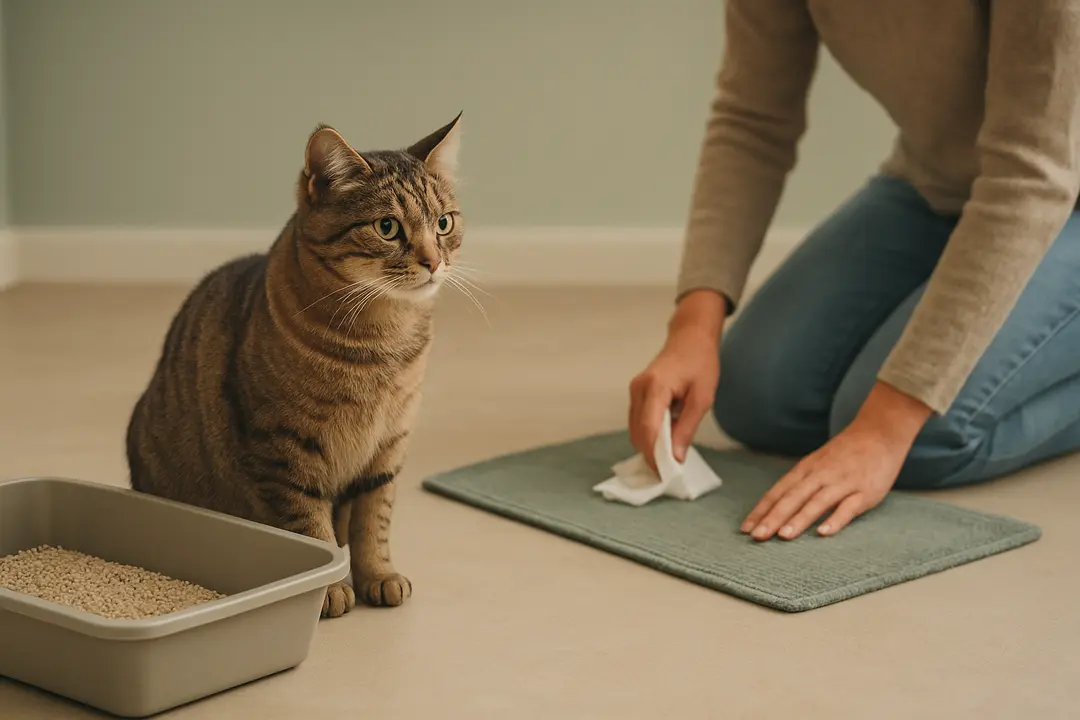
- Blot fresh urine. Press a clean, absorbent towel against the wet area to lift out liquid. Separate removable layers so you can see what needs cleaning. Under a rug, check the floor or carpet; under carpet, check the pad if you can reach it. For a folded quilt, unfold it and check the bedding below.
- Choose a cleaner for the material that got wet. For rugs, mattresses, and upholstery, look for an enzymatic or bacterial pet-urine cleaner labeled for that surface. These cleaners target urine residue rather than covering the smell. Follow the surface-specific guidance for cleaning cat urine. A washable cover and a cushion insert may need different treatment.
- Treat the affected depth, not just the outline of the stain. Follow the product directions for the amount and how long to leave it in contact with the material. If urine reached the cushion, treat the affected part of the insert. Keep your cat off the area while you're cleaning and until the treated surface is dry, as described in this guide to removing urine odor from cushions and other soft surfaces.
- Skip steam, ammonia-based cleaners, and scented deterrents. Steam can set urine odor in carpet, and ammonia-based cleaners may encourage repeat marking. Humane World's guide to pet stains and odors is especially useful if you suspect urine reached the carpet pad. Spraying a scent over the rug won't clean the pad beneath it.
If the target is a removable bath mat, you can leave it up temporarily after cleaning it and the floor. If it's the sofa, keep the treated cushion out of use while it dries. In either case, keep a litter box available throughout cleanup. Taking the favorite surface away is more useful when your cat also has somewhere convenient to pee.
Add a nearby litter box without taking the familiar one away
If space allows, add a box at or near the chosen spot rather than moving the only box your cat knows. A clean patch of bathroom floor where the mat used to be may be a practical place to try one. For a couch, think about the route from the living room to a box, not about fitting a box beside the cushion itself.
- Watch the step in. If your cat struggles to lift their legs over a tall rim, try a box with a low entrance. Note which movement looks difficult so you can describe it at the exam. Cleaning the original box more often won't change the height of that step.
- Give your cat a second route. In a home with several cats, put boxes in different places. If one cat often sits in the laundry room doorway, two boxes inside that room still require the other cat to pass the same doorway. A box accessible from the hall gives a genuinely different choice.
- Remove waste daily from every box. Include the familiar box even if you're hoping your cat will use the new one. Notice which box your cat actually enters and uses; that's more informative than whether the new location seems ideal to you.
The RSPCA's litter box guidance emphasizes a choice of locations, daily waste removal, and an entrance the cat can manage. Start with the obstacle you can see: a lower rim for a difficult step, a different room for a blocked approach, or a nearby option for a cat repeatedly choosing one corner.
What to track over the next few days
Once you've arranged the exam, keep a brief record of successful box visits as well as accidents. A useful entry might read: Morning: used the hall box. Evening: squatted on the bathroom mat and left a puddle. If you only found a damp mat, write that instead. Note when you treated the underlying layer or added a box so you can tell what happened before and after the change.
Record changes in routine and whether another cat was near the box or outside the window when it happened. VCA's house-soiling checklist recommends keeping this kind of written history. If the new box gets used but marks still appear under a window, describe both observations to your clinic rather than calling the whole plan a success or a failure. You don't need a complete log before calling, and a new pattern of nearly dry attempts is an emergency, not something to track at home.
Talk it through with Vicky
You can tell Vicky what you're seeing right now: where the urine lands, what you've already cleaned, and how your cat gets to the box. Vicky will bring in Dr. Hana (Virtual DVM, DACVB), our veterinary behaviorist, to help you work through the pattern and choose a practical change for your home.
Common questions
Why does my cat use the litter box most of the time but still pee on one bath mat?
Using the box at other times doesn't rule out a medical problem or an obstacle that's only there sometimes, such as another cat in the doorway. Check beneath the mat for missed urine, and tell your vet about both the normal box visits and the accidents.
How much enzyme cleaner should I use on a folded quilt?
There's no single amount for every quilt or product. Unfold it, identify which layers got wet, and use the directions on a cleaner labeled for that fabric rather than guessing from the size of the stain on top.
What if there's no room for a second litter box in the corner my cat chose?
Choose a nearby place your cat can enter easily; the box doesn't have to cover the exact spot. If possible, leave the familiar box in place so the new location adds a choice rather than taking one away.
What should I tell the vet if I have two cats and didn't see which one peed?
Say where and when you found the urine without assigning it to either cat. For box visits you do witness, note which cat went in and whether urine came out. If either cat repeatedly tries but produces only drops or nothing, go to an emergency veterinarian now.
What if the first urine test doesn't explain the accidents?
Contact your clinic again if the accidents continue. Report whether the amount, posture, location, or drinking has changed and which boxes your cat is using. An unexplained result doesn't by itself show that the cause is behavioral.
Sources
- Feline Lower Urinary Tract Disease — Cornell University College of Veterinary Medicine
- Urinary Obstruction in Male Cats — American College of Veterinary Surgeons
- Cat Behavior Problems: House Soiling — VCA Animal Hospitals
- Get Urine Smell and Pet Stains Out of Carpet — Humane World for Animals
- Top 10 Ways to Stop Your Cat from Peeing Outside the Litter Box — PetMD
- How Do I Encourage My Cat to Use a Litter Tray? — RSPCA Australia
- Essential Oils and Cats — Pet Poison Helpline
- House Soiling in Cats: Synopsis — VCA Animal Hospitals
- PetMD — How To Get Rid of Cat Pee Smell