Is it safe to trim my cat's whiskers during grooming?
Leave your cat’s whiskers intact. Learn how to groom around them, what to do after an accidental snip, and which signs of eye pain need urgent care.

In this guide (7 sections)
No. Leave your cat’s whiskers intact during grooming, even if they look long, curly, or uneven. Cutting the exposed hair doesn’t itself hurt, but it shortens your cat’s reach for sensing nearby objects. If you’ve already snipped a whisker, stop trimming; the first thing to establish is whether the tool touched only hair.
Why a painless trim still matters
A whisker has two parts that matter here. The part you see is the shaft. At its base is the follicle, the pocket in the skin where the hair grows. When the shaft brushes against something, its movement sends information to nerves at the base. Cutting the tip and pulling the whisker are different: a snip through the hair itself is painless, while a tug on the sensitive base can hurt.
Picture your cat passing the edge of a chair in dim light. A whisker can brush the chair before your cat’s cheek reaches it. Shorten that whisker and the chair has to be closer before it makes contact. As VCA Animal Hospitals explains in its guide to whiskers, this close-range sense helps cats navigate around objects, including at night. A cat doesn’t have to flinch at a haircut for the cut to make a difference.
Which hairs should you leave alone?
Leave the whiskers on both sides of the muzzle, the ones above the eyes, and the ones on the backs of the front legs. There is no grooming length to aim for. Whiskers naturally vary in length and curl, so the straightest whisker on one cheek isn’t a guide for what to do on the other.
Suppose you’re brushing your cat and notice a long whisker curving up toward one eye. Look from the front and the side without pulling the whisker straight. Pointing toward the eye and rubbing the eye are not the same thing. If you can see that the whisker clears the eye, the curl itself needs no correction. If you think a hair actually touches the eye, the useful question is whether it’s irritating the surface, not how much of the tip to remove.
How to brush cheek fur and handle a facial mat
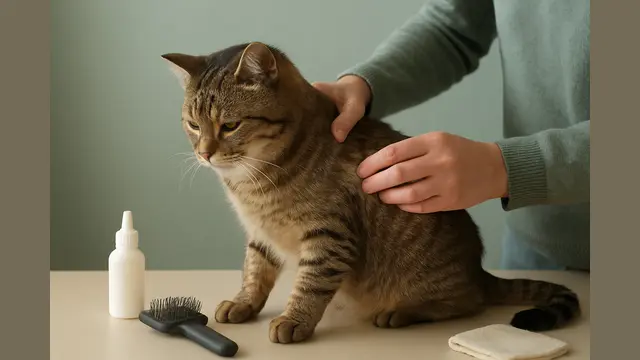
- Start with the loose coat. Before each pass of the brush, look at where the whiskers cross the fur. Brush the surrounding coat rather than gathering whiskers and cheek hair into a single tuft. Above the eyes, leave the whiskers in place rather than shortening them to neaten the outline of the face.
- Distinguish loose fur from a tight mat. Regular brushing helps prevent mats, but a knot that sits tight against the skin is a different problem. Don’t try to brush it out by force: pulling on the mat can tear the skin. Don’t slide scissors under it, either. The Cats Protection guide to grooming long-haired cats recommends taking a matted cat to a veterinarian rather than trying to cut the mat away.
- Stop if you lose sight of what you’re grooming. If your cat turns toward the tool, or you can’t tell where the knot ends and the skin begins, leave that patch unfinished. When you contact your clinic about a mat, say whether it’s on the cheek or above an eye and whether whiskers appear caught in it. You don’t need to pull it apart to give a useful description.
What to do if you accidentally clipped a whisker
An accidental snip can happen to a careful owner, especially when a cat turns mid-groom. Put down the tool and think back to what you saw. Did you see one tip fall away well clear of the face? Did a trimmer pass through several whiskers on one cheek? Or did your cat turn while a sharp tool was near the eye? Those details matter more than measuring the missing length.
If you saw that the tool cut only hair, leave the shortened whisker in place. Don’t bend it to test whether your cat can feel it. If several whiskers were clipped, preserve the reach of the ones that remain. One short tip and a whole row cut close to the cheek are different amounts of lost reach, but neither tells you, by appearance alone, how your cat will move.
Watch your cat during an ordinary activity, such as walking through a familiar doorway. There’s no reason to set up an obstacle course or turn out the lights to test the whiskers. If you notice a new difficulty getting around, describe the change to your veterinarian rather than assuming the haircut explains it. Being able to sense an object beside the face is not the same thing as being able to keep balance.
How long do clipped whiskers take to grow back?
If the follicle is undamaged, a facial whisker can grow back. PetMD’s guide to cat whiskers gives a rough range of six weeks to three months for regrowth to a useful length. That’s not a deadline by which a whisker must look exactly as it did before the cut, or match its neighbor on the other cheek.
The estimate describes hair growth. It does not tell you that your cat will have trouble navigating for that long or that a particular period of restricted activity is needed. If you’re concerned about a change you see today, tell your clinic what your cat is doing differently. That’s more useful than waiting for the two sides to look alike.
When a curled hair near the eye needs a vet
If a facial hair seems to brush the eye as your cat blinks, arrange a veterinary exam rather than trimming it at home. The cornea is the clear surface at the front of the eye. A hair that turns inward can irritate that surface; repeated rubbing can cause a sore or leave a scar. The Merck Veterinary Manual explains how inward-facing hairs affect the eye. Your vet can check whether a hair is making contact and whether the eye itself has been hurt.
If your cat is squinting, rubbing the eye, or tearing more than usual, call your veterinarian now for immediate assessment. Don’t wait for a routine grooming appointment. Both the American College of Veterinary Ophthalmologists and Texas A&M Veterinary Medicine identify these as signs of eye discomfort that need immediate attention. If your regular clinic can’t assess your cat promptly, go to an emergency veterinary clinic.
If you suspect a sharp tool cut or pierced the eye, or your cat appears to have significant eye pain, go to an emergency veterinary clinic now. A wound doesn’t have to look large to threaten vision. PetMD’s guide to cat eye injuries and the Merck Veterinary Manual’s guide to eye emergencies explain why injury to the eye itself is different from a cut through hair.
Tell the clinic which eye is affected, what tool you were using, when it happened, and whether your cat is holding the eye open. Be clear about what you saw versus what you suspect. “My cat turned toward the scissors, and now the left eye is watering” gives the clinic more to work with than “I cut a whisker.” You don’t need to identify the injury yourself before seeking care.
Talk it through with Vicky
For help with grooming, you can tell Vicky what you’re seeing right now, whether that’s an uneven row of whiskers or a tangle in the cheek fur. Vicky will bring in Dr. Ravi (Virtual DVM), our feline-friendly general practice veterinarian. For eye pain or a suspected eye wound, seek veterinary care directly rather than waiting for grooming advice.
Common questions
If one side was clipped, should I trim the other side to match?
No. Matching the sides would take away sensory reach from whiskers that are still intact. Your cat gets no benefit from making the two cheeks look even.
Should I pull a clipped whisker out so a new one can grow?
No. Pulling tugs on the sensitive follicle and can hurt. A shortened whisker can grow back without being pulled if its follicle is undamaged.
I found a loose whisker on the floor. Can it grow back?
Yes. A lost whisker can be replaced if its follicle is intact. Finding the hair doesn’t, by itself, tell you that the follicle was damaged.
Can I tell whether a groomer trimmed whiskers by comparing the two cheeks?
Not from length or curl alone. Whiskers naturally vary, so ask the groomer what was trimmed rather than treating an uneven pair as proof of a cut.
Would nail clippers be safer for shortening one curly whisker?
Changing tools doesn’t change what shortening the whisker does: it still reduces the hair’s reach. Leave a natural curl alone, and ask your vet to examine a hair that appears to rub the eye.
Sources
- Why Do Cats Have Whiskers? — VCA Animal Hospitals
- Why Do Cats Have Whiskers? — PetMD
- Blindness in cats — PDSA
- Vestibular Syndrome — Cornell Feline Health Center
- Disorders of the Eyelids in Cats — Merck Veterinary Manual
- Signs of Ocular Discomfort in Your Pet — American College of Veterinary Ophthalmologists
- What Is a Cat Eye Injury? Types, Treatment, and How To Prevent Them — PetMD
- Why do cats have whiskers? — Cats Protection
- Tips for grooming long-haired cats — Cats Protection
- Be on the lookout for vision impairment in pets — Texas A&M Veterinary Medicine
- Overview of Ophthalmic Emergencies in Small Animals — Merck Veterinary Manual