What signs suggest a yeast infection in my dog's ear, and how can a vet confirm it?
Learn which ear changes suggest yeast, how a vet confirms overgrowth with an ear swab, and when head tilt, balance trouble, or pain needs urgent care.
In this guide (7 sections)
A musty smell and brown, waxy discharge can suggest yeast overgrowth, especially if your dog keeps shaking their head, rubbing an ear, or pulling away from touch. Bacteria can cause similar signs, and both can be present in the same ear. To confirm whether yeast is part of the problem, your vet examines the ear canal and checks a swab of ear debris under a microscope—a test called ear cytology.
How soon does your dog need to be seen?
- Book a prompt appointment with your regular vet for an ear that is sore, smells different, or has discharge. Repeated scratching or rubbing is also a reason to call, even if your dog won't let you look inside. You don't need to see brown wax before booking.
- Call your vet now for same-day assessment if your dog develops a new head tilt or loses balance. A shake is a brief movement; a tilt means the head stays tipped to one side, even at rest. Stumbling or falling is different from stopping to scratch. Mention any rapid, jerking eye movements, too. PDSA's ear infection guide recommends same-day assessment for head tilt or loss of balance. The American Kennel Club's guide to balance problems advises calling immediately about these changes. An ear infection is one possible explanation, not the only one.
- Seek emergency veterinary care now if your dog is in severe pain or distress, or cannot stand or walk. Don't wait for a regular appointment or try to examine the ear first. Both Cornell's guide to emergency signs and Texas A&M's veterinary emergency service identify severe pain or distress and inability to get around as reasons for immediate care.
What you can tell from the outside of the ear
Start with what's different for your dog. A dog who usually leans into a head rub may duck when your hand approaches one ear. You might see them rub that side of the head against the couch or repeatedly stop what they're doing to scratch. Those changes can tell you the ear is uncomfortable without your having to touch the sore spot.
If your dog is comfortable letting you look, compare the two ear openings. Note which side has swelling or waxy discharge, whether there's a new odor, and which ear your dog is bothering. If they turn away, stop there. “My dog keeps rubbing the left side but won't let me look” is useful information for your clinic; there's no need to hold your dog still to get a better view.
These signs can point to otitis externa, meaning inflammation of the outer ear canal. They don't tell you why the canal is inflamed. In addition to yeast or bacteria, ear mites or a piece of plant material trapped in the canal can cause irritation. As Banfield's guide to yeast in dogs' ears explains, neither smell nor appearance identifies the cause. Even a clear photo of the discharge can't tell you whether the ear needs the same treatment as last time.
What to do before the ear exam
- Leave the debris in place unless your clinic tells you otherwise. The material you might want to wipe away is what the vet needs for the swab. If you've already cleaned the ear, keep the appointment. Tell the clinic what you used, which ear you cleaned, and when.
- Don't put anything down a painful ear on your own. A cotton swab can push debris farther in or injure the canal or eardrum. Alcohol and peroxide can irritate inflamed tissue. Even if you have a cleaner for routine ear care, ask your vet before using it in an ear that now hurts. Set aside leftover drops until your vet can check whether they're appropriate for this episode.
- Give the clinic a short timeline. Say when the rubbing, smell, or discharge started, whether it affects one or both ears, and whether it's happened before. If your dog has had treatment, it helps to distinguish “the itching never stopped” from “the itching stopped and then came back.” Bring the names of any ear products you used so the vet knows what your dog has already received.
What the vet looks for with an otoscope
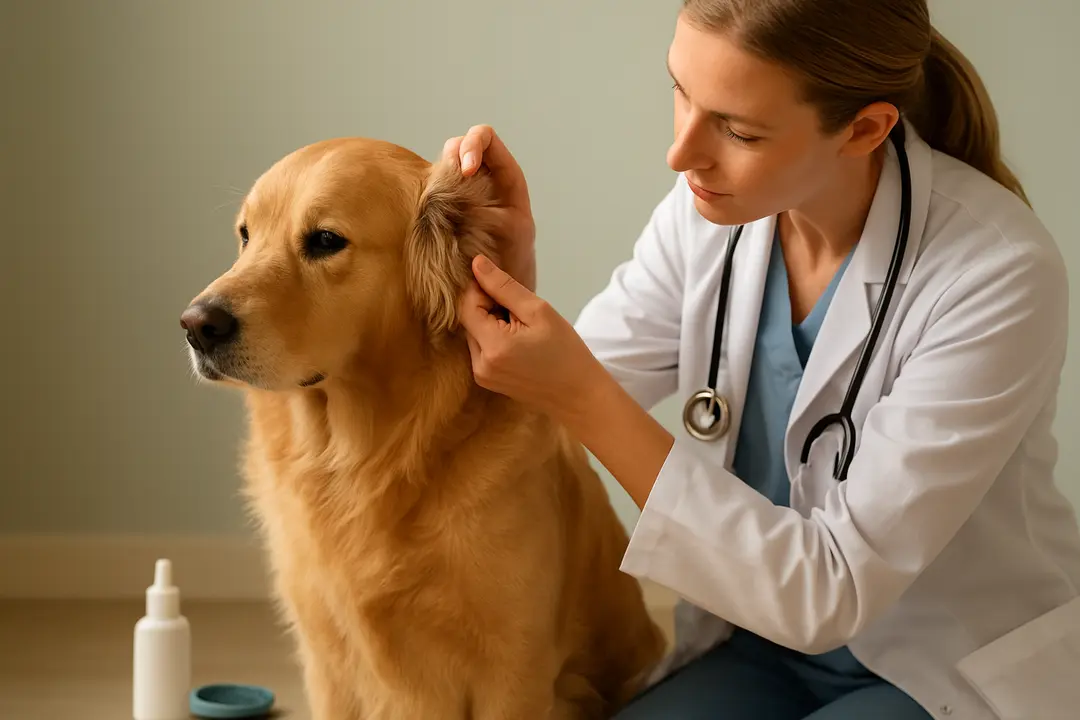
An otoscope is a lighted, magnifying instrument. It lets your vet inspect the canal for swelling, accumulated debris, or a trapped object. This answers a question the swab can't: is there something physically irritating the ear? For example, a swab might show yeast, but it can't show a piece of plant material lodged farther down the canal.
The vet also tries to inspect the eardrum. Swelling or debris may block the view. If the vet says the eardrum wasn't visible, that isn't the same as saying it looked healthy. The distinction matters because some ear medications can damage hearing if the eardrum is torn. VCA's guide to the ear exam explains why the vet considers the condition of the eardrum when choosing treatment.
How the ear swab confirms yeast overgrowth
Each affected ear gets its own sample. Before cleaning, the vet takes a swab of debris and keeps the right and left samples separate. There's a practical reason to test both if both are sore: similar-looking brown material can hide different problems. In a Clinician's Brief example of ear cytology, one ear had yeast overgrowth while the other had both yeast and bacteria. Testing only the first ear would have missed part of the picture.
The vet examines a stained slide. Material from each swab is spread onto a glass slide and stained so it's easier to see under a microscope. The vet looks for yeast, including yeast cells forming small buds, as well as bacteria and cells associated with inflammation. The scope showed where the ear was sore or blocked; the slide shows what's in the debris from that ear.
A few yeast cells are not proof of infection. Small numbers of yeast can live in healthy dog ears. What supports yeast overgrowth is the amount seen on the slide together with signs of inflammation and discomfort in the ear it came from. “Was there more yeast than you'd expect, and did you also see bacteria?” is a more useful question than “Was the swab positive?” The answer helps explain what the treatment is meant to address.
What to expect after the results
For a straightforward infection, the exam and microscopy usually give your vet enough information to choose treatment without sending a sample for a bacterial culture. Before you leave, ask which treatment goes in which ear, whether to clean either ear, and when your vet wants an update. If the results differed between ears, ask for directions labeled left and right rather than relying on which ear smelled worse.
Over the next few days, keep track of the signs that led you to book: rubbing, avoidance of touch, odor, and discharge. Tell your vet which signs ease and which persist. If the smell goes away but your dog still ducks when you reach toward the ear, report both observations rather than assuming the problem has cleared.
Ear trouble can recur even in carefully cared-for dogs. If it persists or returns, your vet may examine the ear and repeat cytology to see what's present now. A bacterial culture is a different lab test that can help the vet investigate bacteria in a persistent infection. As MSPCA-Angell explains in its guide to canine ear inflammation, repeated episodes can also prompt a check for underlying allergies. Finding yeast helps explain the current flare-up; it doesn't necessarily explain why the ear keeps getting sore.
Talk it through with Vicky
You can tell Vicky what you're seeing right now, including which ear your dog rubs and what's changed since the last flare-up. Vicky will bring in Dr. Nadia (Virtual DVM, DACVD), our veterinary dermatologist, to help you prepare questions for your vet about the ear exam, swab results, or recurring signs.
Common questions
Can the vet check the ear swab during the visit?
A clinic with a microscope can examine the stained slide during the visit. Ask when your clinic expects to have the result; a bacterial culture, if needed, is a separate lab test.
Why repeat an ear swab if my dog has stopped scratching?
Less scratching tells you your dog feels more comfortable, but it doesn't show how much yeast or bacteria remain. If your vet recommends a recheck, a new slide lets them compare the findings in each ear with those from the first visit.
Does a musty ear after swimming or a bath mean my dog has yeast?
No. Mention the timing, especially if you notice the same pattern more than once, but timing and smell can't distinguish yeast from a mixed infection. Ask your vet before using a drying cleaner in an ear that's already tender.
Do recurring ear yeast infections mean I should change my dog's food?
A swab can show yeast overgrowth, but it can't tell you whether food is involved or which diet to choose. If the trouble keeps returning, ask your vet whether an allergy evaluation makes sense rather than changing foods based on the swab alone.
Sources
- Ear infections in dogs — PDSA
- Why Your Dog’s Ears Stink and What To Do — PetMD
- Ear Infections in Pets: Causes and Treatments — Animal Medical Center
- Ear Infections in Dogs (Otitis Externa) — VCA Animal Hospitals
- Otitis Externa — Clinician’s Brief
- Ear–Scratching, Head Shaking, and Ear Discharge: Does Your Dog Have Otitis? — MSPCA-Angell
- When to go to the ER — Cornell Riney Canine Health Center
- Instructions for Ear Cleaning in Dogs — VCA Animal Hospitals
- Banfield Pet Hospital — Dog ear yeast infections: signs, smell, causes, and treatment
- American Kennel Club — Vestibular Disease in Dogs: Signs, Symptoms, Treatment
- Texas A&M Veterinary Medical Teaching Hospital — Emergency Medicine