
What signs suggest my dog has an ear infection, and how can a vet confirm it?
Learn which changes in your dog's ears warrant an exam, which balance signs need urgent care, and how a vet uses a scope and an ear swab to confirm infection.
In this guide (8 sections)
Repeated head shaking, scratching or rubbing an ear, a new smell, or discharge can suggest an ear infection, but none of these signs proves it. Your vet looks down the ear canal with a lighted scope and examines a sample of ear debris under a microscope. Together, those checks help distinguish an irritated ear from one where yeast, bacteria, or both are contributing to the problem.
When ear symptoms need urgent care
If your dog cannot stand or move, go to an emergency veterinary clinic now. Whether your dog is falling over or seems too distressed or in too much pain to get up, don't stop to inspect the ear. If your dog is crying out in pain or showing severe distress, seek emergency veterinary help rather than trying to find the sore spot yourself. Cornell's guide to veterinary emergencies describes signs of severe pain and distress.
For a new head tilt or loss of balance, call your vet now for a same-day assessment. A head shake ends with the head back in its usual position. A tilt means your dog keeps the head tipped to one side, even while standing still. Stumbling, falling, or eyes that jerk back and forth on their own are also reasons to call right away. These can be signs of a problem affecting balance, not proof that an ear infection has spread. The American Kennel Club's guide to balance changes explains why they need attention even without visible ear discharge.
If your dog is walking normally but keeps shaking, rubbing, or scratching an ear, call your regular clinic for a prompt exam. Crusts or smelly discharge also warrant a visit. You don't need to wait for itching, odor, and drainage to appear together. PDSA's ear infection guide distinguishes these signs from the head tilt or balance loss that needs same-day care.
What to look for without probing the ear
- Watch before you touch. Notice which ear your dog scratches or rubs and whether the behavior keeps interrupting rest or play. If your dog pulls away from a familiar touch on the head, report that change. There's no need to repeat the touch to check whether it hurts.
- Look only where your dog is comfortable letting you look. Gently lift the ear flap enough to see its underside and the opening of the canal. Look for redness, swelling, crusts, or more wax or drainage than usual. Stop if your dog resists. You don't need a good view inside to make the appointment.
- Describe each ear separately. Note which side looks different and whether there's a new odor. For example, “He keeps rubbing the left ear, but I see dark wax in both” gives the vet two useful observations. You don't have to decide whether the wax explains the rubbing.
Why an itchy or smelly ear isn't always infected
Otitis externa means inflammation of the outer ear canal. It's a description of where the ear is irritated, not a diagnosis of what caused it. A skin problem such as an allergy can inflame the canal. Something stuck inside can also make a dog suddenly favor one ear. Yeast or bacteria may be part of the problem, but they aren't the only explanation for head shaking.
A strong smell is worth reporting; what it reminds you of is less useful. Different conditions can produce discharge of a similar color, and smell can't reliably distinguish yeast from bacteria. Ear trouble can happen even with attentive care. Rather than trying a different cleaner based on the smell, tell the vet how the ear has changed from your dog's normal. The Merck Veterinary Manual's guide to outer ear inflammation explains how the history, skin exam, and ear sample help narrow down the cause.
What to do before the appointment
Leave a painful or inflamed ear alone unless your vet advises otherwise. Don't put a cotton swab into the canal; it can push debris deeper or injure the ear. Avoid peroxide and alcohol, which can irritate it. Even if you normally clean your dog's ears, ask the clinic before cleaning this one. VCA's instructions for ear cleaning explain when to check with your vet first.
When you call, lead with any change in your dog's ability to stand, walk, or hold the head normally. Mention if one side of the lip or an eyelid has started to droop, too; weakness on one side of the face can be a clue to a deeper ear problem. Then tell the clinic:
- When the scratching or shaking began, which ear your dog favors, and what has changed since.
- Whether your dog also has itchy skin elsewhere or has had ear trouble before.
- What you've put into either ear. Bring the bottle or a photo of its label. If this is a repeat problem, say whether the signs ever went away completely after the last treatment.
What the vet can see with an otoscope
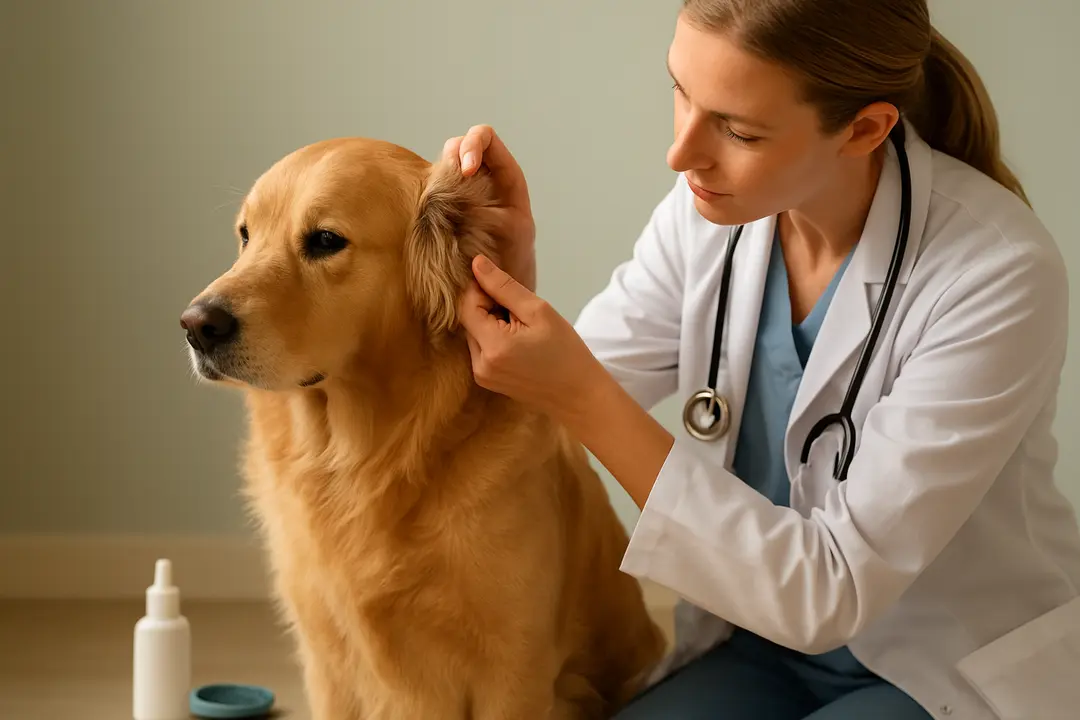
Your vet examines the skin as well as the ears, then uses an otoscope, a lighted magnifying instrument, to look down the canal. It lets the vet look for trapped material and see inflammation or discharge beyond the opening. A photo can show how the ear flap looked yesterday, but it can't show your vet what's lodged farther in or whether the eardrum is intact.
Checking the eardrum matters before choosing drops. Some ear medicines can damage hearing if they pass through a torn eardrum. That's a reason not to restart drops left over from a previous infection, even if the symptoms look familiar. VCA's guide to the ear exam explains what the vet looks for with the scope and why it affects treatment.
How an ear swab helps confirm infection
The scope shows the condition of the canal. The swab answers a different question: does this ear contain enough yeast or bacteria to help explain the soreness and discharge? For a test called ear cytology, the vet collects a little ear debris, stains it on a slide, and examines it under a microscope. The stain helps the vet see different organisms and cells involved in inflammation.
A healthy ear can contain small numbers of microbes. So “the vet saw bacteria” isn't the whole result. Your vet considers the types and numbers of organisms alongside the cells on the slide, the appearance of the canal, and your dog's symptoms. The findings may point to yeast, bacteria, or a mixture, and help your vet choose the initial treatment.
If both ears are sore, ask what the sample from each ear showed. Similar-looking discharge on the left and right doesn't guarantee the findings are the same. Clinician's Brief explains how vets interpret ear samples and why appearance alone can be misleading.
What to watch for after the visit
Before you leave, ask which ear to treat, whether it needs cleaning, what improvement to expect, and when your vet wants to check it again. If you're unsure how to give prescribed drops, ask for a demonstration. At home, follow the changes that first caught your attention. “The smell has faded, but she still wakes up to scratch” tells the clinic more than “the ear looks better.”
If the signs never clear or return soon after treatment, let your vet know which happened. A bacterial culture is a possible next step, not a test every itchy ear needs. Unlike a first look under the microscope, a culture can identify the bacteria; a related test called susceptibility testing checks which antibiotics are likely to work against them.
Repeated episodes raise another question: what keeps setting off the inflammation? Finding what's growing in the ear today and finding out why the ear keeps getting sore are different tasks. As MSPCA-Angell's guide to recurring ear problems explains, repeat trouble is a reason to look for the underlying cause rather than assume the last treatment is the answer again.
Talk it through with Vicky
You can tell Vicky what you're seeing right now, including which ear your dog favors and whether this has happened before. Vicky will bring in Dr. Nadia (Virtual DVM, DACVD), our veterinary dermatologist, to help you sort through those observations and prepare questions for your dog's in-person ear exam.
Common questions
Can my dog have an ear infection if the ear looks clean and doesn't smell?
Yes. A clean-looking ear opening and no noticeable odor don't rule out a problem farther down the canal. Repeated shaking, scratching, or discomfort is enough reason to arrange an exam.
Does dark brown ear wax mean mites, yeast, or just wax?
Color alone can't distinguish ordinary wax from debris caused by mites or infection. Tell your vet if the amount has changed or the ear seems sore; the exam and a sample are more useful than a color match.
My dog suddenly started shaking one ear after a walk. Could something be stuck in it?
Yes, a piece of plant material is one possibility, though the timing doesn't prove it. Tell the clinic how suddenly it started and which ear your dog favors. Leave the search inside the canal to your vet.
Can I tell from the prescribed drops whether my dog had yeast or bacteria?
The medication name doesn't tell you what your vet found in your dog's ear. Ask what showed up on the slide from each affected ear and which findings the drops are meant to treat.
Sources
- Ear infections in dogs — PDSA
- When to go to the ER — Cornell Riney Canine Health Center
- Vestibular disease in dogs — PDSA
- Ear Infections and Otitis Externa in Dogs — Merck Veterinary Manual
- Otitis Externa — Clinician’s Brief
- Ear Infections in Dogs (Otitis Externa) — VCA Animal Hospitals
- Ear–Scratching, Head Shaking, and Ear Discharge: Does Your Dog Have Otitis? — MSPCA-Angell
- Antibiotic-Resistant Bacterial Infections in Dogs — VCA Animal Hospitals
- Instructions for Ear Cleaning in Dogs — VCA Animal Hospitals
- Clinician’s Brief — Clinical Suite: Otitis Externa
- American Kennel Club — Vestibular Disease in Dogs: Signs, Symptoms, Treatment
- Merck Veterinary Manual — Otitis Media and Interna (Middle and Inner Ear Infections) in Dogs



