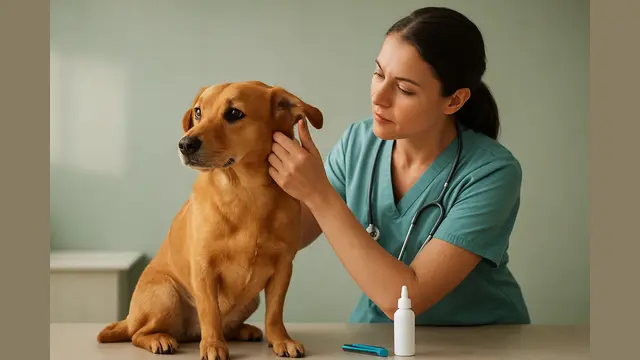
How do vets treat a hematoma in a dog's ear flap, and how soon should my dog be seen?
Learn when a swollen ear flap needs an exam or an emergency visit, how vets choose between drainage and stitches, and how to care for the ear afterward.
In this guide (7 sections)
- How soon does a swollen ear flap need care?
- What to check at home without handling a sore ear
- Why the vet checks the ear canal as well as the flap
- How vets choose between monitoring, drainage, and stitches
- What if you'd be happy to leave the ear wrinkled?
- What to do in the days after treatment
- Talk it through with Vicky
Call your vet today about a newly swollen ear flap, even if your dog is acting normally; if your dog is in severe pain, collapses, or cannot walk, go to an emergency clinic now. If the swelling is a hematoma, or pocket of blood, your vet may recommend monitoring it, draining it, or using stitches to keep it from filling again. The exam also helps find and treat whatever made your dog shake or scratch the ear in the first place.
How soon does a swollen ear flap need care?
- Go to an emergency clinic now if your dog collapses, cannot stand or walk, or shows severe pain or distress, such as repeatedly crying out in pain. Don't wait to take a picture of the ear or for your regular clinic to open. Both Cornell's guide to emergency visits and the MSD Veterinary Manual's emergency triage guide identify these as reasons for immediate assessment.
- Seek same-day veterinary care if your dog develops a head tilt that persists or starts losing balance. Mention that sign first when you call. Don't assume your dog is holding the head to one side because the flap feels heavy. As PDSA's ear infection guide and Cornell's guide to itchy ear problems explain, a tilt or unsteady gait can point to a problem deeper in the ear. If your clinic is closed, call an emergency service for direction.
- If the swollen flap is the only change you see, call promptly to arrange an exam. Say whether your dog seems comfortable and ask how soon the clinic wants to see them. If you discover the swelling at night and are unsure whether it can wait, describe it to the on-call service. The size of the lump, or a photo of it, isn't enough to settle that question.
What to check at home without handling a sore ear
You might notice the swelling when one ear suddenly looks like a little pillow. An aural hematoma forms when blood collects beneath the skin of the ear flap, against the cartilage that gives the flap its shape. That blood isn't inside the ear canal, so cleaning the canal won't empty the swelling.
- Look at the outline of the flap. Note which ear is affected and whether one area bulges or most of the flap looks swollen. A photo taken without lifting or squeezing the ear gives you a useful point of comparison. Tell the clinic when you first noticed the change and whether the bulge has grown since then.
- Think back to what happened before the swelling. Was your dog already shaking their head or scratching that ear? Has that continued? Describe what you've seen rather than trying to test for pain by pressing the lump. Mention any recent ear problems and the names of any ear treatments you've used.
- Leave the pocket alone. Don't puncture it with a needle or try to press the blood out. A puncture can introduce infection, and emptying the pocket doesn't stop it from refilling. If your dog seems sore, ask your vet what you can safely do for pain before the visit rather than giving medicine on your own.
Why the vet checks the ear canal as well as the flap
Your vet is looking for two things: what the swelling is, and why your dog has been bothering the ear. An itchy or painful ear can set off repeated scratching and head shaking that injure the flap. An infection, an allergy, ear mites, or something lodged in the canal can all cause irritation. A swollen flap alone doesn't tell you which, if any, is responsible.
The vet will examine the flap and may use an otoscope, a lighted instrument for looking down the ear canal. They may also examine a swab under a microscope to look for yeast or bacteria. These checks, described in this veterinary guide to ear hematomas in dogs, help the vet choose treatment for the cause rather than treating every itchy ear as an infection.
For example, removing something lodged in the canal addresses a different problem from treating an allergy. Neither step empties a blood pocket that's already formed. Before you leave, make sure you know which part of the plan is for the flap and which part is to relieve the irritation and reduce the chance of another hematoma.
How vets choose between monitoring, drainage, and stitches
Not every hematoma needs surgery. Your dog's comfort, the size of the pocket, and whether it has filled again after drainage all matter to the decision. The key difference between procedures is whether the vet empties the pocket once or also keeps the layers of the flap together as they heal.
| Option | What it does | What to discuss with your vet |
|---|---|---|
| Monitoring after an exam | Leaves the blood to be absorbed without a procedure. A vet may consider this for a small pocket causing little discomfort. | How will you keep your dog comfortable, and what change would make treatment preferable? |
| Needle drainage, sometimes with a corticosteroid | The vet draws out blood and may use a prescribed steroid to reduce inflammation. | The pocket can refill after drainage. What should you do if the bulge comes back? |
| Temporary drain | Gives fluid a way out over time rather than removing it only once. | How should you protect the drain, and when does the clinic want to check or remove it? |
| Surgical drainage and stitches | The vet removes blood and clots, then places stitches across the affected area to hold the layers together. | How will you protect the flap while it heals, and what follow-up does the repair need? |
PDSA's guide to a swollen ear flap describes pain relief, drainage, and surgical options. The reason for stitches is practical: once the blood is out, there can still be space beneath the skin for more to collect. As the American College of Veterinary Surgeons explains, stitches close that space. If a drained ear swells again, tell your vet how long it stayed flatter and whether drainage relieved your dog's discomfort. That helps you discuss the next step without assuming the same procedure must be repeated.
What if you'd be happy to leave the ear wrinkled?
It's reasonable to care more about comfort than the final shape of your dog's ear. The trade-off is that an untreated clot can be absorbed, but the flap may remain uncomfortable during that process. Scar tissue can also leave a lasting fold or wrinkle. Early assessment gives you a chance to address pain and discuss ways to limit scarring while there's still a choice about treatment.
Monitoring is a plan you make with your vet, not a reason to put off the first exam. If you choose observation together, agree on when the ear will be rechecked. Ask what to do if the pocket grows, if your dog seems more bothered by it, or if head shaking continues despite treatment for the original ear problem.
What to do in the days after treatment
- Get instructions for your dog's particular procedure. Before going home, ask the team to show you the treated area. If there's a drain, find out what fluid to expect, what to leave untouched, and whom to call if it looks different. A photo of the flap at discharge gives you something concrete to compare it with later.
- Protect the flap and follow the pain-control plan. Use the cone if your vet recommends one to keep your dog from scratching the healing ear. Give prescribed pain relief and follow the separate instructions for any ear infection or other irritation. A flatter flap tells you the pocket has been emptied; it doesn't tell you that the itch has stopped.
- Keep the recheck appointment. Get a date for the wound check and for drain or stitch removal if needed. If a bulge returns before then, contact the treating clinic rather than trying to drain it. Tell them what's changed in the ear's outline and in your dog's comfort since the procedure.
Talk it through with Vicky
You can tell Vicky what you're seeing right now, whether you've discovered a swollen flap or are weighing repair options after an exam. Vicky will bring in Dr. Grace (Virtual DVM, DACVS), our veterinary surgeon, to help you understand the options and prepare questions for your dog's own vet.
Common questions
Is repeated drainage less expensive than ear hematoma surgery?
Ask for estimates for the whole course of care rather than comparing the first visit alone. For drainage, ask what a repeat visit would involve if the pocket refills. For surgery, find out whether pain relief, rechecks, and stitch removal are included.
Can the cone come off when the drain comes out?
Ask your vet for two instructions: when to return for drain removal and when the ear no longer needs protection from scratching. Don't use the drain coming out, or the flap looking flat, as your cue to stop the cone without checking the plan.
Does a firm spot mean my dog's ear hematoma has filled up again?
A firm spot alone doesn't confirm that fresh blood has collected; healing can leave scar tissue that changes the shape of the flap. Rather than squeezing it, compare its outline with an earlier photo and tell your clinic if a bulge has returned or your dog seems less comfortable.
Can I restart old ear drops if my dog is shaking the ear again?
Ask your vet before restarting drops. Drops in the canal won't empty blood trapped in the flap, and the cause of the irritation may be different this time. Give the clinic the name of the drops and say when you last used them.
Sources
- PDSA — Aural haematoma (swollen ear flap) in a dog
- American College of Veterinary Surgeons — Aural Hematoma
- Veterinary Partner — Aural Hematoma in Dogs and Cats
- PDSA — Ear infections in dogs
- PDSA — Lump monitoring
- PetMD — Easier Treatment for Aural Hematomas
- American College of Veterinary Surgeons — Postoperative Care After Surgery: What Animal Owners Should Expect
- Cornell University College of Veterinary Medicine — Itchy ear problems
- Cornell Riney Canine Health Center — When to go to the ER
- MSD Veterinary Manual — Initial Triage and Resuscitation of Small Animal Emergency Patients
- PetMD — Ear Hematomas in Dogs
- MSPCA-Angell — Minimally Invasive Surgical Management of Aural Hematomas Using a Vacuum Drain System