What changes in my dog's movement or behavior can signal pain, and when should I call a vet?
Compare your dog's steps and daily habits with their usual routine, learn which changes need emergency care, and know what to report if a limp comes and goes.
In this guide (6 sections)
A shorter step, less weight on one paw, stiffness after a nap, or new hesitation before stairs can signal pain, even if your dog doesn't cry. Call your vet about a mild limp that lasts more than a day or keeps returning, or a sudden change in behavior you can't explain. Seek immediate veterinary care for severe pain, collapse, difficulty breathing, staggering, or sudden loss of the ability to use a leg.
Does my dog need an emergency vet or a regular appointment?
Look first at what your dog can do on their own. There's a difference between taking shorter steps on one leg and suddenly being unable to use that leg at all. You don't have to find the sore spot before getting help.
| What you notice | What to do |
|---|---|
| Your dog suddenly can't use a leg, won't put the paw down at all, staggers, or can't stand. | Seek veterinary assessment immediately. If your regular vet can't see your dog right away, go to an emergency clinic. Being able to stand on the other three legs doesn't make a sudden loss of leg use less urgent. |
| Your dog is in severe pain, collapses, struggles to breathe, or has very pale or white gums. | Go to an emergency vet now. Don't spend time checking each paw or filming how your dog walks. |
| Your dog has a slight limp but still bears weight and otherwise seems comfortable. | Note when it started. If it lasts more than 24 hours, contact your regular vet. Arrange an exam for a limp that keeps coming back, even if it's gone when you call. |
The MSD Veterinary Manual's guide to when to see a veterinarian distinguishes mild, persistent limping from sudden, severe lameness. The one-day guide is for a mild limp; it isn't a waiting period if your dog develops an emergency sign.
What happened matters, too. If your dog was hit by a car, go to an emergency vet now, even if your dog gets up and you don't see a wound. As Cornell's canine emergency guide explains, serious injuries aren't always visible from the outside.
Notice what your dog no longer does easily
Start with one activity you know well. A dog who has always waited to be lifted into the car is different from one who jumped in every morning until this week. In the second case, waiting by the door is a change worth reporting, even if the walk across the driveway looks normal.
Think about both the activity and the part that seems difficult. Perhaps your dog still comes over when you pick up the leash but pauses at the step outside. Or they finish their usual walk but take several attempts to get up from bed afterward. “Still wants the walk; getting up is what's changed” tells your vet more than “slowing down.” Gradual changes can be easy to miss, even when you pay close attention. Consider what you've started doing for your dog, such as lifting them into the car, and what prompted you to help.
If behavior is your main concern, you can call without having seen a limp. Describe the change in familiar terms: “He used to settle beside me all evening; last night he kept getting up,” or “She moved away when I reached to pick her up, which is new.” Neither observation proves pain or tells you where it hurts. For a sudden, unexplained behavior change, call your vet for advice rather than waiting for it to happen again.
How to watch a few steps without testing a sore leg
If your dog seems comfortable enough to get up and walk on their own, watch a trip they would make anyway, such as from their bed to the water bowl. VCA's guide to observing a limping dog suggests looking at step length, paw placement, and how much weight the dog puts on the foot.
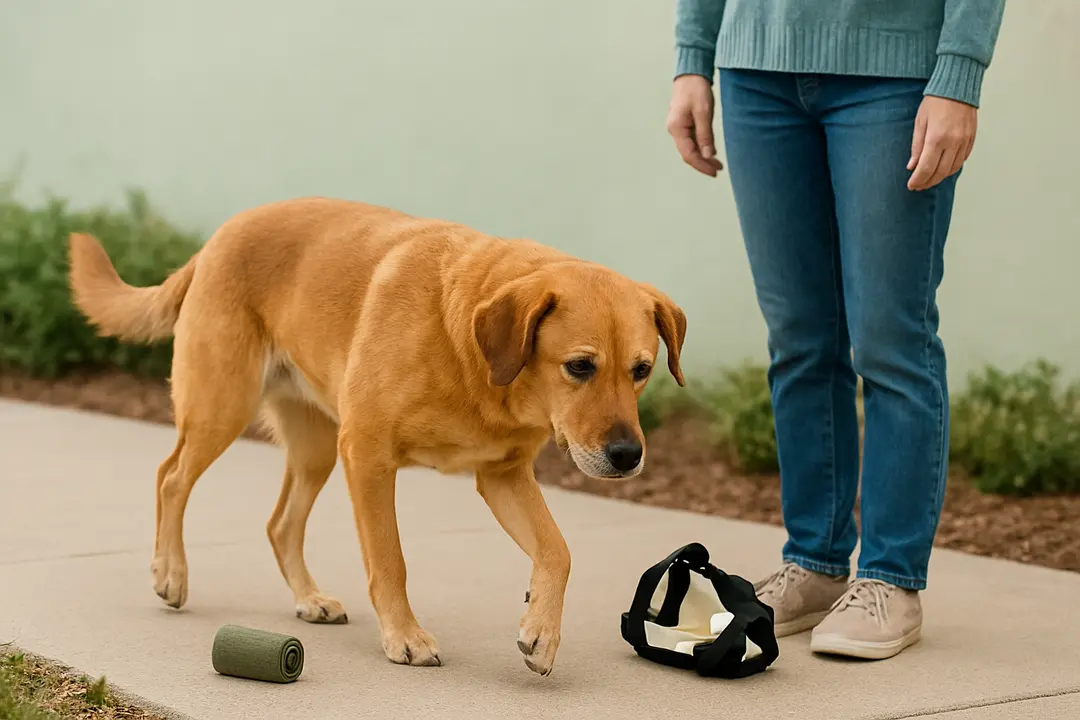
- Watch the first few steps. Does your dog rise stiffly and then move more freely? Is one step consistently shorter than the others? Notice whether the change is there only on getting up or stays there as your dog crosses the room. Don't ask for another lap to be sure.
- Look at what happens when the foot reaches the floor. Your dog might set the paw down, then quickly shift weight away from it. Or the toes might touch briefly without the foot taking much weight. Tell the clinic which you saw. If you're unsure which side it was, “one of the front feet” is more helpful than a guess.
- Distinguish favoring a leg from losing coordination. A dog that favors a leg puts less weight on it. A dog that wobbles may seem unable to place the feet where they mean to. For example, the American College of Veterinary Surgeons' guide to disc disease describes how a spinal cord problem can make the hind feet cross while stepping. That doesn't diagnose your dog, but new staggering or trouble using the legs is not a routine limp to watch at home.
- Record the change if it happens naturally and it's safe. A short video of those first steps can show something your vet might not see at the visit. Don't make your dog jump, take the stairs, or walk farther to capture it. A description is enough to make the call.
What you can safely do before the appointment
Let your dog rest rather than trying to locate the pain by pressing, bending, or straightening the leg. Moving a broken bone or a joint that's out of place can make the injury worse. If your dog is in severe pain, leave the examination to the emergency team. If you're unsure how to get your dog into the car, ask the clinic for instructions.
Don't give ibuprofen, naproxen, aspirin, acetaminophen, or medicine left over from another dog's treatment unless your vet directs you to use it for this dog. The FDA's guide to pain relievers for pets explains why reaching for a familiar medicine can cause harm.
If your dog may already have swallowed an unsafe medicine, call your vet or an animal poison control service now, even if your dog seems well. Have the package and any remaining pills handy so you can identify exactly what your dog may have taken. Follow animal poison control guidance and get instructions before giving anything at home. As this guide to first steps in a pet emergency advises, don't try to make your dog vomit unless a veterinarian tells you to.
What to tell your vet and what to expect at the visit
Lead with what your dog can or can't do now. Then give the timeline: when you last saw your dog move normally, when you first noticed a change, and whether it has improved, worsened, or come and gone. Mention any fall or impact you saw. “I didn't see an injury” is useful information, too. Tell the clinic about any medicine your dog has received.
For a recurring limp, a short account is enough: “Three mornings this week, she took short steps with a front leg when she got up. By breakfast I couldn't see the limp.” At the visit, your vet can examine how your dog moves and use that history to guide the examination. Cornell's guide to a vet visit for limping explains why a home video and details about difficulty with usual activities are useful, especially when your dog walks normally in the exam room.
Before you leave, ask what activity is appropriate for the next few days, what improvement your vet expects, and which changes should bring you back sooner. That gives you a plan specific to your dog rather than leaving you to decide whether one easier walk means the problem has resolved.
Talk it through with Vicky
If you're unsure how to describe a change in your dog's movement or behavior, you can tell Vicky what you're seeing right now. Vicky will bring in Dr. Priya (Virtual DVM, DACVAA), our Anesthesia & Pain Specialist, to help you put those observations into words for your vet. If your dog has an emergency sign, go directly to an emergency clinic.
Common questions
Can my dog still be in pain if they never whine and still want to play?
Yes. Wanting to play doesn't cancel out a change such as putting less weight on one leg. Report what you see during ordinary movement; there's no need to throw a ball to see whether your dog will run.
Is avoiding the stairs just aging, or could it be arthritis?
Avoiding stairs alone can't tell you whether your dog has arthritis. Rather than assuming it's age, tell your vet when the hesitation started and whether other activities, such as getting up from the floor, have changed too.
Could panting and pacing at night mean pain?
Panting and pacing alone don't establish that pain is the cause. If this is a sudden change, call your vet and describe what your dog was doing when it began, including whether they were resting. If your dog is struggling to breathe, go to an emergency vet now.
Why has my normally friendly dog started growling when I pick them up?
A new growl during handling is worth reporting, but it doesn't identify a sore spot or prove that pain is the cause. Don't repeat the lift to test the reaction. Call your vet about the sudden change and say exactly what you were doing when it happened.
Is dragging the toes the same as favoring a sore paw?
No. Favoring a paw means taking weight off it; dragging means the toes scrape the ground as the foot moves forward. If new dragging comes with trouble using the leg, staggering, or difficulty walking, seek immediate veterinary assessment rather than monitoring it as a mild limp.
Sources
- First Aid for Limping Dogs — VCA Animal Hospitals
- When to See a Veterinarian — MSD Veterinary Manual
- When to Go to the ER — Cornell Riney Canine Health Center
- Get the Facts about Pain Relievers for Pets — U.S. Food and Drug Administration
- Localizing Thoracic Limb Lameness on Orthopedic Examination in Dogs — Clinician’s Brief
- Intervertebral Disc Disease — American College of Veterinary Surgeons
- What To Do in a Pet Emergency: 5 Key Steps — PetMD
- What to Expect When Taking Your Limping Dog to the Veterinarian — Cornell University College of Veterinary Medicine
- What to Do if Your Pet Is Poisoned — ASPCA Animal Poison Control