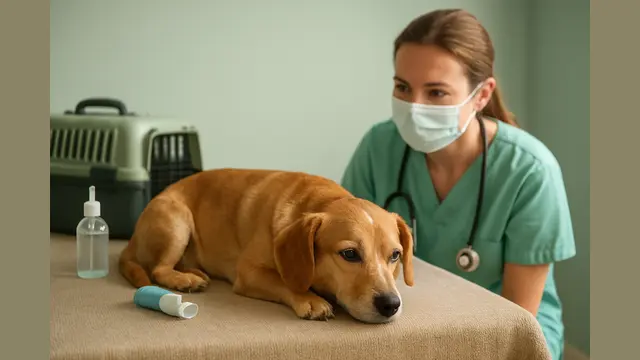
How do vets treat mange in dogs, and what care will my dog need at home?
Learn how vets treat scabies and Demodex, which dogs need medication, what to wash at home, and how to track itching and skin healing before your recheck.

In this guide (6 sections)
- How does the vet tell which kind of mange my dog has?
- If it’s scabies: treat the dogs and clean shared resting places
- If it’s Demodex: the extent of the skin changes matters
- How to follow the treatment plan and check the skin at home
- How long does healing take, and when should I call?
- Talk it through with Vicky
If your vet suspects sarcoptic mange (canine scabies), start the prescribed mite treatment as directed, arrange treatment for every dog in your home, and avoid contact with other dogs until your clinic confirms the infestation has cleared. Demodectic mange (Demodex) is different: widespread disease needs mite treatment, but your other pets don’t need treatment for your dog’s Demodex. With either type, healing the skin can take longer than you might expect from the first signs of improvement.
How does the vet tell which kind of mange my dog has?
An itchy dog or a patch of missing hair isn’t enough to identify a mite. Flea allergy, ringworm, and other skin infections can look like mange. Tell your vet when you noticed the first change, where it started, and whether it has spread. Mention recent contact with other dogs, including at daycare or boarding, even if you don’t know of another dog that’s scratching.
Your vet may take a skin scraping: a small sample from affected skin to examine under a microscope. A scraping can reveal Demodex mites. Scabies mites live near the skin’s surface, but there may be so few that even several samples miss them. As Texas A&M explains in its guide to sarcoptic mange, your dog’s history, skin changes, and response to treatment can all help your vet work out what’s wrong.
If the scraping was negative, ask, “Do you still suspect scabies, and should we follow scabies precautions?” Your vet may recommend a trial of a medicine that kills the mites. That’s not the same as saying the test found scabies. It means there’s enough reason to treat while you and your vet track what happens next.
If it’s scabies: treat the dogs and clean shared resting places
Vets can treat scabies with a medicine applied to the skin, such as selamectin, or with a medicine from a group called isoxazolines. Depending on the product, an isoxazoline may go on the skin or be given by mouth. Your vet chooses one that fits your dog. Cornell’s guide to canine scabies explains why the plan includes dogs that don’t have symptoms.
Scabies spreads readily between dogs, including in well-cared-for homes. Suppose your two dogs share a blanket but only one scratches. There are three things to do: get instructions for both dogs, clean their shared resting place, and prevent contact with dogs outside your home. Washing the blanket doesn’t replace treating the dog that looks healthy.
- Get a plan for each household dog. Give the clinic a list of all your dogs and the flea or tick products they already use. Write down which medicine is for which dog and the dates it’s due. Don’t divide one dog’s prescription among the others.
- Wash bedding and vacuum the places your dogs use. Hot-wash and dry their bedding, including shared blankets. If bedding can’t be cleaned, discard it. Vacuum the areas where your dogs usually rest. These are the practical cleaning steps in WSAVA-hosted guidance for households dealing with canine scabies.
- Pause daycare, boarding, and playdates. Starting medication doesn’t mean your dog can’t pass on mites. If your dog has already had close contact with another dog, tell that dog’s owner what your vet suspects so they can ask their clinic for advice. Resume contact only when your clinic confirms the infestation has resolved, not when the scratching first eases or a certain number of days has passed.
If it’s Demodex: the extent of the skin changes matters
Your vet may use the word localized for a few affected areas or generalized for widespread disease. If your puppy has only a few bald spots, ask which spots the vet found and what plan they recommend for those spots. Take a photo that shows both the patch and where it sits on the body. A close-up alone can make it hard to tell later whether you’re looking at the original patch or a new one.
For widespread Demodex, the vet treats the mites and checks whether the skin also needs care. A medicated shampoo may be part of the plan. If there’s a bacterial infection, your dog may need antibiotics. The wash, antibiotic, and mite medicine have different jobs: improvement in the infected skin isn’t a reason to stop the mite treatment.
The household plan is easier than it is for scabies. Other pets don’t need mite treatment because your dog has confirmed Demodex. Focus on your dog’s prescribed care rather than putting the whole household on a scabies routine. If recovery is slow or the problem comes back, ask whether an underlying illness needs investigation. PDSA’s guide to Demodex in dogs explains the skin treatments and why care may continue after your dog looks better.
How to follow the treatment plan and check the skin at home
Keep the medication and bath instructions on one calendar. Mark a treatment after you give it, especially if more than one person cares for your dog. If you miss an application or don’t know how much reached the skin, tell the clinic the product name, what happened, and when. Ask what to do next rather than repeating it on your own.
When you check your dog, look at three things separately:
- Scratching: Is your dog scratching less during a familiar activity, such as settling down for the night? Note that improvement even if the coat looks unchanged.
- Skin: Compare the same areas in similar light. Note new patches, scratched-open skin, swelling, an unusual smell, or discharge. If a spot seems painful, tell the clinic where it is. The Merck Veterinary Manual’s guide to bacterial skin infections explains why the skin itself may need attention as well as the mites.
- Coat: Photograph hair returning to the original patches, but also look for newly affected areas. “Hair is returning on the shoulder, but there’s a new patch on the leg” is more useful to the vet than “the coat looks about the same.”
How long does healing take, and when should I call?
With scabies, improvement often starts within one to two weeks. That’s an early milestone, not a deadline for all itching to stop. Skin healing can take longer: the University of Florida’s canine scabies treatment guidance describes skin lesions clearing over one to two months with its treatment plan. Ask what progress your clinic expects with your dog’s prescription.
With Demodex, recovery can take weeks to months. There’s no single date to expect a full coat back. If scratching is easing, the skin is healing, and no new patches are appearing, keep giving treatment as directed and bring your notes to the planned recheck. For widespread Demodex, your vet may use follow-up scrapings to assess progress. In this dermatologist’s example of generalized Demodex, successive samples helped guide when to stop. Your vet will set the plan for your dog.
Call your regular clinic before the recheck if new areas appear, scratching is opening wounds, or the skin is getting worse instead of healing. Describe what changed, whether there’s any discharge, and which treatments you’ve given. The clinic can decide whether your dog needs another skin exam rather than a change in mite medicine. If you think your dog is having a medical emergency, seek emergency veterinary care now rather than waiting for the mange follow-up.
Talk it through with Vicky
You can tell Vicky what you’re seeing right now: which type of mange your vet suspects, which pets share your home, and how the skin has changed since treatment started. Vicky will bring in Dr. Nadia (Virtual DVM, DACVD), our virtual veterinary dermatology specialist, to help you understand the instructions and prepare questions for your clinic. This is AI guidance, not a human veterinary review or an examination of your dog.
Common questions
Does my dog’s regular flea and tick medicine treat mange?
Some flea and tick medicines in the isoxazoline group are options for scabies, but don’t assume your current product covers the mite your vet suspects. Give the clinic its exact name and the date you last used it before adding or changing a treatment.
Does my cat need medicine if my dog has mange?
Your cat doesn’t need treatment for your dog’s confirmed Demodex. If your vet suspects scabies, mention the cat’s contact with your dog and ask for cat-specific advice. Don’t use the dog’s prescription on your cat.
Can I bathe my dog after a spot-on mange treatment?
Ask the clinic for bath timing for the specific medicine applied to your dog’s skin. If your vet also recommended a medicated shampoo, have them write down the application and bath days together rather than guessing at the interval.
What if someone in my house develops an itchy rash?
Animal scabies mites can cause temporary itching and irritation in people, but they don’t reproduce on people or cause lasting human scabies. Ask your own healthcare professional about the rash and mention your dog’s suspected scabies rather than assuming the mites are the cause.
Sources
- Sarcoptic mange (scabies) — Cornell University College of Veterinary Medicine
- Sarcoptic Mange and Your Dog — Texas A&M University
- Demodicosis (Red Mange) Is Caused by Mites on Dogs — Veterinary Partner
- Demodex mites in dogs — PDSA
- Sarcoptic Mange in Dogs — Veterinary Partner
- Pyoderma in Dogs — Merck Veterinary Manual
- Preventing Scabies — Centers for Disease Control and Prevention
- My Dog Has Scabies. Should She Be Rehomed? — WSAVA-hosted veterinary client guidance
- Treatment of Canine Sarcoptic Mange — University of Florida Shelter Medicine
- Juvenile Generalized Demodicosis in a Dog — Clinician’s Brief
- When to go to the ER — Cornell Riney Canine Health Center