How can I tell if my cat has a fever, and when should I call a vet?
Learn what a normal cat temperature is, when a high reading means a vet call, and which signs need emergency care even if you can’t use a thermometer.
In this guide (7 sections)
A cat’s usual temperature is 100–102.5°F (37.8–39.2°C). Warm ears or a dry nose can’t confirm a fever; call your vet today if your cat’s temperature stays above that range at rest, or if your cat is hiding, shivering, or eating much less than usual. If your cat is struggling to breathe or you suspect heatstroke, seek emergency care now rather than trying to get a reading.
When to get help without a thermometer
Look at your cat’s breathing first. If your cat is breathing with an open mouth or visibly working to draw each breath, go to an emergency veterinary hospital. Don’t wait for a high temperature to confirm that something is wrong. The Cornell Feline Health Center’s guide to breathing difficulty explains why a cat struggling to breathe needs treatment regardless of the cause.
Consider heat exposure. If you find your cat panting or unwell after being trapped in a hot car or a poorly ventilated room, suspect heatstroke. Move your cat out of the heat, start gentle cooling with cool or room-temperature water and airflow, and arrange immediate veterinary care. Don’t use an ice bath or delay the trip to finish cooling. Tell the hospital at once if your cat collapsed, had a seizure, or is hard to wake. The Virginia-Maryland College of Veterinary Medicine’s heatstroke guidance describes what to do while getting help.
If breathing looks comfortable and there was no heat exposure, compare today with a normal day. Suppose your cat usually comes running at the sound of breakfast. Today the food is untouched, and you find your cat shivering under the bed. Those changes are enough to call your regular vet today, even if you don’t own a thermometer. Tell the clinic what your cat did differently rather than trying to decide by touch how high the fever might be.
What does a temperature of 103°F or 104°F mean?
Use the reading alongside how your cat looks and what happened before you took it. A reading of 103°F in a cat resting quietly is more useful to the clinic than the same number taken in the middle of a struggle. Neither reading tells you why the temperature is high.
| What you find | What to do |
|---|---|
| 100–102.5°F (37.8–39.2°C) | This is the usual range. If your cat is listless, hiding, or not eating or drinking as usual, call about those changes. A normal reading doesn’t explain them. |
| Above 102.5°F at rest, such as 103°F (39.4°C) | Call your regular vet today. Give the exact reading and say whether your cat was calm. You don’t need to wait for it to climb further. |
| 104°F (40°C) or higher | Call your vet now with the exact number rather than continuing to monitor at home. Above 104°F, seek veterinary assessment; contact an emergency hospital if your clinic is unavailable. |
The Schwarzman Animal Medical Center’s fever guide recommends a vet call even for readings near the upper end of the usual range. The difference between a same-day call and an emergency trip isn’t always a degree on the thermometer: a cat breathing with effort at 101°F needs emergency care for the breathing problem.
How to get a useful temperature reading safely
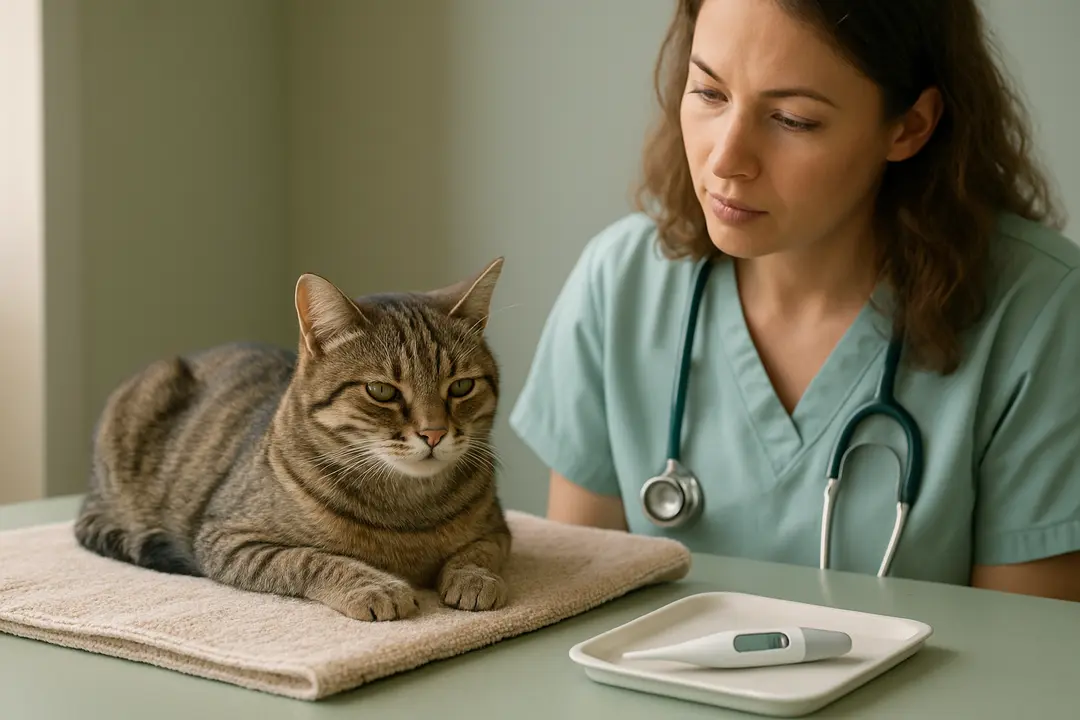
- Decide whether to measure at all. If your cat is calm and your veterinary team has shown you how to use a digital rectal thermometer, use the method they demonstrated. If you haven’t been shown how, or your cat tries to get away, stop and let the clinic check. A description of an alert cat who refuses breakfast is more useful than a number you had to wrestle to obtain.
- Write down the result as it appears. Include the time, whether the display is in °F or °C, how you took the reading, and whether your cat was relaxed. If your cat already seemed unwell before you picked up the thermometer, tell the clinic that, too. Struggling might affect the number, but it doesn’t explain a meal your cat missed earlier.
- Recheck only if it will clarify a borderline result. If your cat otherwise looks well and the reading was only slightly high right after a struggle, VCA’s guidance on taking a pet’s temperature suggests letting your cat settle quietly for 10 minutes. Recheck only if you can do so calmly. If the resting reading is still high, call your vet. Don’t use this pause for a cat that looks sick, has a very high reading, or may have overheated.
What could cause a cat’s temperature to rise?
An infection can cause a fever. A reaction to medication is another possibility. Stress from struggling and overheating in a hot space can also raise body temperature, but they call for different responses. That’s why your vet will want to know both when your cat started acting differently and when you measured the temperature. PDSA’s guide to high temperature in cats describes hiding, low energy, shivering, and reduced eating or drinking as signs worth reporting.
One easily missed clue is a recent fight. A bite can leave a pocket of infection under the skin, called an abscess. Your cat may be tired, feverish, and off food before you can see a lump. Mention a possible bite even if you haven’t found a wound. If a swollen spot has opened and drained, report that as well: as VCA’s guide to abscesses in cats explains, a cat can still have a fever after an abscess bursts. An open wound is a reason for veterinary advice, not proof that the infection has cleared.
What to do while arranging care
For a cat resting comfortably while you await your vet’s instructions, offer a quiet place and fresh water. Keep track of what your cat actually eats and drinks. In a home with more than one pet, an empty bowl may not tell you which cat ate. If you didn’t see your cat eat, say that rather than guessing.
Don’t give a human fever reducer. Even small amounts of acetaminophen (Tylenol) or ibuprofen (Advil or Motrin) can seriously harm a cat. If your cat may have swallowed either one, call your veterinarian, an emergency veterinary hospital, or an animal poison control service now. Don’t wait for symptoms or try to make your cat vomit unless a veterinarian directs you to. Have the package handy if possible so you can read off the product name and strength. ASPCA Poison Control’s guide to household hazards for cats identifies both medicines as dangerous for cats.
What to tell the clinic and what to watch next
Start with the finding that changes what needs to happen first. If your cat is having trouble breathing, was trapped in the heat, or received the wrong medicine, lead with that rather than a list of temperature readings. For a cat that’s stable, these three details make a useful handoff:
- What changed and when: Say when you last saw your cat eating, drinking, and moving around as usual, then describe what you see now.
- What you measured: Give the reading, time, and method. If you took a second reading after your cat settled, report both in order. If you couldn’t get one safely, say so.
- What happened recently: Mention time in a hot space, a possible bite, a wound that drained, or a new medication. At the visit, the team can check the temperature and use those clues to look for the cause.
If your vet recommends watching your cat at home, ask whether they want another temperature reading and what change should prompt a return visit. Over the next meals, note whether your cat comes out to eat, how much they take, and whether their usual activity returns. Report changes in either direction. If your cat worsens, call again rather than waiting for a scheduled check; VCA’s advice on caring for a sick cat emphasizes tracking food and water intake during home care.
Talk it through with Vicky
You can tell Vicky what you’re seeing right now, whether that’s a temperature reading or a change in how your cat is acting. Vicky will bring in Dr. Ravi (Virtual DVM), our virtual specialist in feline-friendly general practice, to help you organize those observations. For breathing difficulty or suspected heatstroke, go directly to an emergency veterinary hospital.
Common questions
My cat’s ears feel hot but their nose is cool and wet. Which should I trust?
Neither tells you your cat’s body temperature. If your cat is acting normally, warm ears alone don’t establish a fever; if your cat seems ill, a cool nose isn’t a reason to put off a vet call.
Can I use a baby ear thermometer if my cat won’t allow a rectal check?
Ask your clinic whether it can interpret a reading from the device you have. If your cat resists, don’t keep trying different thermometers. Describe the signs and let the veterinary team take the temperature.
Could a stressful car ride affect my cat’s temperature at the vet?
Stress and struggling can temporarily raise the reading. Tell the team how your cat acted on the ride and whether the car was hot; a stressful ride and a dangerous heat exposure are different clues.
What if my cat starts eating again but the temperature goes back up?
Call your vet with the new resting reading and the time you took it. Mention the improved appetite, too: eating again is useful information, but it doesn’t tell you why the temperature rose.
Who can help after hours if I already gave my cat fever medicine?
Call an emergency veterinary hospital or a 24-hour animal poison control service now, even if your cat still looks well. Tell them the medicine’s exact name, how much your cat may have received, and when.
Sources
- Fever in Dogs and Cats — Schwarzman Animal Medical Center
- Taking Your Pet’s Temperature — VCA Animal Hospitals
- Initial Triage and Resuscitation of Small Animal Emergency Patients — MSD Veterinary Manual
- Dyspnea (Difficulty Breathing) — Cornell Feline Health Center
- High Temperature (Fever) in Cats — PDSA
- Heatstroke in Cats — PDSA
- Caring for Your Sick Cat — VCA Animal Hospitals
- Who Do You Call if You Have a Pet Emergency? — U.S. Food and Drug Administration
- Cat Bite Abscesses — PDSA
- Heatstroke in pets: What every pet owner should know — Virginia-Maryland College of Veterinary Medicine
- Abscesses in Cats — VCA Animal Hospitals
- These Harmful Feline Hazards Could Be in Your Home — ASPCA Poison Control