How can I tell if my dog has a fever, and when should I call a vet?
Check your dog’s temperature safely, see what 101°F or 103°F means at rest, and learn when to call your vet or go straight to an emergency veterinary hospital.
In this guide (7 sections)
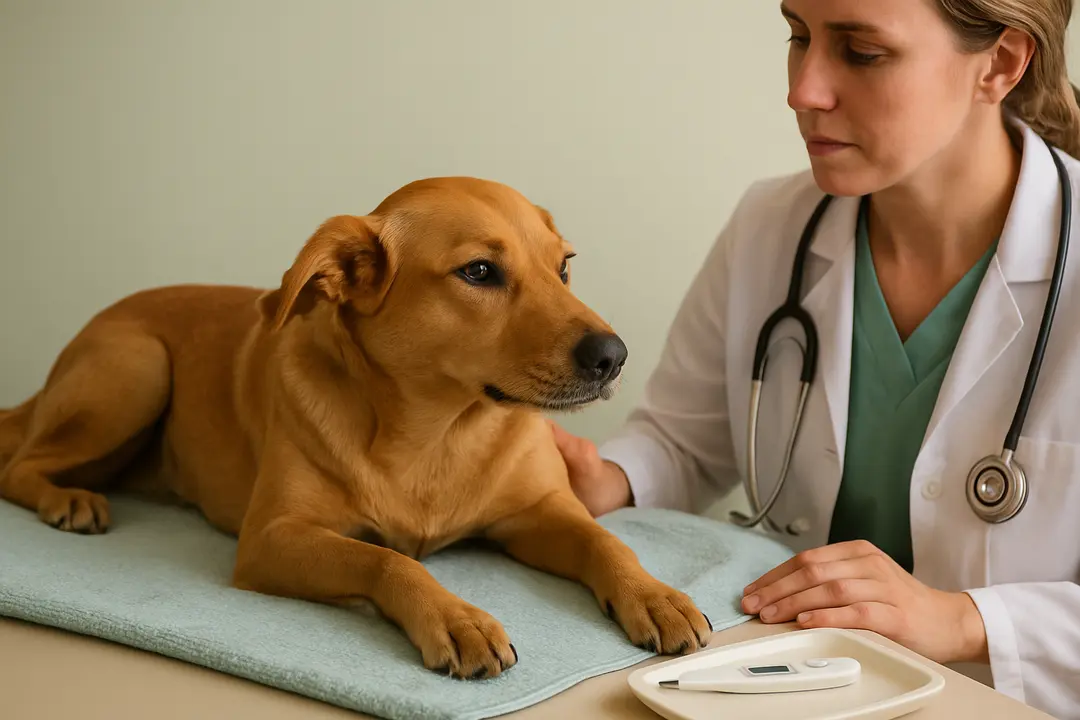
Go to an emergency veterinary hospital now if your dog is struggling to breathe, or if they become confused, collapse, or are too weak to walk after heat or exertion. Don’t delay to find a thermometer. For a stable dog, a digital rectal thermometer is the best home check: 100–102.5°F (37.8–39.2°C) is usual at rest; call your vet about a higher resting reading, and take your dog in for urgent assessment if it’s above 104°F (40°C).
What does my dog’s temperature mean?
A rectal temperature tells you how warm your dog is, not why. To decide what to do, pair the number with two observations: what your dog was doing before you measured it and how they look now. Use this table for a dog who is alert and breathing comfortably. If your dog looks ill after heat exposure, follow the heatstroke advice below instead.
| Rectal temperature | What to do |
|---|---|
| 100–102.5°F (37.8–39.2°C) | This is the usual range. 101°F is normal for a dog. If your dog won’t eat, is vomiting, or seems unusually tired, call about those changes even though the temperature is normal. |
| Above 102.5°F but below 104°F | Call your vet about an elevated reading taken at rest, particularly if your dog seems sick. A mildly high reading right after ordinary play is different: if your dog is alert and comfortable, let them rest somewhere cool and recheck once settled. Call if it stays high. |
| 104°F (40°C) | Call your veterinarian now and give the exact reading and symptoms. If your clinic is closed, contact an emergency veterinary hospital for guidance. |
| Above 104°F (40°C) | Take your dog to a veterinarian for urgent assessment. If your clinic cannot see them promptly, go to an emergency hospital. Above 104.5°F (40.3°C), seek immediate attention. Don’t wait at home for a repeat reading or a call back. |
The distinction at the high end matters. The Schwarzman Animal Medical Center’s fever guide recommends consulting a vet through 104.5°F and immediate attention above it. VCA’s temperature guide recommends taking your pet to a veterinarian above 104°F. So if the thermometer reads 104.2°F, for example, plan to go in rather than watching to see whether it reaches the higher cutoff.
What signs suggest fever if I don’t have a thermometer?
You may notice a change in routine first: your dog stays on their bed when you put breakfast down, shows little interest in a walk, shivers, or vomits. These can all accompany fever, but none proves it. The warmth of your dog’s skin is not a reliable measure, either. It’s easy to notice hot ears before noticing a skipped meal; the skipped meal is the more useful detail to tell your vet.
Describe what you see rather than trying to put a number on it. “She didn’t get up for breakfast, but she walked over when I called” tells the clinic more than “she feels feverish.” Notice whether your dog can get up, responds to you as usual, and is breathing comfortably. Breathing, the ability to walk, and awareness are among the things clinicians assess in Merck’s guide to emergency evaluation. You can call without a temperature; you don’t need to buy a thermometer before asking for help.
Is it fever, exercise, or heatstroke?
Consider two dogs with the same reading of 103°F (39.4°C). One has been resting indoors and has started shivering and refusing food. Call your vet about that dog’s elevated resting temperature and symptoms. The other has just come in from an ordinary walk, greets you as usual, and is breathing easily. Activity and excitement can raise a reading without an illness-related fever. A check after a quiet rest is more useful for that dog than a reading taken at the door.
A dog who looks ill after heat or exertion is not a rest-and-recheck case. Heavy panting together with weakness, confusion, or collapse after heat exposure can mean heatstroke. If you suspect it, start cooling your dog immediately with cool water if available, and head to an emergency veterinary hospital. Use the car’s air conditioning on the way. Don’t wait for telephone instructions to begin cooling or stay home to see how far the temperature falls. Cornell’s heatstroke guidance describes cooling during transport.
How to take your dog’s temperature safely
Only attempt a rectal reading if your dog is calm and willing to be handled. If you’re unsure how to do it, or your dog is likely to snap, let the clinic measure it. A missing reading is better than a struggle that could hurt either of you.
- Prepare before handling your dog. Have a digital thermometer suitable for rectal use and lubricant for the tip. Ask another adult your dog trusts to help keep them steady. If your dog won’t settle with gentle handling, stop here.
- Take the reading gently. Lubricate the tip, lift the tail, and gently ease the tip into the rectum. Never push against resistance. If your dog pulls away or turns to bite, stop rather than asking your helper to hold them tighter.
- Record what the thermometer says. If your dog remains comfortable, keep hold of the thermometer until it signals, then remove it. Write down the exact number, the time, and that it was a rectal reading. Include whether your dog had been resting, exercising, or upset. Don’t round a reading down when you report it: the difference between 104°F and a reading above it changes the next step.
What can I do while arranging veterinary care?
For a stable dog with a possible fever, provide a quiet place to rest while you contact the clinic. If your dog is alert and hasn’t recently vomited, offer small drinks of water without forcing them. Veterinary Partner’s fever first-aid guide recommends recording the rectal reading and calling a veterinarian above 103°F. You don’t have to wait for it to get that high if your dog already seems sick.
Don’t give acetaminophen (Tylenol), ibuprofen, or aspirin to lower the temperature. These human medicines can harm dogs. Ask your veterinarian before giving any medicine. The cooling steps for suspected heatstroke are not a treatment plan for a dog shivering indoors with a possible fever. In that situation, report the resting temperature and let your vet guide the next step.
What will the vet want to know?
A fever can accompany infection or inflammation, and sometimes follows a vaccination. A thermometer can’t distinguish among those explanations. At the clinic, the team can check the temperature and assess your dog alongside the reading. You can help by giving a short timeline:
- Start with what’s happening now. Give the exact reading if you have one. Say how your dog is breathing, whether they can walk, and whether they respond to you normally. If heat or exertion was involved, say so right away.
- Describe the change. When did your dog last act like themselves? Mention missed meals, shivering, vomiting, or a drop in energy. If you have two readings, give each with its time and circumstances rather than averaging them.
- Add relevant recent history. Mention vaccination dates, medicines, parasite prevention, recent travel, and whether other animals your dog has been around are ill. These are details vets consider when investigating an unexplained fever.
If your vet recommends watching at home, ask when they want an update, whether to take another reading, and what change should bring you in. There isn’t one recovery timetable for every cause of fever. If your dog looks worse or the resting temperature climbs, call back with what has changed rather than waiting for the planned update.
Talk it through with Vicky
If your dog is stable and you’re unsure what a reading means, you can tell Vicky what you’re seeing right now. Include the temperature if you have it, what your dog was doing beforehand, and what seems different. Vicky will bring in Dr. Andy (Virtual DVM), our general practice veterinarian, to help you sort through those details. For an urgent reading or emergency signs, go directly to your own veterinarian or an emergency veterinary hospital.
Common questions
My dog’s ears are hot but their nose is cool and wet. Which should I trust?
Neither reliably tells you your dog’s internal temperature. Hot ears don’t confirm a fever, and a cool, wet nose doesn’t rule one out.
Can I use a human digital thermometer for my dog?
Yes, if it’s designed for rectal use. Lubricate the tip, and only attempt the reading if your dog tolerates gentle handling. If not, ask the clinic to check.
My dog’s resting temperature is 103.5°F tonight. Can the call wait until morning?
Call for advice tonight. If your regular vet is closed, give an emergency clinic the exact resting reading and describe how your dog is acting. The reading warrants a call, but it doesn’t by itself determine whether your dog needs an emergency visit.
Does my dog still need care if they seem better after cooling?
Yes. After suspected heatstroke, keep going to the veterinary hospital even if your dog seems brighter or the temperature drops. Internal injury may not be visible at first, so tell the team how your dog looked before cooling began.
If my dog had a vaccine yesterday, can I assume that explains the fever?
No. A recent vaccination is one possible explanation, but the timing doesn’t establish the cause. Give your vet the vaccination date, the resting temperature, and any changes in appetite, energy, or breathing.
Sources
- Merck Veterinary Manual: Initial Triage and Resuscitation of Small Animal Emergency Patients
- VCA Animal Hospitals: Taking Your Pet’s Temperature
- Schwarzman Animal Medical Center: Fever in Dogs and Cats
- American Kennel Club: Fever in Dogs: Signs, Symptoms, Treatments
- PetMD: Fever in Dogs: Signs, Symptoms, and Treatment
- Cornell University College of Veterinary Medicine: Heatstroke: A Medical Emergency
- U.S. Food and Drug Administration: Get the Facts about Pain Relievers for Pets
- Merck Veterinary Manual: Fever of Unknown Origin in Dogs
- Veterinary Partner — Fever: First Aid
- American Kennel Club — Heatstroke in Dogs: Signs, Symptoms, Treatments