What could make my cat limp on a front or back leg, and how soon should a vet check it?
Learn when a cat’s limp needs an emergency visit, what walking on three legs means, and how to check a sore paw safely while you arrange veterinary care.
In this guide (6 sections)
A torn claw, cut pad, bite, muscle strain, or bone or joint injury can make your cat limp on either a front or a back leg. Go to an emergency veterinary hospital now after a car strike or major fall, or if the leg looks broken, your cat is in severe pain, or your cat cannot stand or walk without help. If your cat can walk on three legs but won’t put the fourth paw down, call a vet now and let the clinic decide where and how soon your cat should be seen.
How soon does a limping cat need a vet?
Whether your cat can get across the room and whether your cat can use the sore leg are two different questions. Both help the clinic decide what care your cat needs. Use what you’ve already seen; there’s no need to make your cat walk again.
| What you see | What to do |
|---|---|
| A car strike or fall from a height, an obviously broken leg, severe pain, or a cat that needs help to stand or walk | Go to an emergency hospital now. After a major accident, internal injuries may not show, even in a cat that can walk. |
| Your cat can stand and walk independently but holds one paw off the ground | Call your vet or an urgent-care clinic now. Say that your cat puts no weight on that leg. The clinic may direct you to come straight in. |
| The limp is mild, your cat puts weight on the paw and otherwise acts normally, and there was no major accident | Call your vet for advice about brief rest and monitoring. If they advise monitoring and the limp hasn’t improved within 24 hours, arrange an exam. Follow an earlier appointment recommendation. |
VCA’s guide to urgent care for limping distinguishes a pet that can walk on three legs from one that cannot stand unaided. Texas A&M’s veterinary emergency service also lists inability to stand or walk, broken or dislocated limbs, severe pain, and major accidents as reasons for immediate care. If you’re going in after an accident, tell the hospital if your cat is also struggling to breathe or bleeding heavily.
Tell the clinic if the change was sudden. In particular, if a back leg suddenly drags instead of taking a step, call now, even if your cat can still move using the other legs. Describe the loss of use rather than calling it a slight limp. The 24-hour guidance from PDSA on limping and stiffness is for an unimproved mild limp. It isn’t permission to wait overnight when your cat suddenly loses use of a leg.
What can hurt in a front or back leg?
A claw, pad, or the space between two toes. A broken nail can make it painful to take a step. So can a claw that has grown into the paw pad, a cut on the underside of the foot, or an object caught between the toes. The top of the paw may look normal in all of these cases.
A bite wound. A bite can lead to an abscess, a painful pocket of pus under the skin. Your first clues might be a limp, less interest in food, or less energy rather than a visible lump. If your cat may have been in a fight, tell your vet; you don’t need to wait for swelling to appear before reporting a suspected bite. PDSA’s guide to cat bite abscesses explains what owners may notice.
A muscle, ligament, bone, or joint injury. A strain affects a muscle; a sprain affects a ligament, one of the bands that support a joint. Neither has to leave a mark on the paw. A fracture is a broken bone, while a dislocation means the bones at a joint have moved out of place. You can’t reliably tell these injuries apart by looking at the foot, and bending the leg to find out can make an injury worse.
Painful joints. A gradual change can look different from an injury. You might notice that your cat hesitates at a once-easy jump or moves stiffly when getting up. Those details are worth reporting even if you can’t pick out a single sore paw. They can point to joint pain, including arthritis, but they don’t establish the cause on their own.
How to check a sore paw without hurting your cat
- Watch an ordinary movement. If your cat gets up on their own, notice whether the sore paw stays raised, touches down briefly, or takes weight through a whole step. For example, “she rests the paw on the floor when sitting but lifts it for every step” tells the clinic more than “she can walk.” Don’t encourage a jump or another lap of the room to test it.
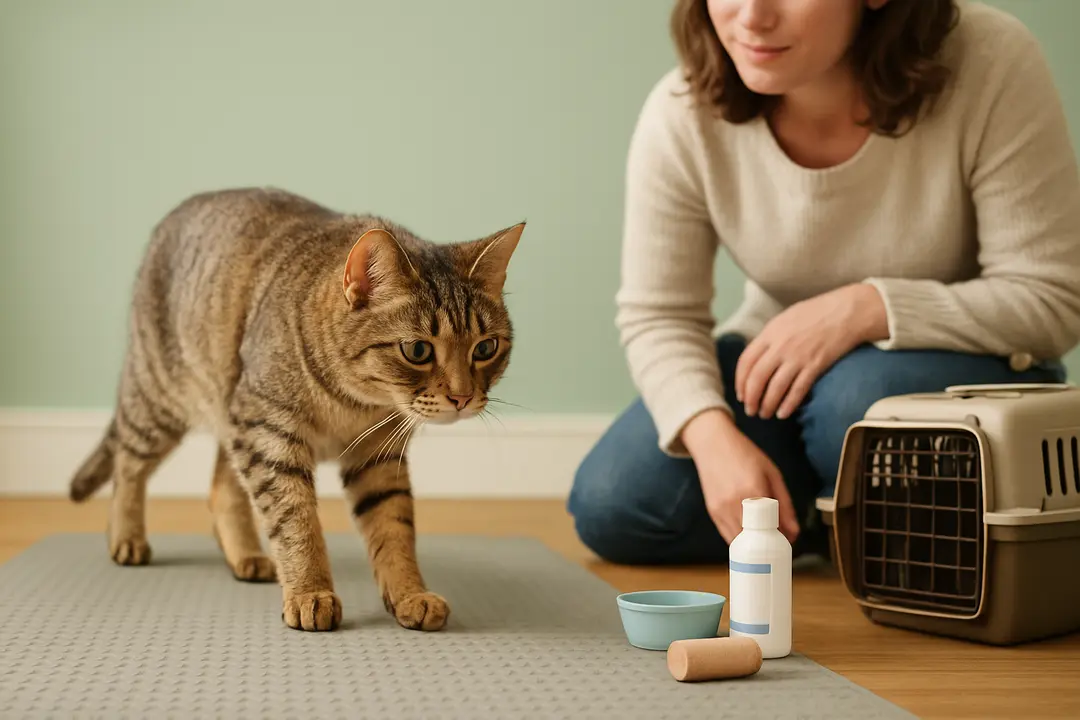
- Look only if your cat is comfortable. Glance at the claws, paw pads, and spaces between the toes that you can see without pulling the leg toward you. Note a split claw, cut, or visible object and where it is. If your cat pulls away or you would need to hold them down, stop. In severe pain, skip the home exam altogether.
- Don’t try to prove where it hurts. Avoid squeezing the leg, flexing each joint, or straightening a limb that looks out of place. If all you could see was the top of the paw, say so. “I didn’t see a wound” is useful information; it doesn’t mean there’s no injury. VCA’s first-aid guide for limping cats explains why some painful legs are best left untouched.
How to keep your cat comfortable while arranging care
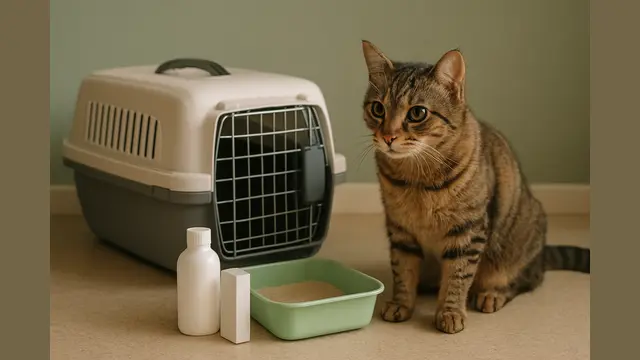
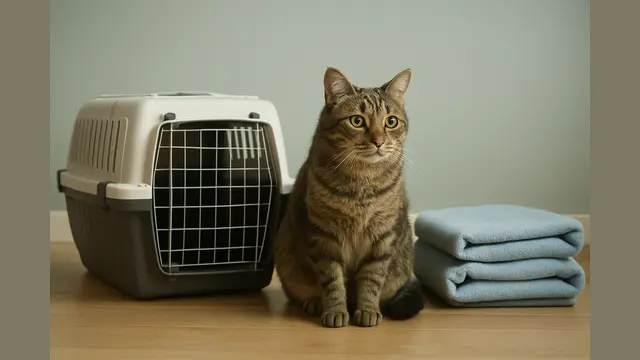
Keep your cat indoors in one quiet room and let them rest at floor level. Limit opportunities to jump. If you’re leaving for the clinic, prepare a padded carrier first so you can move your cat with as little handling as possible. After major trauma, spend that time getting ready to go, not searching for a sore toe. Cats Protection’s first-aid guidance covers handling and transporting an injured cat.
Ask your vet what is safe for pain. Do not give medication meant for a person or left over from another pet unless your vet specifically directs you to. Acetaminophen (Tylenol) can be fatal to cats, and ibuprofen (Advil or Motrin) can also poison them. Pet Poison Helpline’s guide to human medications explains why these familiar pain relievers are dangerous for cats.
What to tell the clinic and what to expect at the visit
Start with when it began, what happened beforehand, and whether the leg takes weight now. If you didn’t witness an injury, it’s useful to say when you last saw your cat moving normally. Mention a possible fall or fight, any change in appetite or energy, and whether the limp is getting more noticeable. You don’t have to decide whether the problem is in the paw, knee, or hip before calling.
If your cat happens to take a few steps while your phone is handy, a short video can show the vet exactly what you mean. Some cats hide or won’t walk in the exam room. Film natural movement rather than coaxing your cat to perform, and don’t delay urgent care to get a recording. MSPCA-Angell’s guide to feline bone and joint problems explains how home videos can help with the assessment.
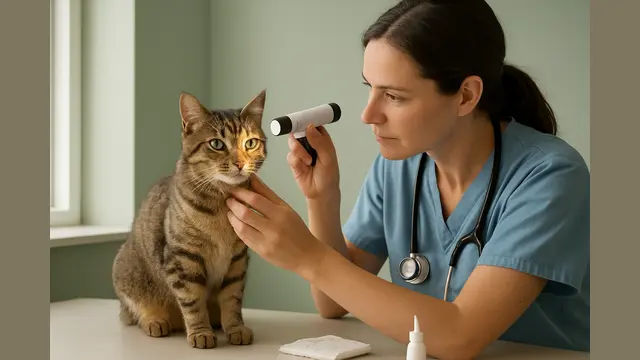
Your vet can examine the paw and joints and decide whether X-rays would help identify a bone or joint change. A minor injury may improve with rest, but the follow-up plan depends on what the exam shows. Ask what improvement should look like during ordinary activity, how long to limit jumping, and when to report back. If your cat was using the leg when the clinic advised monitoring but now holds it off the ground, call again now. That change matters more than how much time is left until the planned check.
Talk it through with Vicky
You can tell Vicky what you’re seeing right now, including which leg your cat favors and whether the paw takes weight. Vicky will bring in Dr. Ravi (Virtual DVM), our feline-friendly general practice veterinarian, to help you sort through those observations. For urgent signs, contact your own vet or emergency hospital first.
Common questions
Could my cat’s leg be broken even if my cat still jumps or lets me touch it?
Being able to jump or tolerate touch doesn’t rule out a fracture. Don’t repeat either as a test. A veterinary exam and, when appropriate, X-rays are more useful.
Why does my cat limp after a nap and then seem to walk normally?
Stiffness when getting up can be a sign of painful joints, especially if your cat is also more reluctant to jump. That pattern alone doesn’t prove arthritis. If it recurs, tell your vet when it first started, not just when you last noticed it.
Can my cat wait until morning if I see a torn claw?
A torn claw can explain a limp, but finding it doesn’t settle the timing. If your cat won’t use the paw, call now and let the clinic decide whether waiting is appropriate. A major accident, obvious fracture, or severe pain warrants an emergency visit regardless of what you see on the paw.
What if I can’t tell which leg my cat is favoring?
You can still give the clinic useful information: describe whether your cat can get up without help, whether a paw stays off the floor, and whether the change was sudden or gradual. If you already have a video, show it to the vet rather than making your cat walk again to identify the side.
Sources
- VCA Animal Hospitals — Urgent Care for Pain or Limping
- PDSA — Limping and stiffness in cats
- PDSA — Cat bite abscesses
- VCA Animal Hospitals — First Aid for Limping Cats
- PetMD — Why Is My Cat Limping? Causes, Treatment, and How To Prevent It
- Cats Protection — Cat first aid
- US Food and Drug Administration — Potentially Dangerous Items for Your Pet
- Pet Poison Helpline — Top 10 Human Medications Poisonous to Pets
- MSPCA-Angell — Feline Orthopedic Disease
- Emergency Medicine — Texas A&M Veterinary Medical Teaching Hospital
- Arthritis — Cats Protection
- Poisoning in cats — Cats Protection